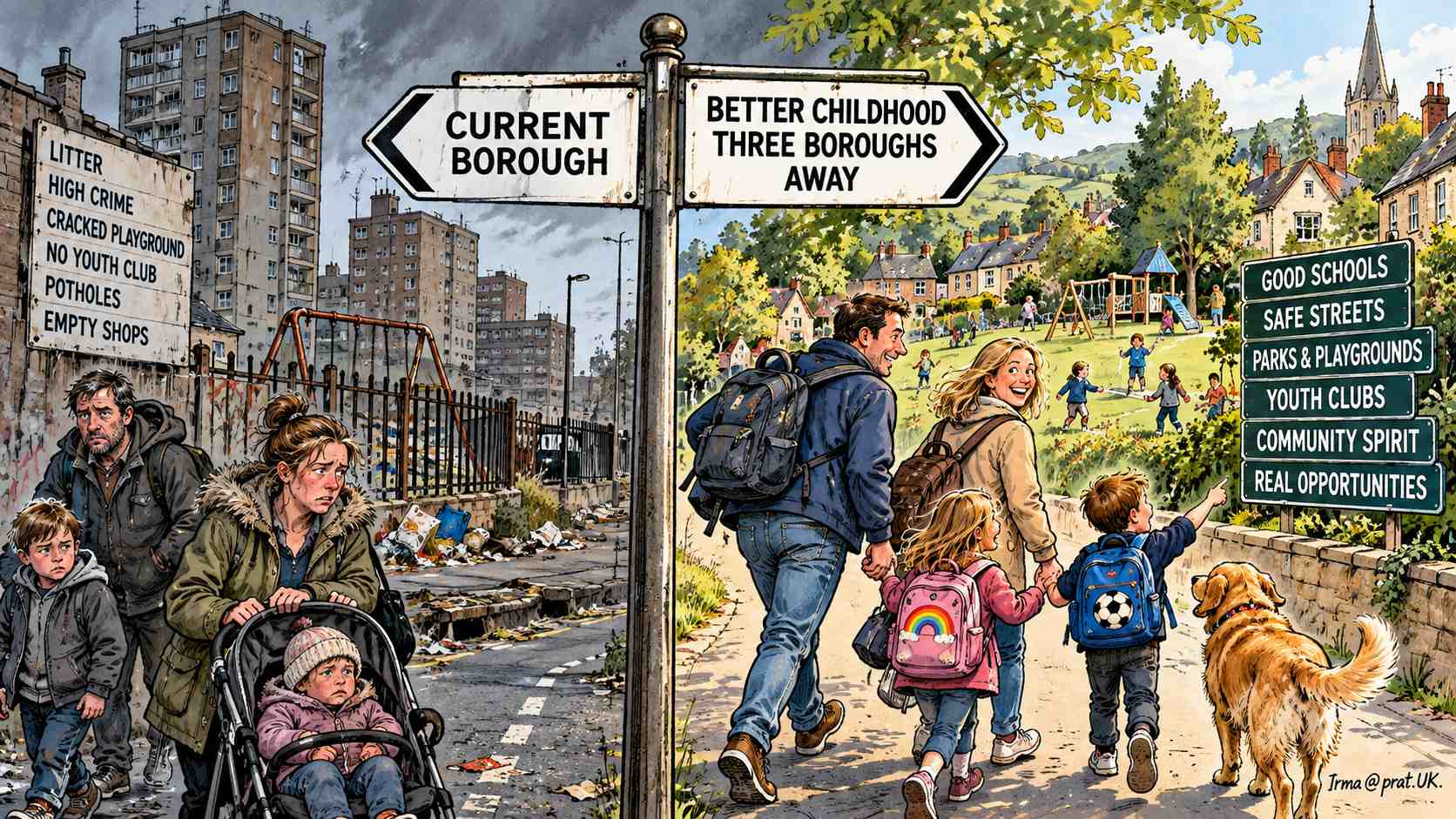
Relocation costs may be spread over several additional childhoods
STRATFORD, LONDON - Working parents examining the childhood comparisons published by the Evening Standard have welcomed the discovery that improved opportunities may be only a short journey away, followed by a deposit, moving expenses and a complete reconstruction of their working lives.
The Solution Has an Address, and It Costs More Than the Problem
"It is reassuring to know the solution has an address," said commuter Helen. "Less reassuring that the address costs more than the problem."
Her family spent Sunday comparing boroughs on a laptop. By lunchtime they had found several promising areas. By mid-afternoon they had learned that promises were affordable until one selected the property tab.
The relocation spreadsheet now contains rent, travel, deposits, childcare, school arrangements and the financial value of a grandmother living close enough to collect someone at short notice. The grandmother had previously appeared in family discussions as a person. She is now an irreplaceable infrastructure asset.
Moving Farther Out Means a Longer London Commute
An adviser suggested moving farther out. Helen explained that moving farther from work might increase the hours spent travelling. The adviser recommended working nearer home, completing an elegant circle in which everything would improve once the family had replaced everything.
Her husband Dan leaves before breakfast on several mornings. He calculated that reaching a different station could add enough time to his commute for his children to regard him as a recurring weekend guest.
"We want them to have a better childhood," he said. "Ideally one in which they can occasionally confirm who I am."
The children have their own assessment criteria. These include keeping their friends, seeing their grandparents and remaining within practical distance of the person who knows where the missing football kit is. None appeared as a filter on the property website.
The Moving-House Story Nobody Can Afford to Repeat
One estate agent suggested the family should see relocation as investing in the future. Dan asked whether the future accepted monthly instalments and what happened if the present continued charging rent throughout.
A colleague offered the usual encouraging story about somebody who moved and never looked back. On closer examination, the somebody had received a deposit, worked remotely and possessed an employer remarkably relaxed about which side of London contained the desk.
Helen said she was happy for them. She would be happier if their arrangement stopped being presented as a universally available form of determination.
Families weighing the cost of a move can compare local rents and housing costs through the Office for National Statistics, and tenants can check their rights before signing anything on GOV.UK. The Mayor of London's office publishes data on housing and transport across the capital. None of these sources includes a field for grandmother proximity, which Helen described as an oversight.
Better Local Services Instead of Moving Home
Local parents proposed that good services should be accessible where families already lived, reducing the need to treat every childhood problem as a property search. The suggestion was considered radical because it placed the work of improvement on organisations rather than asking children to change stations.
The family has therefore postponed the move while continuing to ask concrete questions about local provision. They would like opening hours that acknowledge work, information that stays current and answers from someone empowered to act.
Their spreadsheet remains open. Its final column calculates the year in which they could afford the ideal move. The eldest child will then be forty, but Dan remains optimistic that the new playground might still offer somewhere comfortable to discuss pension contributions.
Helen said she had not yet told the children about the spreadsheet. They were at school, where a teacher had given them a worksheet on measuring distances between towns. They had completed it quickly and asked if they could use their grandmother's house as the starting point.
The estate agent has since sent Helen three further listings, all of them cheaper, none of them within two stops of a grandmother. Helen has saved them in a folder called Maybe Later, next to a folder called Maybe Never, which is slightly larger.
SOURCE: https://www.standard.co.uk/news/london/best-worst-places-london-children-grow-up-b1301437.html
Five Humorous Observations
- "The solution has an address." Great. So does the problem. The problem's got a lovely address, and it's the same house. That's the trick, the solution just costs more.
- The grandmother used to be a person. Now she's in the spreadsheet as infrastructure. "Nan: pick-up capacity, 3pm to 6pm, tea included." She's a utility. She's basically gas with a cardigan.
- Move farther out, they say. Then work closer to home. So you leave your job to move closer to the job you just left. It's a flat-pack circle. You build it, it's still a circle.
- Dan hopes his kids can "occasionally confirm who I am." That's brilliant parenting. Goal for a better childhood: kid recognises Dad on sight. Gold standard. Cher couldn't do it for her own kids.
- Last column: the year they can afford the move. The eldest will be forty. So the dream is to move for the kid's childhood, and the kid hears about it at his own mortgage meeting. "Congratulations, you're finally in the nice borough. Now sit down, you're a grandfather."
This disclaimer moved three boroughs away for a better upbringing and now commutes back. The parents and removal quotes are comic exaggeration of the real Evening Standard childhood rankings. More UK satire on the Northern line. https://prat.uk/?p=53873


Comments
Post a Comment