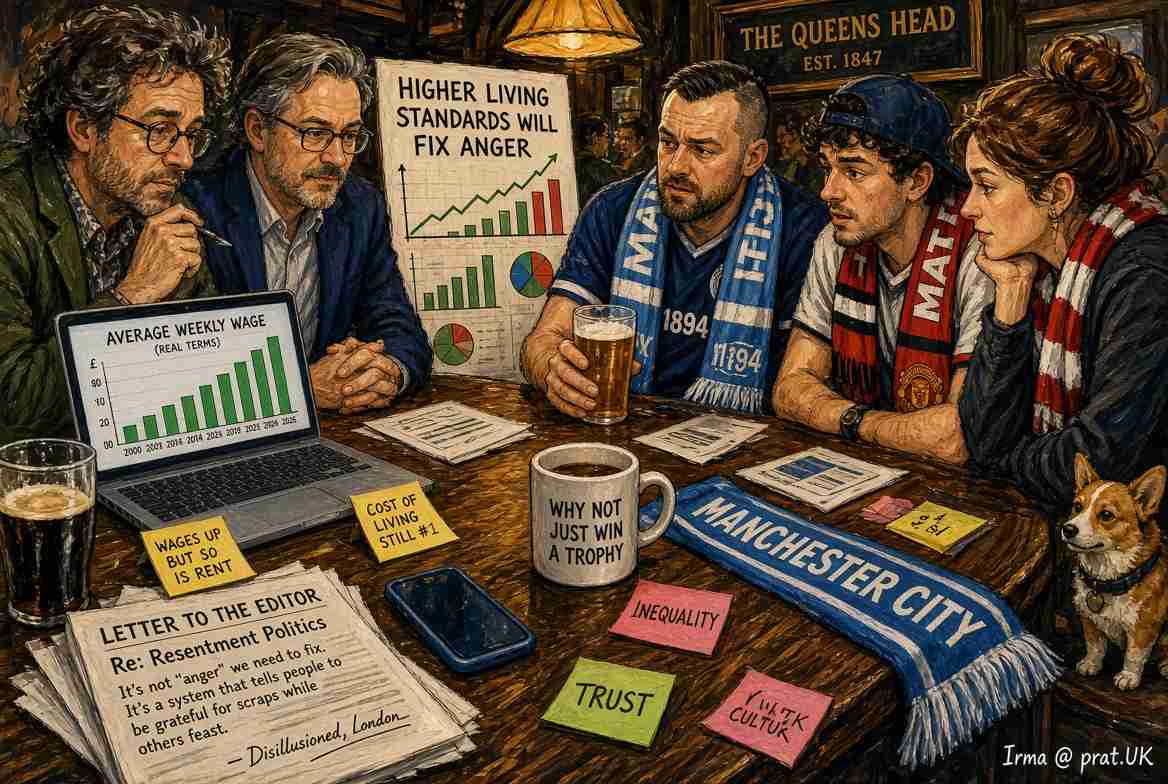
Manchester City Theory Suggests Britain Cannot Repair Its Political Divisions With GDP Growth Alone, Although GDP Growth Would Be a Pleasant Surprise
LONDON - British economists have run into a serious challenge to their traditional belief that better living standards reduce public dissatisfaction. Football supporters have shown that people can stay furious even when their teams are winning.
The discovery follows renewed attention to the link between sporting loyalty and political identity. Manchester City have won eight Premier League titles and the 2023 Champions League since 2008, and their supporters are no less indignant for it.
Do Better Wages Buy Happier Voters?
Economic analysts generally assume voters respond to changes in their material circumstances. Better wages, affordable housing, reliable public services and greater economic security should produce greater public satisfaction. The Resolution Foundation and the Institute for Fiscal Studies have built careers on that assumption.
Football suggests human motivation is much messier.
A Manchester City supporter can celebrate enormous sporting success while staying furious at rival clubs, referees, regulators, journalists and anybody who questions the legitimacy of his team's achievements. Political voters show similar tendencies. They can see their circumstances improve without growing fond of the government responsible. They can also watch their living standards slide while defending the party they've supported for decades.
A London economist, Professor Harold Thrift, expressed concern.
"We've spent fifty years building sophisticated models of political behaviour based on economic incentives. Apparently we should have spent more time listening to the arguments outside football stadiums."
His colleague proposed adding sporting variables to economic forecasting. Instead of asking households whether their financial situation had improved, researchers would ask how much they disliked the opposition.
The answers might prove more revealing.
What the Pensioner Wants
A Manchester pensioner explained his own political philosophy.
"I don't care what their economic plan says. I want my electricity affordable, my hospital working and my rubbish collected. After that, they can call themselves whatever they like."
This practical attitude has become almost revolutionary. British political debate increasingly treats economic performance as one part of a bigger struggle over identity, belonging, history and national pride.
Resentment as a Campaign Strategy
Politicians have noticed the opportunity. An ambitious party no longer needs to promise only prosperity. It can promise that supporters belong to a righteous community whose grievances have finally been recognised. The reward comes not just from improving people's lives but from assuring them that their enemies are responsible for making those lives difficult.
A pub philosopher in Liverpool gave his assessment.
"Politics used to be about putting food on the table. Now it's about proving the bloke next door is the reason you haven't got any."
His friend disagreed.
"That's not fair. Sometimes it's the bloke in France."
The government keeps presenting economic growth as a central national objective. Yet growth alone can't settle every political dispute, especially when voters read prosperity through competing ideas of fairness, identity and national direction. A person may get wealthier without feeling respected. Another may get poorer without abandoning a political movement that gives him companionship and purpose.
The lesson is unsettling for economists because emotional loyalty doesn't fit neatly into spreadsheets.
A National Supporter Satisfaction Index
A civil servant proposed developing a National Supporter Satisfaction Index. It would combine economic confidence, political allegiance, football results and the number of times citizens had shouted at television news programmes. Researchers suggested collecting the data in pubs during televised matches.
The national statistics would show Britain getting angrier whenever Manchester United win, a good deal happier when the opposition lose, and completely irrational during penalty shootouts.
An economic adviser warned that no serious government should swap tribal emotion for practical policy. Unfortunately politicians have found tribal emotion is considerably cheaper than practical policy.
You can't build a hospital with resentment.
You can't repair a railway with national pride.
You can't generate electricity by insisting the opposition are idiots.
But you can win an election. And in modern Britain, winning the election is increasingly treated as an adequate substitute for doing anything useful afterwards.
Five Observations on Being Angry While Winning
- City fans win everything and they're still furious. It's like a bloke who wins the lottery and goes round complaining about the font on the cheque.
- Fifty years of economic models and what do they find? People are more annoyed by the bloke next door than by their own bank balance. A cat could have told them that. Mine's been furious at next door's cat since 2019 and she's well-fed.
- "Sometimes it's the bloke in France." I want that on the side of a bus. Every national crisis, one man in a beret taking the blame. He's been working double shifts since 1066.
- The Supporter Satisfaction Index collects data in pubs during matches. That's not data, that's a confession. By the second half it's all "I love you, mate" and "that referee's a thief" and the same sentence.
- You can't build a hospital with resentment. You can't. But they've tried, and it's the only thing Britain has in unlimited supply. If resentment were oil, we'd be Saudi Arabia, and half of Leeds would own a yacht.
Satire. The quotes, characters and proposals are invented. The Manchester City case and the club's record are real, and the club is appealing. Economists suggest that higher living standards would allow readers to be angry at this disclaimer in greater comfort; until then, the British Onion offers a cheaper supporter satisfaction scheme. https://prat.uk/?p=52854


Comments
Post a Comment