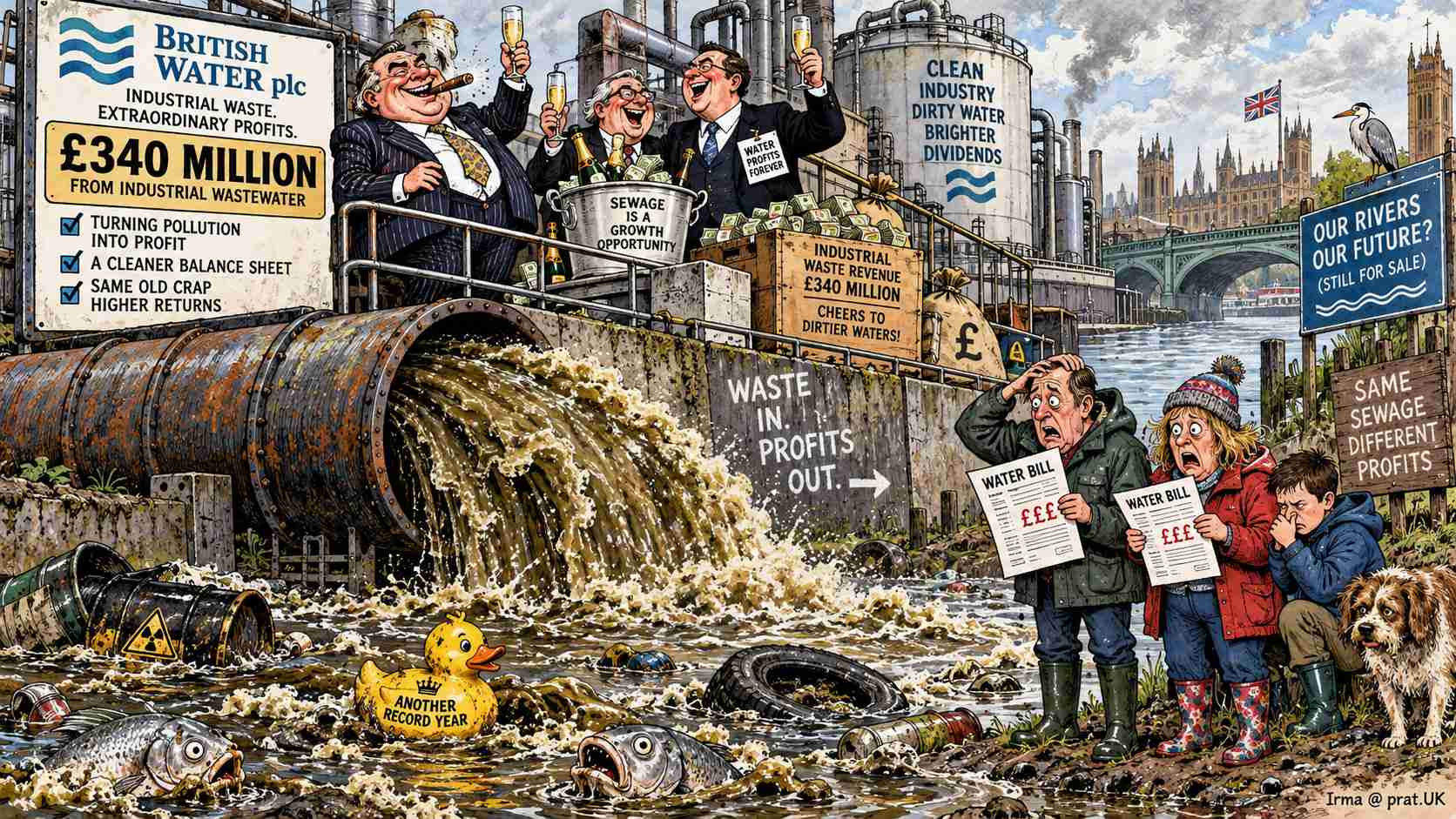
Water industry discovers rivers can accommodate industrial chemicals, household waste and corporate ambition, provided the public doesn't insist on drinking anything
LONDON - Britain's water companies have discovered another lucrative opportunity in the national sewage system, generating more than £340 million in annual revenue from accepting industrial and commercial wastewater, some of which contains chemicals that conventional treatment plants are poorly equipped to remove.
A Guardian investigation into Britain's £340 million industrial wastewater trade, published on October 9, found that the industry takes in enormous quantities of liquid waste from factories, hospitals, power stations and other commercial operations. An analysis identified approximately 26,000 trade-effluent consents and a maximum permitted annual volume of 608 billion litres.
The findings have surprised customers who assumed that the industry's main business was supplying clean water and removing dirty water, and not building an increasingly profitable relationship with the dirty water.
Water Industry Profits: Sewage Is an Excellent Business Because Nobody Wants It Back
The British water industry enjoys a remarkable commercial advantage, which is that customers cannot easily choose another supplier when their existing company disappoints them. If a supermarket sells unpleasant milk, shoppers can buy milk elsewhere. If a restaurant serves contaminated soup, customers can leave. If a water company delivers questionable performance, householders cannot generally switch to a rival sewer network. The customer keeps paying the bill and waits for the company to develop an interest in improving the service.
Industrial wastewater has added a new dimension to the arrangement. Companies receive payment for processing commercial waste, while some treatment works are not designed to remove substances such as certain industrial chemicals, pharmaceuticals and PFAS. That creates an extraordinary business opportunity. A company can be paid to accept waste, process what its equipment can handle and discharge treated effluent containing pollutants it cannot adequately remove. The river, unfortunately, does not have a customer complaints department.
Gareth Pugh, 58, a retired lock keeper from Shrewsbury, said he had fished the same stretch of river for forty years and had never once been invited to comment on a consent. He added that the heron had not been consulted either, and that it had looked equally concerned.
Customers who ring to ask about any of this are invited to hold. The hold music is pleasant, the wait is long and the recorded message thanks callers for their patience, which the industry appears to regard as a renewable resource. A household that finally reaches a human being can expect a sympathetic hearing, a reference number and the assurance that the matter has been passed to the relevant team, which on closer inspection turns out to be the river.
Trade Effluent Consents: Industry Supervises Its Own Homework
The trade-effluent consent system lets water companies issue permissions governing what businesses can discharge into sewers. The Environment Agency and Ofwat oversee wider wastewater controls, but the investigation identified gaps in independent scrutiny of the trade-effluent process.
The arrangement resembles letting restaurants inspect their own kitchens, issue themselves hygiene certificates and charge customers extra for the inspection. The regulator then turns up several years later to investigate why the salmon has developed a complicated relationship with the local hospital.
Britain has become extraordinarily skilled at building regulatory frameworks in which everybody is responsible for something and nobody seems responsible for everything. The water company monitors the industrial discharge. The environmental regulator monitors broader environmental standards. The government monitors the regulator, and the taxpayer monitors the river, particularly when it starts producing foam that nobody ordered. The Consumer Council for Water represents customers in the process, and has the advantage of being able to receive their letters.
Thames Water Leads Britain in Permitted Volumes of Industrial Sewage
According to the investigation, Thames Water has the largest permitted industrial sewage volume, at about 113 billion litres a year. United Utilities follows with 105 billion litres, and Severn Trent with 79 billion. The figures show that British infrastructure remains capable of handling extraordinary quantities of something, even if that something is not always clean drinking water.
Water UK argues that companies have legal obligations to receive trade effluent and that manufacturers should take greater responsibility for removing harmful substances. That is a legitimate policy question, although customers might reasonably prefer a system in which responsibility is settled before the chemicals reach the river.
For years, water companies have explained that infrastructure improvements need substantial investment. The public has responded by paying its bills, and the infrastructure has responded by needing further substantial investment. Customers have now found out that accepting additional waste brings in hundreds of millions in revenue. For shareholders and executives, wastewater has become a significant commercial activity. For taxpayers, the ambition remains simpler. They would like water that is clean, sewage removed without contaminating waterways, and an end to the idea that delivering either service deserves a standing ovation. The Rivers Trust would settle for the first part.
Five Humorous Observations
- Water companies make money taking in sewage. Great business. It's the only product where the customer pays you to take it away and then pays you for the river it ends up in.
- You can't switch water supplier. You can't say, I'm taking my sewage elsewhere. It's the only monopoly where you're locked in and also marinating.
- The river doesn't have a complaints department. The river doesn't leave a review. Honestly, the river is the perfect customer.
- The company inspects its own discharge. That's like letting me mark my own diet. Salad. Entirely salad. (Four biscuits.)
- Everybody's in charge of something. The company watches the discharge, the regulator watches the standards, the government watches the regulator, and I watch the foam. I'm the only one doing anything.
Satire: this is satirical news based on the reporting linked above. The retired lock keeper, the heron, the hold music and the reactions are invented. This disclaimer has been treated to the highest standard currently available, which is not saying much. More from further upstream at the British Onion. https://prat.uk/?p=51827


Comments
Post a Comment