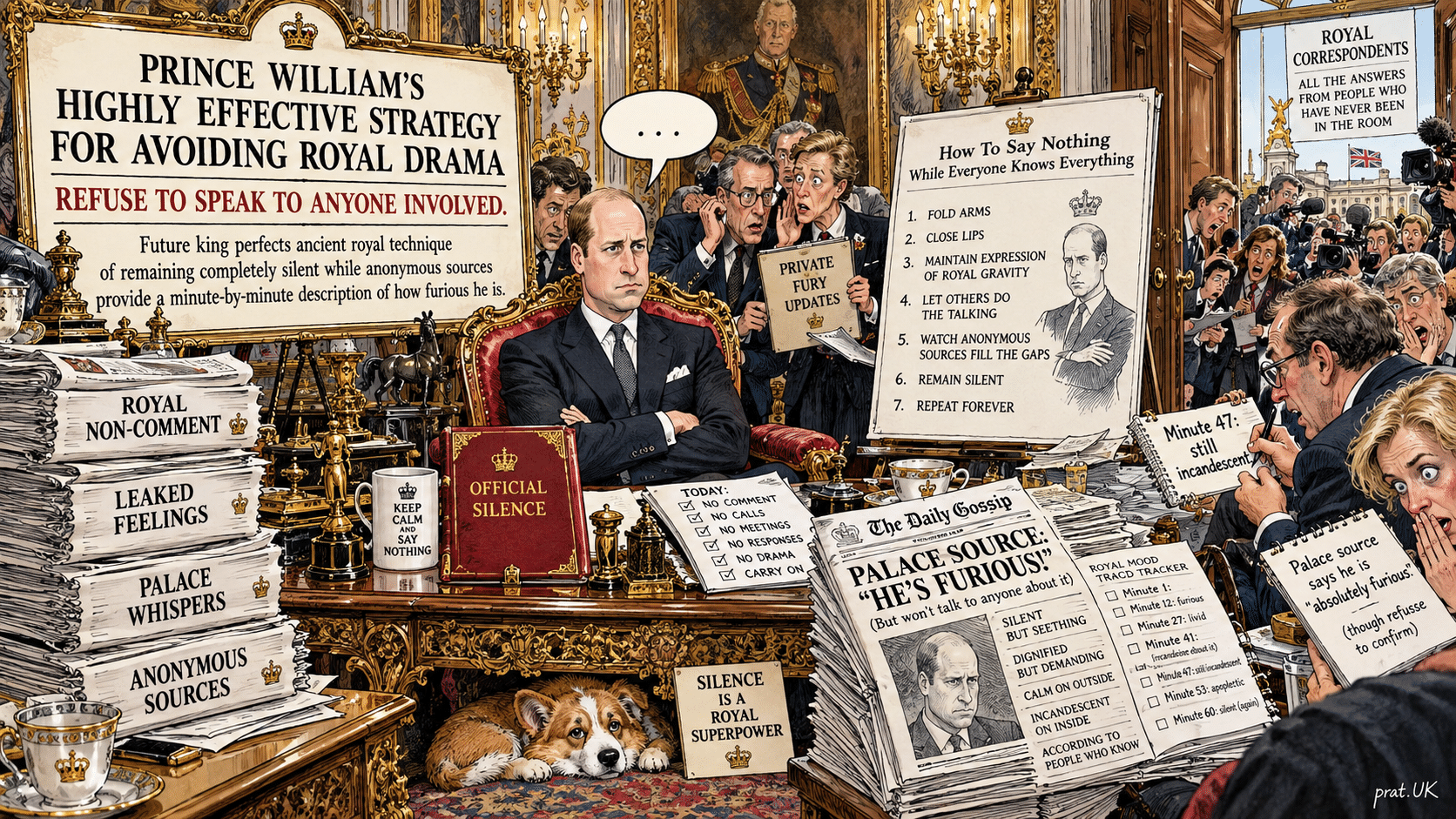
Prince William Unveils Highly Effective Strategy for Avoiding Royal Drama: Refuse to Speak to Anyone Involved
Future king perfects ancient royal technique of remaining completely silent while anonymous sources provide a minute-by-minute description of how furious he is
LONDON — Prince William has reportedly discovered the most effective method yet devised for avoiding royal family drama: never speak directly to anyone involved, while allowing Britain's enormous Royal Source Industrial Complex to explain precisely why you are not speaking to them.
The strategy arrives amid renewed attention on Earl Spencer's memoir about Princess Diana and the continuing public fascination with William's relationship with Prince Harry. InStyle reports that William and Catherine have deliberately stayed out of the controversy and concentrated on public duties, a technique royal commentator Jennie Bond described as effective.
This represents an important development in conflict resolution, because ordinary families have traditionally believed that solving a disagreement requires something reckless, such as talking.
William has apparently improved on that primitive system.
Prince William
- William has perfected the art of avoiding family drama by eliminating the family portion of family drama.
- The modern royal communications strategy appears to be: "Never complain, never explain, but have somebody familiar with your thinking complain and explain."
- William can remain completely silent while newspapers somehow know whether he is disappointed, furious, saddened, betrayed, frustrated, wounded or merely having a difficult Wednesday.
- Royal silence now contains approximately 11,000 words per week.
- Most ordinary people who refuse to speak to their brother are described as "not speaking to their brother." Add a palace and suddenly it becomes "a carefully calibrated strategy emphasizing stability."
Prince William's Silent Strategy: The Royal Revolution in Not Talking
There was a time when family disputes required exhausting activities. You had to telephone someone. You had to meet them. You might even have to say, "I think we misunderstood each other."
Terrible.
Fortunately Britain has a monarchy. Under the emerging William Doctrine, disagreement can now be handled through an elegant five-stage constitutional process:
First, do not speak to the person.
Second, do not comment publicly.
Third, allow royal correspondents to report that your silence demonstrates dignity.
Fourth, have somebody described as "close to the Prince" explain how deeply unhappy you are.
Fifth, deny that you are participating in drama.
It is conflict management with all the conflict carefully outsourced, and the brilliance is breathtaking.
When William recently visited a west London cinema, he ignored a reporter who asked whether he had read Earl Spencer's controversial new memoir, a moment covered by The Independent. For an ordinary British man, this is known as "pretending you didn't hear somebody." For a future king, it becomes statecraft.
Political scientists will probably study it for generations. Possibly from behind a hedge.
Never Complain, Never Explain: How Royal Sources Do the Talking
The traditional royal motto is often summarized as "never complain, never explain." Someone clearly wrote that before Britain developed approximately 9,000 royal correspondents.
The modern version looks closer to this: never complain, never explain, and let somebody else explain the complaint.
It's an extraordinary system. Try it at home. Your wife says, "Are you angry with me?" You say nothing. Three minutes later a man from People magazine rings the doorbell.
"Sources familiar with Alan's thinking say Alan remains deeply committed to the marriage but is understood to be saddened by developments surrounding the dishwasher."
That isn't communication. That's NATO.
Under this arrangement, William theoretically never needs to complain personally. His emotional condition gets distributed wholesale to the press, like electricity entering the National Grid. Somebody familiar with his thinking explains that he is disappointed. Somebody close to the household says he feels betrayed. A royal expert explains why he feels betrayed, a historian explains why Edward VII would also have felt betrayed, and a body-language specialist notices that William's left eyebrow briefly travelled north during a tree-planting ceremony in Kent.
By lunchtime Britain knows everything except whether William actually said anything.
Royal Institute of Advanced Sulking Discovers Silent Rage
Researchers at the entirely imaginary Royal Institute of Advanced Sulking have allegedly discovered that a prince can generate tremendous quantities of news while remaining completely motionless.
Professor Nigel Fortescue-Smythe, chairman of the institute's Department of People Who Look Concerned Near Palaces, explained the breakthrough.
"Our measurements indicate that traditional anger requires shouting," he said in this satirical account. "Royal anger is much more efficient. The subject merely attends a charity event while sixteen journalists report that he remains profoundly hurt."
The institute estimates that one minute of princely silence can power approximately 34 tabloid articles. Researchers hope eventually to connect William directly to the national grid, which could finally solve Britain's energy crisis. Why build another nuclear power station when the Prince of Wales can simply refuse to answer a question about Harry?
Earl Spencer's Diana Memoir and the Other Royal Communications System
Much of the latest commotion concerns Earl Spencer's Swan Song: Diana, My Sister, which contains controversial claims about Diana and King Charles. Buckingham Palace actually responded to one of Spencer's claims, an unusual move according to reporting around the book.
This created a fascinating constitutional situation. Buckingham Palace spoke. Earl Spencer spoke. Authors spoke. Journalists spoke. Piers Morgan spoke. Television presenters spoke. Prince Harry's position was discussed at length.
William said nothing.
Naturally, the resulting coverage concentrated heavily on what William might be thinking. Britain has turned nonparticipation into one of its most successful spectator sports, and cricket occasionally has more action.
Is William's Silence Really Effective? Royal Experts Say Yes
The word "effective" deserves attention. Effective at what?
Avoiding headlines? Apparently not. Avoiding speculation? Clearly not. Avoiding people writing articles about your silence? We are literally reading one.
Perhaps it is effective at stopping William himself from making matters worse, which is entirely possible. History is full of people who would have benefited enormously from saying absolutely nothing. Politicians. Football managers. Blokes being interviewed outside nightclubs at 2:17 a.m. Anyone who has ever started a sentence with "What I meant on social media was…"
Silence has real advantages. But royal silence has developed a unique characteristic: it talks. It sends briefings. It has context and background. It has people "familiar with the situation." Occasionally it seems to know more about itself than William does.
The William Method at Christmas: Family Drama, Royal Style
The William Method could revolutionize British family life. Imagine Christmas. Your uncle complains about Brexit. Your sister mentions inheritance. Your cousin announces he has become a cryptocurrency consultant.
Traditionally this ends in an argument shortly before pudding.
Not anymore. Simply adopt the royal system. Say absolutely nothing, leave the room, and then have an anonymous source tell your mother: "People close to Kevin say he remains committed to Christmas but believes recent remarks surrounding the Brussels sprouts have crossed a line."
Your mother will understand immediately. By Boxing Day, Hello! magazine will report that reconciliation remains possible but no formal summit has been scheduled.
That's progress.
Royal Sources: Britain's Most Important Anonymous Royal
Perhaps the real future of the monarchy belongs not to William, Harry, George or Charlotte, but to The Source.
The Source is everywhere. The Source knows who William trusts, what Harry wants and what Charles thinks. The Source knows whether reconciliation is imminent and also whether it is impossible, and occasionally those two reports appear on the same Tuesday.
Nobody has ever photographed The Source. Nobody knows where The Source lives. Yet The Source apparently wanders freely through royal residences collecting emotional data, which is why anonymous sourcing remains the backbone of royal reporting.
MI6 should hire this person immediately. We could know what Vladimir Putin is thinking before breakfast.
The Great Royal Paradox: Avoiding Drama by Making It Louder
There is something wonderfully British about the whole arrangement. The future king avoids drama by refusing to participate in it. The newspapers then ask why. Experts explain. Sources clarify. Biographers interpret. Commentators analyze. Television panels debate. Social media erupts. Another expert explains why William refuses to participate.
And eventually somebody publishes a 900-word article titled "William's Brilliant Strategy for Avoiding Drama Is Working Perfectly," at which point several million people discuss the drama. It is the communications equivalent of announcing that nobody should panic through a megaphone.
To be fair, William may have perfectly sensible reasons for keeping private disagreements private. Silence can be dignified. It can stop careless remarks from adding fuel to an already crowded royal bonfire. But calling the resulting ecosystem "avoiding drama" stretches the English language until it needs physiotherapy.
The Windsor family hasn't eliminated royal drama. They've professionalized it. The participants no longer need to argue personally because they have representatives.
Britain once exported parliamentary democracy, steam engines and association football. Now it may have created its greatest institution yet: the proxy family argument.
Nobody speaks. Everybody knows what everybody supposedly thinks. And a nation of 70 million people waits patiently for the next anonymous person to explain how successful the silence has been.
Should You Try the William Method? Advice for Ordinary Families
Before adopting the strategy yourself, remember that results may vary. If you stop speaking to your brother for five years, newspapers will probably not describe you as "focused on duty." Your mother will call. Your aunt will intervene. Someone will create a WhatsApp group without you.
And unlike Prince William, you probably don't have an entire constitutional ecosystem capable of turning "Kevin won't answer the phone" into "a dignified effort to preserve institutional stability."
Royalty has advantages. Even sulking gets a communications department.
10 Observations From the Royal School of Not Having an Argument
- The monarchy has finally discovered quantum communication: William can simultaneously say nothing and make the front page.
- Buckingham Palace operates rather like a restaurant where the chef refuses to discuss the soup but fourteen anonymous waiters describe his emotional relationship with the carrots.
- If William gets any better at staying above the drama, air traffic control may have to issue him a transponder.
- Royal commentators treat silence as evidence of maturity, which means every husband hiding in the garage after an argument is apparently constitutional material.
- When William ignores a reporter's question, nobody says he ignored it. He has "declined to be drawn into speculation," which is British for walking past someone.
- Anonymous palace sources can know private royal thoughts while somehow never knowing who keeps talking to the newspapers.
- The Windsor family's solution to communication problems increasingly resembles British rail maintenance: close the line indefinitely and announce that the disruption demonstrates commitment to improvement.
- William's relationship with Harry has apparently reached the stage where international diplomacy might be easier, because at least ambassadors answer emails.
- Royal silence is so effective that an entire industry of authors, experts, insiders, historians and body-language analysts is required to explain it.
- The greatest achievement of William's strategy is making silence considerably noisier than an argument.
Satirical Disclaimer
This article is satire. Statements attributed to satirical experts, researchers, institutes, polls and anonymous characters created for comic purposes should be read accordingly. Real reporting used as the factual springboard concerns public reporting about Prince William's decision not to comment on current royal controversies and the wider dispute surrounding Earl Spencer's memoir.
For the underlying reporting, see InStyle's report on William and Catherine's strategy for avoiding royal controversy and The Independent's reporting on William declining to answer a question about Earl Spencer's Diana memoir.
This story is entirely a human collaboration between two sentient beings - the world's oldest tenured professor and a philosophy major turned dairy farmer.
SOURCE: InStyle https://prat.uk/prince-williams-silent-strategy/


Comments
Post a Comment