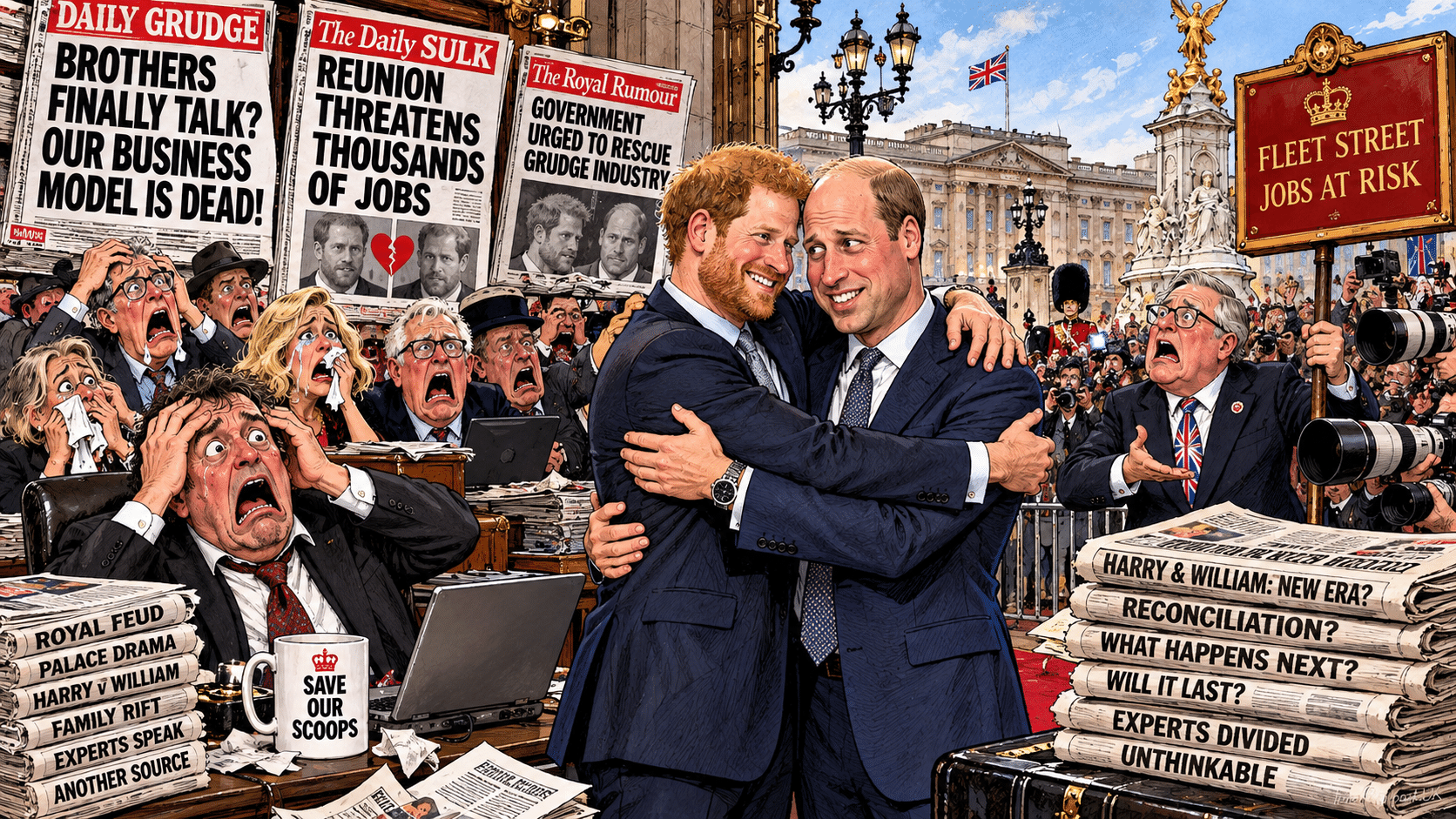
Prince Harry and Prince William Reunion Threatens Fleet Street Jobs as Editors Demand Government Rescue of the Royal Grudge Industry
Harry and William threaten Britain's most dependable newspaper business model by considering the reckless possibility of behaving like brothers again.
Tabloid executives warn that reconciliation could devastate an industry built on anonymous sources, suspicious body language, royal grudges and the commercial value of two grown men refusing to answer the telephone.
LONDON, England, October 10, 2026 — Britain's newspaper industry is facing its gravest economic threat since the invention of the internet, following renewed speculation that Prince Harry and Prince William might eventually reconcile. The latest royal reunion coverage, including Yahoo's report on a likely Harry and William reunion, has set off alarm across Fleet Street, where editors fear that an end to the royal feud could wipe out thousands of jobs propped up by the extraordinary profitability of two brothers not speaking to each other.
For six years, Britain's royal correspondents have enjoyed a dependable source of income that needs almost no fresh information. Harry remains offended. William remains offended. Charles wants everyone to stop being offended. Meghan gets mentioned whether she's involved or not.
Four sentences. Forty newspaper articles. Three television documentaries. A special edition of the Sunday Express.
It is possibly the most efficient business model in British journalism.
Now, with reports that King Charles is considering a family gathering to mark the thirtieth anniversary of Princess Diana's death, newspaper executives are staring down an alarming possibility. The brothers could shake hands. The consequences for British journalism would be catastrophic, because the public might even start reading about something else.
Fleet Street Warns Royal Reconciliation Could Destroy Britain's Most Profitable Family Business
The Royal Grievance Industrial Complex has become one of Britain's most successful commercial enterprises, turning ordinary family disagreements into an apparently inexhaustible national resource. Britain no longer manufactures enough cars, steel or affordable housing to go round. But it can still produce forty-seven newspaper articles about Prince William's facial expression before breakfast.
Royal resentment is renewable energy. One ambiguous photograph can power a Sunday newspaper for an entire weekend. An anonymous source claiming Harry is disappointed keeps a newsroom running until Wednesday. A second anonymous source claiming William is furious carries production through Christmas. And if somebody mentions Meghan, the presses can run indefinitely.
The economics are extraordinary. A normal journalist has to find something that happened, investigate it, interview witnesses and work out what it means. A royal correspondent merely writes that something might happen, quotes somebody who believes it shouldn't, and asks a third person whether it would be catastrophic if it did. By Thursday, it's a constitutional crisis.
According to the Institute for the Preservation of Profitable Resentment, an organisation whose headquarters conveniently occupy the space between a newspaper editor's conscience and his advertising department, the feud supports an entire ecosystem of specialists. These include body-language analysts, lip-readers, anonymous palace insiders, royal historians, reconciliation consultants, professional Meghan critics and photographers skilled in interpreting the emotional significance of a man's left eyebrow.
One industry representative explained the danger.
"We've spent six years training people to recognise William's anger from photographs in which he is simply standing beside a car. What are those people supposed to do if he starts smiling?"
Retraining could be expensive. A specialist who has spent his whole career spotting tension between royal relatives can't suddenly become a railway correspondent. He'd have to find out whether the trains were actually arriving late.
That involves leaving the office.
King Charles Plans Diana Memorial Reunion as Palace Advisers Seat the Royal Brothers in Separate Postcodes
The immediate crisis emerged amid reports that King Charles is weighing a memorial service for Princess Diana in 2027, giving his estranged sons a chance to attend the same family occasion. The idea has been aired in Page Six's reporting on how the King hopes to heal the rift, and in The Nightly's account of the King's reunion plan.
Palace advisers have met the prospect with the traditional British answer to an uncomfortable family relationship: an elaborate seating plan. Early proposals would put William in Westminster Abbey, Harry in St Paul's Cathedral, and Meghan somewhere far enough away that no opinion column suffers structural damage. The brothers would share the service by live video link.
William would be permitted to acknowledge Harry's existence, provided the acknowledgement received advance approval from six courtiers, three lawyers and an Anglican bishop with experience in hostage negotiations. Harry would be allowed to say hello. William would then have forty-eight hours to decide whether hello was an acceptable opening position.
A second meeting could follow in 2028, by which point the brothers might progress to the weather. Royal protocol specialists consider rain the safest subject. It affects everybody equally, it can't be blamed on Meghan, and it hasn't yet turned up in Harry's memoir, Spare.
Charles, meanwhile, would reportedly prefer an ordinary family gathering. That's understandable. The King has spent decades handling constitutional complications, parliamentary ceremonies, troublesome relatives and the upkeep of several extremely large houses. He'd now like something less demanding, such as two sons eating lunch without needing a former United Nations negotiator.
Unfortunately, the monarchy has never been much good at making simple things simple. It once took a full constitutional crisis for a king to marry the woman he loved. Getting two brothers to share a cheese sandwich could need a referendum.
Prince William Speaking to Prince Harry Declared Greatest Diplomatic Breakthrough Since the Cold War
The mere possibility that William might one day consider speaking to Harry has thrilled commentators who are used to reporting no progress whatsoever. For years the diplomatic situation has been Harry expressing a wish for better relations, William keeping his distance, and royal experts announcing that things remain complicated.
This month, People reported that Harry and Meghan were not planning an apology, contradicting another paper's account of a possible reconciliation push. That produced precisely the sort of disagreement that keeps royal journalism solvent. One newspaper reports an apology. Another denies the apology. A third investigates whether the denial itself needs an apology.
By Sunday, six commentators are arguing over who should apologise for reporting that someone else might apologise. Nobody has actually spoken to anybody.
Still, the possibility of a conversation counts as a major diplomatic development. The brothers are British, after all. Ordinary British men can go thirty years without discussing their feelings and still think of themselves as extremely close. Two of them might sit in a pub, drink three pints, moan about parking charges and leave without once mentioning the disagreement.
Fleet Street would call this a historic emotional breakthrough. Buckingham Palace would call it a private family matter. A tabloid would run:
WILLIAM AND HARRY IN EXPLOSIVE THREE-HOUR PUB SUMMIT: PALACE INSIDERS REVEAL WHAT REALLY HAPPENED WHEN HARRY ORDERED CHIPS.
The article would explain that William ordered vinegar. Harry preferred ketchup. Experts would warn that the condiment dispute exposed profound differences in their competing visions for the future of the monarchy.
Meghan would be accused of influencing the ketchup.
Harry's Olive Branch Must Be Inspected for Netflix Cameras, Palace Insists
Harry has said more than once that he'd like to repair things with his family. Unfortunately, royal reconciliation now looks a lot like international arms control. Every gesture has to be checked for concealed equipment, and an olive branch is no longer enough. It must clear palace security, earn certification from the Royal Horticultural Society and survive forensic examination for Netflix recording devices.
There are worries that Harry could turn up with a camera crew. There are equal worries that William could turn up with a team of constitutional lawyers. Both fears ignore the obvious fact that the British press would already have seventeen photographers in the nearest hedges.
One palace communications consultant suggested the brothers meet privately in a room with no cameras, microphones, recording devices or journalists. Fleet Street objected at once.
"How can two internationally significant public figures resolve a family disagreement without allowing newspapers to interpret it incorrectly?"
The question shows the difference between ordinary families and royal ones. When ordinary brothers quarrel, their mother tells them to stop being idiots. When royal brothers quarrel, six newspapers hire psychologists, three television networks commission documentaries and a retired courtier explains that the whole thing could threaten the Crown.
When ordinary brothers make up, they shake hands. When royal brothers make up, somebody negotiates the global streaming rights.
The olive branch itself could become a commercial property. Experts estimate a genuine reconciliation might generate one week of extraordinary newspaper sales. After that, the industry faces the terrifying prospect of peace.
Government Urged to Create a Royal Feud Protection Scheme for Fleet Street
With reconciliation threatening the livelihoods of journalists, political commentators and professional interpreters of palace curtains, newspaper executives want help from the government. A proposed Royal Grievance Preservation Act would designate the William and Harry disagreement an Asset of National Journalistic Importance.
Under the legislation, the brothers would have to maintain a minimum level of mutual irritation sufficient to sustain newspaper circulation. Each would file quarterly resentment statements. Harry might declare that he remains disappointed with the family's handling of earlier disagreements. William could confirm that he still regards certain matters as unresolved. The statements would then be distributed to newspapers under licence, so editors get guaranteed access to outrage without the princes having to do anything particularly interesting.
The scheme has attracted interest from economists studying Britain's shift from manufacturing to emotional speculation. The country once ran on coal, shipbuilding and heavy engineering. It now has an advanced service economy that can turn a prince's refusal to attend lunch into a seven-part television series.
The government could offer tax breaks to newspapers that employ at least three anonymous palace sources. Public subsidies might fund retraining for journalists displaced by royal happiness, with the most experienced moving across to celebrity divorces, football management disputes or rows between neighbours over garden fences.
There are difficulties, of course. A football manager eventually gets sacked. Neighbours occasionally mend their fences. Royal resentment, properly managed, can survive generations.
Royal Experts Fear Unemployment If the Royal Brothers Actually Speak
Perhaps the greatest threat falls on Britain's enormous population of royal experts. The profession has grown considerably since Harry and Meghan stepped back from royal duties in 2020. An expert now seems to be anyone who has visited Windsor, once attended a garden party, or owns a photograph of Queen Elizabeth II.
Some specialise in interpreting royal silence. Others interpret royal smiles. A particularly advanced subgroup can tell you what a royal figure meant by wearing a certain shade of blue.
The market for all this depends on uncertainty. If William speaks to Harry, the experts lose their central mystery. If Harry explains what William said, the mystery disappears completely. If the brothers agree to stop discussing the disagreement, newspapers face a news blackout. And worst of all, if the brothers become friends again, the experts might have to admit they don't know what's going on inside other people's homes.
That would be revolutionary.
One senior specialist in hereditary displeasure described the professional dilemma. "I have spent six years explaining why reconciliation is impossible. If they reconcile, people might begin questioning whether I know anything about them."
The interviewer assured him there was no immediate danger of that. He was booked on three television programmes the next morning.
Newspaper Editors Draw Up Emergency Plan to Keep the Royal Feud Alive
Fleet Street has therefore prepared several contingency measures. Should the brothers shake hands, newspapers will immediately investigate whether William's grip was sufficiently enthusiastic. If William smiles, analysts will check whether the smile reached his eyes. If Harry smiles, commentators will ask whether it was rehearsed.
If the brothers embrace, the length of the hug will be measured against internationally accepted standards of fraternal affection. Under three seconds will be classed as cold. Three to five seconds suggests guarded optimism. Anything over five seconds raises concerns about an inappropriate public display of emotion.
If Meghan attends, the whole event becomes a Meghan story. If Meghan doesn't attend, her absence becomes a Meghan story. If Meghan stays home reading a book, the choice of book becomes a Meghan story.
The system is practically recession-proof. Even a happy ending can be turned into fresh controversy. Consider the possibilities.
WILLIAM FORGIVES HARRY, BUT DOES HE REALLY MEAN IT?
HARRY HUGS WILLIAM, ROYAL EXPERT QUESTIONS WHY HE USED BOTH ARMS.
CHARLES DELIGHTED BY FAMILY PEACE, INSIDERS FEAR KING HAS BECOME TOO OPTIMISTIC.
Each headline buys another profitable week of outrage. Britain's press has plenty of rules about accuracy, set out in the IPSO Editors' Code of Practice, and in the long shadow of the Leveson Report. Nothing in either document, as far as anyone can tell, forbids the question mark at the end of a headline that explains absolutely nothing.
Why Britain's Royal Feud Has Become Too Big to Fail
There's a larger economic lesson here. Britain has let a whole sector of its media become dependent on the private disagreements of two men who already have enough difficulties without carrying thousands of strangers on advertising revenue. The brothers have become an unofficial national employment programme. Their quarrel supports commentators, columnists, photographers, publishers, broadcasters and the anonymous friends of anonymous friends who keep explaining what everybody is feeling.
In ordinary economics, a product loses value when consumers discover it contains almost nothing. Royal journalism has somehow reversed that principle. The less information available, the more valuable the story becomes.
An actual conversation between Harry and William would provide facts. Facts are dangerous. Facts have endings. Speculation can go on forever.
The financial brilliance of the arrangement is that neither prince needs to take part. William can spend the weekend at home. Harry can take his children to the park. Charles can go to church. By Monday morning, newspapers will have uncovered fresh tensions, important signals, unexpected developments and a deeply worrying change in somebody's posture.
It is journalism powered entirely by the absence of events.
King Charles Faces Impossible Choice Between Family Happiness and Newspaper Profits
The King now faces a dilemma of considerable national importance. He can encourage his sons to reconcile, ending years of family tension and giving Diana's grandchildren more time together. Or he can preserve the disagreement and protect one of Britain's few remaining internationally competitive industries.
The first option would benefit his family. The second would benefit Fleet Street. Both have traditionally claimed to act in the national interest, although only one sells advertising next to photographs of people looking miserable.
Charles may decide that his family's happiness matters more than newspaper circulation. Harry might accept that some disagreements can't be settled overnight. William might conclude that a conversation needn't amount to a constitutional surrender. The brothers could eventually meet privately, speak respectfully, acknowledge their differences and go home without issuing a statement.
It would be a thoroughly sensible outcome. For Britain's tabloids, it would be an act of economic vandalism. One newspaper editor on Fleet Street delivered the industry's closing assessment.
"We've already lost manufacturing, mining and most of our high streets. If these two start getting along, what exactly is Britain supposed to produce?"
For now, the situation remains unresolved. The brothers haven't announced a reconciliation. The newspapers remain profitable enough to keep speculating. And somewhere in London, a royal correspondent is drafting a 1,500-word article explaining that William's failure to telephone Harry yesterday could be the first encouraging sign that he might telephone him tomorrow.
At least one British industry still knows how to manufacture something out of absolutely nothing.
Disclaimer
This article is satirical journalism. The proposed legislation, industry organisations, economic assessments and comic quotations are satirical devices, not verified events or statements. Reports of possible royal reconciliation do not establish that a reunion has been agreed.
This story is entirely a human collaboration between two sentient beings: the world's oldest tenured professor and a philosophy major turned dairy farmer. Both agree that brothers should settle their differences, preferably before newspaper editors apply for agricultural subsidies to keep the feud alive.
SOURCE: https://www.yahoo.com/entertainment/celebrity/articles/harry-william-likely-reunion-gets-192812136.html https://prat.uk/royal-brothers-reunion-threatens-fleet-street-jobs/


Comments
Post a Comment