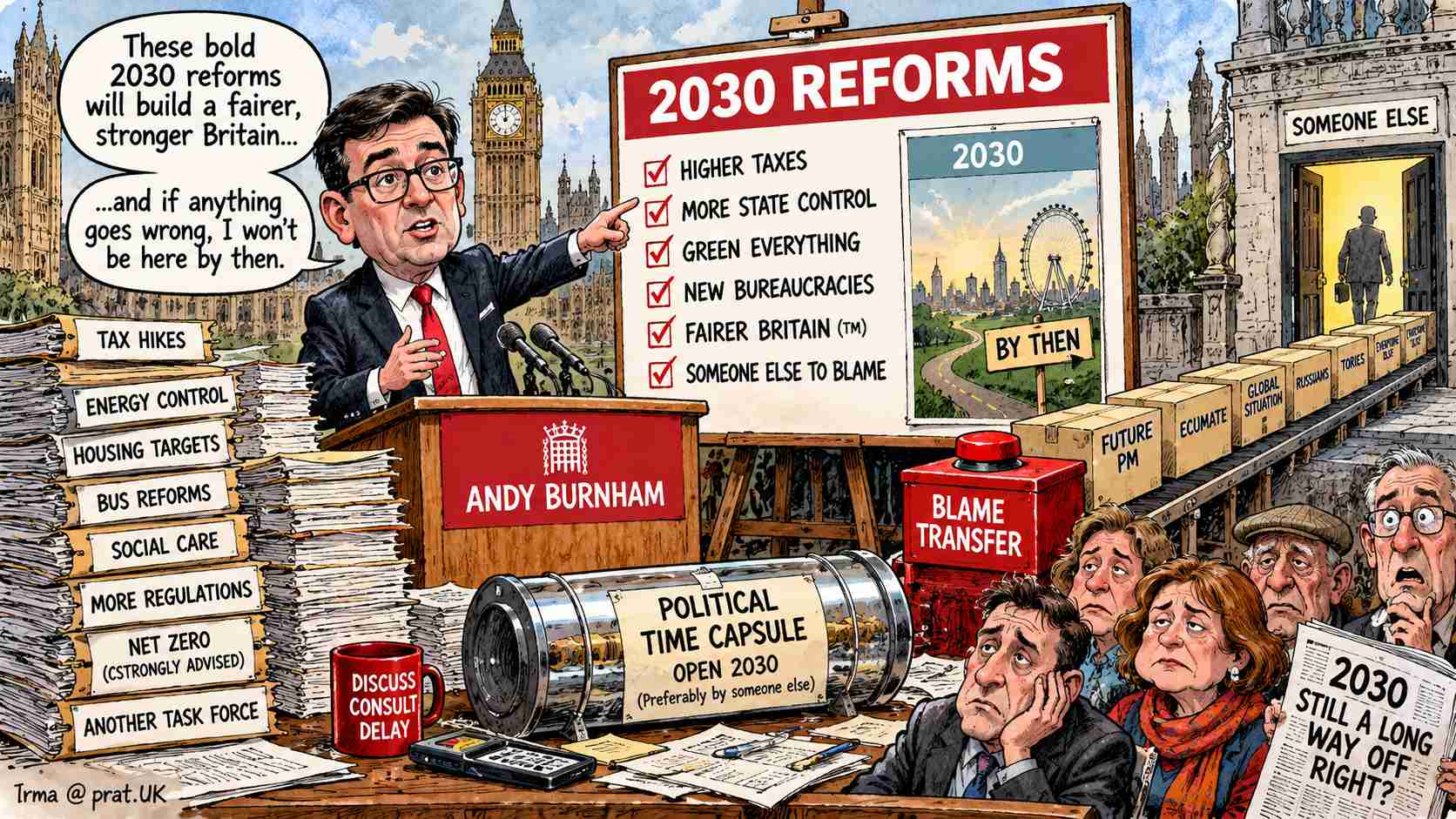
Prime Minister discovers the safest political deadline is one located comfortably beyond the point where everybody can remember who originally promised what
LONDON - Prime Minister Andy Burnham has unveiled an ambitious programme of reforms beginning around 2030, giving Britain several years to prepare, debate, consult, reconsider, commission reports and eventually discover that responsibility has migrated somewhere else.
Why 2030 Is Witness Protection for Policy
It is difficult to overstate the political beauty of 2030.
2030 is not a year.
2030 is witness protection for policy.
Burnham's government has proposed phasing out the pension triple lock from April 2030 while developing a National Care Service. The government says the reform could help finance social care, while independent analysts at the Institute for Fiscal Studies and elsewhere have questioned how much it would ultimately save.
That creates a fascinating political arrangement.
The announcement happens now.
The difficult consequences happen later.
And between those dates lies approximately four years of professionally managed amnesia.
Corporate executives call this long-term planning.
Politicians call it courage.
Taxpayers call it, "Hang on, wasn't this supposed to be somebody else's problem?"
The Whitehall Strategy Paper on Hairstyles and Political Accountability
A satirical Whitehall strategy paper reportedly recommends that all controversial policies be scheduled for dates far enough into the future that ministers can plausibly develop new hairstyles before implementation.
This creates useful visual separation.
A minister appearing on television in 2030 can say, "That was a very different government."
"But you were in it."
"Yes, but look at my glasses."
Case closed.
Political accountability has always suffered from the passage of time. Governments promise something, committees examine it, officials modify it, economic conditions change, ministers move jobs, journalists change beats, and eventually the original policy emerges wearing an entirely different coat.
2030 gives this process room to breathe.
Success Belongs to the Visionary, Failure Belongs to the Weather
Suppose the reforms succeed magnificently.
Burnham can say he possessed extraordinary foresight.
Suppose they fail.
Global circumstances changed.
Suppose taxes rise more than expected.
Independent economic conditions forced difficult decisions.
Suppose the projected savings never appear.
Nobody could have anticipated demographic pressures that demographers spent thirty years anticipating.
This is the great asymmetry of long-range politics.
Success belongs to the visionary.
Failure belongs to weather.
Pitch-Rolling Meets the Next Parliament
The FT's discussion of Burnham's pitch-rolling draws comparisons with corporate leaders who prepare organisations for painful change before acting. In business, however, the chief executive eventually has to produce quarterly numbers. Politics has discovered a more sophisticated reporting structure called "the next parliament."
By 2030, Britain may have experienced several budgets, a general election, additional fiscal emergencies, unexpected international crises and approximately 11,000 newspaper stories beginning with "Ministers are considering."
That is plenty of atmospheric cover.
A policy announced today may emerge in 2030 so extensively renovated that archaeologists will be needed to establish its ownership.
Pensions and Social Care: Everybody Agrees It Needs Fixing, Nobody Agrees How
This is particularly convenient for difficult reforms involving pensions and social care.
Everybody agrees social care needs fixing.
Nobody agrees how.
Every solution costs money.
Every source of money already belongs to someone.
This has caused successive governments to approach social care with the confidence of a man attempting to remove a sleeping tiger from a downstairs toilet.
Burnham's innovation is to announce that the tiger removal will begin in four years.
Britain is therefore invited to admire the bravery immediately.
Actual tiger remains scheduled for 2030.
Perhaps Burnham's reforms will work.
Perhaps long preparation genuinely will build consensus.
But the political genius of a delayed deadline remains undeniable.
By the time the bill arrives, the waiter may have changed shifts.
What Taxpayers Should Demand Before 2030 Arrives
If 2030 is to be more than witness protection, voters can insist on a few modest safeguards. Publish the costings now, not in the final year. Name the minister responsible for delivery, and write the name down somewhere sturdy. Commission an independent body to check the savings claims at regular intervals, then publish the results whether flattering or not. And attach every long-range promise to a date on which somebody can be asked whether it worked. None of this is radical. It is simply the political equivalent of keeping the receipt. Governments that are proud of their long-term thinking should be delighted to be held to it, and governments that are not should probably be asked why the glasses keep changing. A deadline without an owner is not a plan; it is a calendar entry with ambitions. Four years is plenty of time to do the paperwork properly, which is rather the point.
Disclaimer
This is satire built around genuine debate over pensions, taxation and social-care reform. All administrative absurdities are provided for comedic purposes. This story is entirely a human collaboration between two sentient beings: the world's oldest tenured professor and a philosophy major turned dairy farmer.
SOURCE: Financial Times.
15 Observations From the Witness Protection Programme for Policy
- 2030 is the new "next week," but with a manifesto.
- A deadline four years away is not a plan; it is a postponed apology.
- Ministers love 2030 because by then everyone will have changed their glasses.
- Success has a thousand fathers; failure has the weather.
- Nobody could have predicted the demographics that demographers predicted in the 1990s.
- Four years is long enough for a policy to be renamed, reorganised and forgotten by its own author.
- The tiger will be removed from the downstairs toilet in 2030; until then, please use the upstairs.
- "Ministers are considering" has become Britain's most reliable weather forecast.
- Archaeologists will need a dig permit to establish who owned the 2030 reform.
- Witness protection for policy comes with a new name and a consultation.
- The independent analysts have questioned the savings; the Treasury has questioned the analysts' tone.
- A reform that pays for itself in 2030 has the credibility of a gym membership paid for in January.
- The pension triple lock now has a longer notice period than most tenancies.
- By the time the bill arrives, the waiter will have left and the restaurant will have been rebranded.
- Announce it early enough and the blame arrives pre-addressed to your successor. https://prat.uk/burnham-unveils-bold-2030-reforms-confident-someone-else-can-be-blamed-by-then/


Comments
Post a Comment