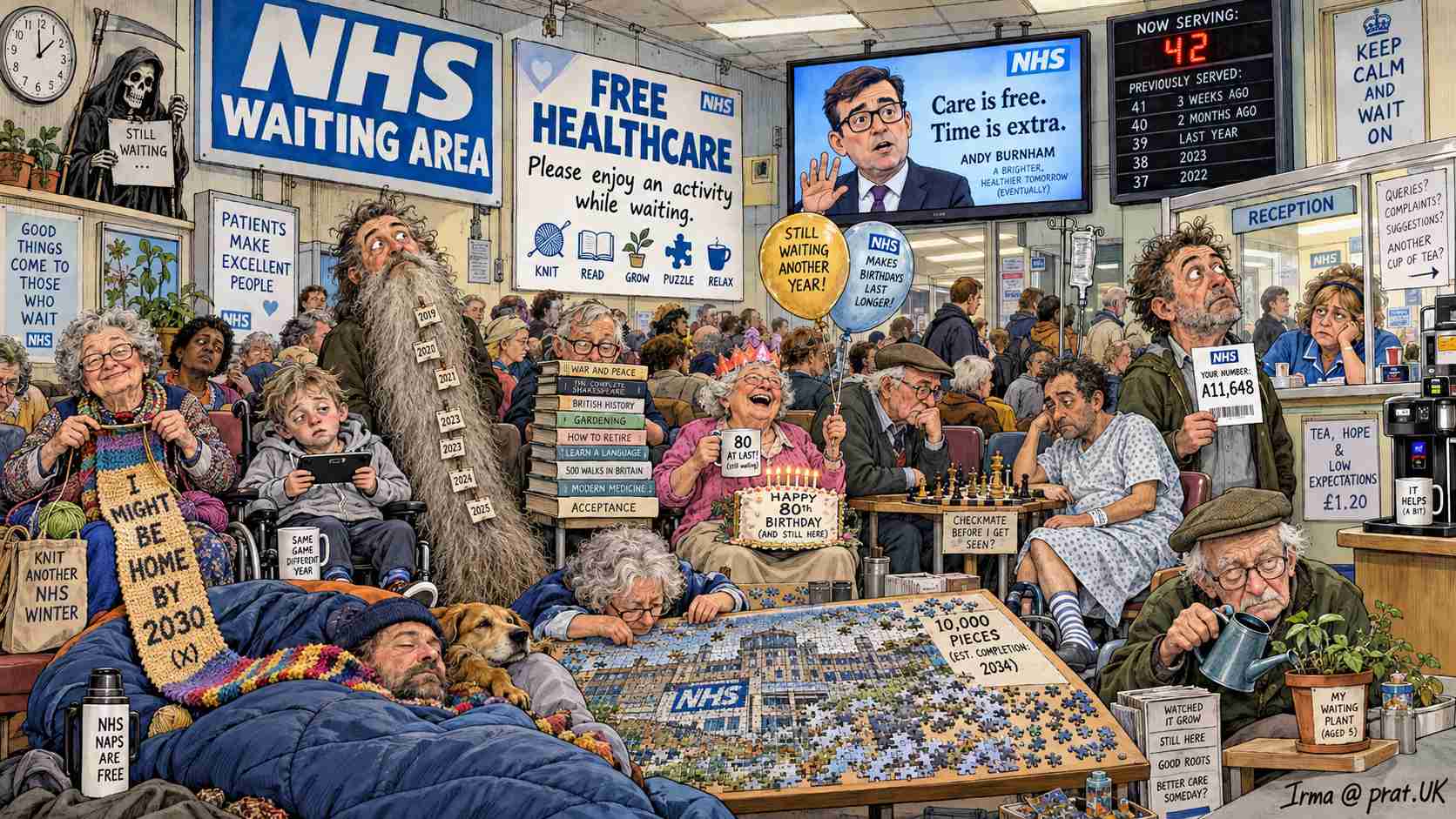
Ministers celebrate the moral triumph of universal treatment while an elderly London patient requests the minor additional benefit of receiving treatment before his next birthday
LONDON - Britain's theoretical healthcare revolution has achieved the remarkable distinction of guaranteeing every citizen the right to medical attention while leaving millions of treatment pathways on a waiting list. Ministers insist the existence of a waiting list should not obscure the achievement of providing a universal healthcare system. Patients agree that universal healthcare is a worthwhile objective. They would also appreciate an appointment.
According to NHS England's September 2026 performance update, the elective waiting list rose to 7.3 million in July. A pathway is not necessarily a separate person, and the same update records millions of tests being carried out, with more than five million diagnostic tests delivered in June and July alone. The monthly referral to treatment waiting times data explains how the figures are counted.
Even so, the number illustrates an uncomfortable truth about any healthcare promise. Access means something only when the medical capacity exists to provide care. Theoretical socialism has responded by proposing another guarantee. This time, ministers promise to guarantee the original guarantee.
Thinking About the NHS...
- A right to healthcare is a wonderful thing, much like a right to a table at a restaurant that has not yet been built.
- "Your Healthcare Journey" is the only journey in Britain where the destination is a waiting room and the travel time is classified.
- Giving a patient a website to see his place in the queue is like giving a drowning man a graph of the depth.
- A hospital with fifteen targets and no operating theatre is a magnificent triumph of measurement over medicine.
- "Healthcare leadership" cannot remove an appendix, but it can host a seminar on the ethics of the appendix.
NHS Waiting Lists in Practice: The Hospital Is Fully Committed to Treating You Eventually
At an imaginary London hospital, pensioner Arthur Pritchard, 74, has asked for an appointment about his troublesome knee. The receptionist assures him that healthcare is a fundamental social right. Arthur agrees. She explains that the hospital is committed to providing timely, compassionate, comprehensive medical services. Arthur agrees again. She hands him a leaflet entitled Your Healthcare Journey.
Arthur asks when he can see the surgeon.
"That depends upon clinical priority and available appointments."
"How long?"
"We'll contact you."
"Will my knee still be attached?"
"We certainly hope so."
Arthur is then invited to complete a patient satisfaction survey. He gives the hospital five stars for its commitment to eventually seeing him and zero stars for its commitment to seeing him while he can still walk. The combined rating is logged in the National Patient Experience Database as encouraging progress.
Healthcare Capacity and Political Promises: The Minister Has Discovered an Unlimited Supply of Compassion
In theoretical socialism, medical treatment is handed out through political aspiration. The government announces that patients deserve shorter waits. Hospital managers confirm that they support shorter waits. Doctors insist that shorter waits would improve patients' lives. Everybody agrees. Unfortunately, agreement does not perform operations.
Surgery needs trained professionals, operating theatres, sterile equipment, nurses, anaesthetists, recovery facilities and available hospital beds. A minister cannot give a speech so moving that a broken hip repairs itself out of gratitude.
An imaginary Health Secretary has therefore announced a National Waiting Time Reduction Strategy. Asked how many extra surgeons the strategy contains, he says the document concentrates on patient-centred language. Asked how many extra operations it will deliver, he explains this will become clear after implementation. Asked whether it has enough funding and staff, he becomes annoyed. "Why must journalists constantly introduce practical complications into healthcare policy?"
The practical complications include patients.
The bill for compassion arrives in a brown envelope. The Office for Budget Responsibility sets out the long-run pressures on the public finances, health spending prominent among them, in its Fiscal risks and sustainability report, a document ministers describe as unhelpfully numerical. One adviser proposed tackling the problem at source by giving the OBR a waiting list of its own. Its next forecast is now expected in eighteen weeks, or twenty-six, or shortly after Arthur's knee.
Universal Healthcare Is Not the Same as Unlimited Healthcare
The argument here is not that the NHS should disappear or that patients should be abandoned to private bills. Many prosperous market economies provide extensive publicly funded healthcare, and some achieve impressive results. The genuine problem is scarcity. No healthcare system has unlimited medical professionals, equipment, beds or funding, so treatment has to be prioritised somehow.
Private systems can ration care through prices, insurance restrictions and other barriers. Public systems can face waiting times and capacity constraints. Mixed systems try different combinations of financing, competition, regulation and universal access.
The OECD's report Waiting Times for Health Services: Next in Line looks at how countries have tackled the problem and finds that lasting improvement tends to need extra capacity, better organisation, clear targets and active management of demand. The King's Fund makes a similar case for the NHS in its report on strategies to reduce waiting times for elective care. In other words, a successful healthcare system takes more than announcing that everybody deserves to be healthy. This is tremendously disappointing to politicians, who are particularly accomplished at announcements.
The Government Opens a Hospital Made Entirely of Targets
Ministers have unveiled a new hospital consisting of fifteen performance targets, eleven equality objectives, twenty-three patient engagement indicators and a magnificent reception desk. Unfortunately, the building has no operating theatres. The architect explains that the theatres were removed to make room for the Department of Clinical Accountability.
A patient asks whether he can have his appendix removed. The receptionist replies that the facility does not provide surgical services.
"Then what does it provide?"
"Healthcare leadership."
"Can healthcare leadership remove an appendix?"
"No, but we have a brochure explaining why appendices should be removed fairly."
The hospital is promptly awarded an innovation prize for outstanding administrative integration. The patient travels elsewhere for his operation.
Public Versus Private Healthcare: The Private Clinic Has Introduced an Uncomfortable Comparison
Arthur eventually thinks about paying for treatment at a private clinic. He isn't wealthy, and the cost worries him. So he asks a reasonable question: why can't the publicly funded system provide the care he has already helped pay for through taxation?
The answer involves capacity, staffing, productivity, medical priorities, funding and how services are organised. It is not solved by declaring private treatment morally suspicious. Nor is it solved by assuming private healthcare automatically works perfectly.
What Arthur wants is not an ideological contest. He wants someone to repair his knee. A government that puts patient welfare above political vanity should weigh every reasonable method of widening access, improving efficiency and delivering safe treatment. Unfortunately, ideological purity is frequently more convenient than administrative reform, especially for people who don't have to sit in the waiting room.
Economists have a dry little term for all this. Opportunity cost is whatever you give up to get the thing you chose: a pound spent on a Deputy Director of Queue Experience is a pound not spent on a surgeon, a bed or an anaesthetist. The department accepts the principle and has acted on it. It has hired an Opportunity Cost Lead, at a cost of one orthopaedic registrar.
The Waiting List Is Officially Becoming More Accessible
At the end of the government's press conference, the Health Secretary announced a major improvement to the waiting-list system. Patients will now be able to see their estimated position online. Arthur checks. He is number 483,716. The website congratulates him.
"You're making progress!"
Arthur rings the hospital.
"What progress?"
"You have successfully accessed your waiting-list information."
"But I still need an operation."
"That's a separate service."
Arthur closes the website and walks to the kitchen, slowly, on his painful knee. He makes himself a cup of tea. At least the kettle has the decency to produce something after being switched on.
Theoretical socialism guarantees the right to medical treatment. Arthur would settle for an appointment.
Humorous Observations on Waiting Lists and the Healthcare Guarantee
- Arthur gave his hospital five stars for commitment and zero for timing, which is the most accurate review the NHS has ever received.
- A Waiting Time Reduction Strategy with no extra surgeons is a diet plan with no food: very concise and rather thin on delivery.
- The kettle works. The kettle has never been reorganised, rebranded or reviewed.
- If sympathy could perform surgery, the Health Secretary would have cleared the list before breakfast.
- The Department of Clinical Accountability has accounted for everything except the operating theatre it displaced.
- Number 483,716 is the only lottery in Britain where winning means you get to be told you're still waiting.
- Somewhere a surgeon is looking at a theatre rota, a bed shortage and a ministerial press release, and wondering which of them is the fiction.
- The Opportunity Cost Lead is, by her own careful calculation, the opportunity cost.
- Putting the forecasters on a waiting list is the first NHS reform to make the bad news arrive late as well.
- Arthur's knee has now outlasted two Health Secretaries and one strategy. It is the most stable part of the system.
Satirical Disclaimer
This article satirizes the difference between promises of universal healthcare and the real medical capacity required to deliver them. It does not suggest that all public healthcare fails or that private systems avoid shortages and rationing. Arthur and the conversations are imaginary. The story is entirely a human collaboration between two sentient beings: the world's oldest tenured professor and a philosophy major turned dairy farmer, who recommend employing actual surgeons rather than merely printing their job descriptions.
SOURCE:https://www.england.nhs.uk/2026/09/busiest-summer-ever-for-nhs-but-aes-see-record-numbers-within-four-hours/
Auf Wiedersehen, amigo!
- prat.UK https://prat.uk/?p=51417


Comments
Post a Comment