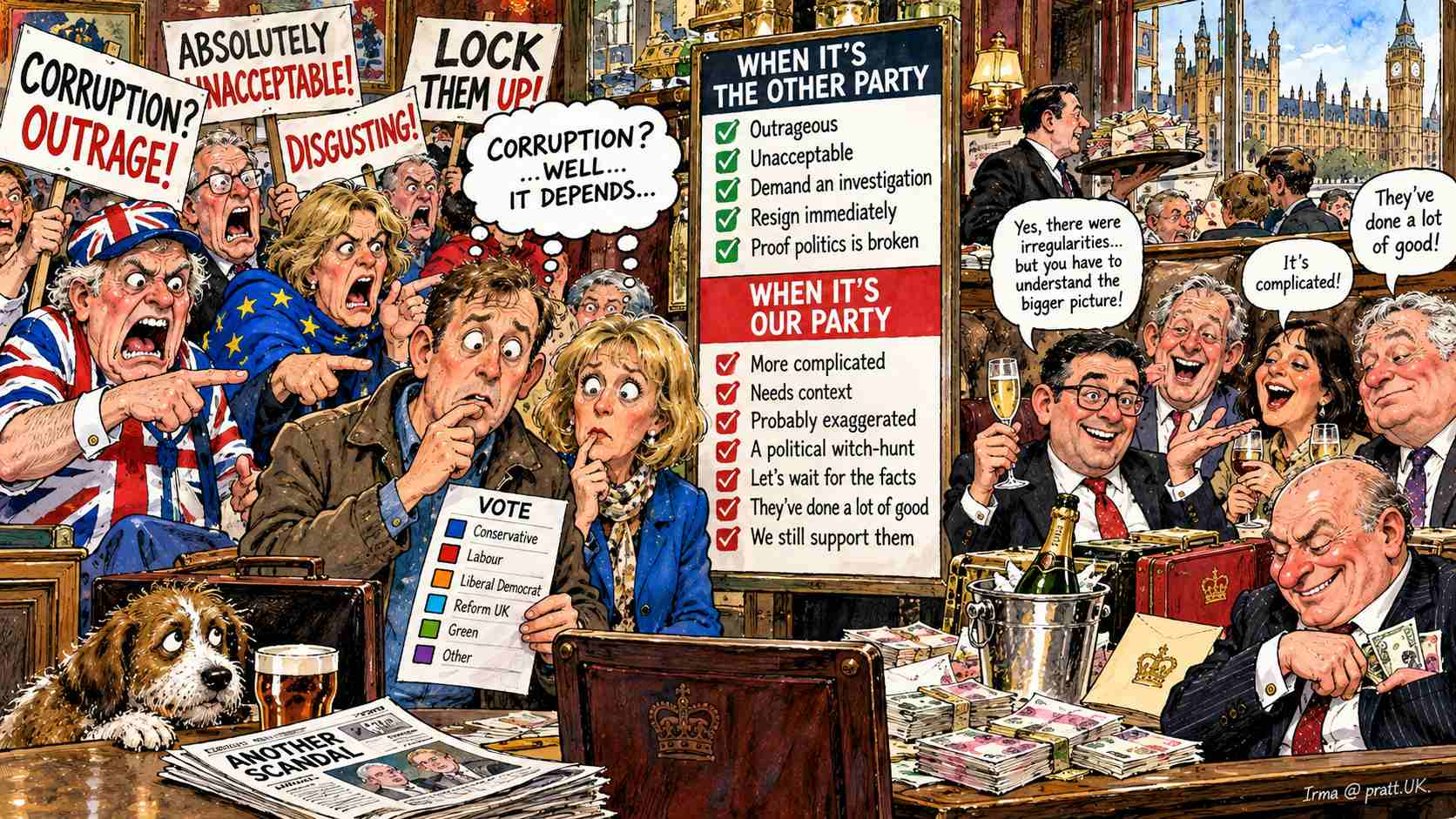
Manchester City Financial Case Inspires Westminster to Replace Political Principles With Team Loyalty and Selective Outrage
LONDON - British political parties have reached an unprecedented agreement on corruption. It is completely unacceptable when committed by their opponents, and requires considerable historical context, legal interpretation and emotional sensitivity when it turns up on their own side.
The agreement follows renewed debate over Manchester City's financial case. An independent commission ruled against the club on all but one of 115 charges, and football supporters have since shown a near-supernatural ability to tell unacceptable behaviour at rival clubs from entirely understandable administrative complexity at their own.
Westminster has been studying the technique for years.
Competitive Moral Accounting at Westminster
Conservative supporters who once treated government borrowing as a national emergency discovered that borrowing could become a regrettable necessity under Conservative governments.
Labour supporters who demand financial accountability from private companies found that government spending raises considerably more complicated moral questions.
Reform UK supporters have the advantage of being able to criticise both established parties without defending decades of national government decisions.
A Westminster analyst called the arrangement competitive moral accounting.
"Morality is rather like a football shirt. It comes in different colours, costs more than it should, and becomes considerably less important when your team is winning."
The Resignation Double Standard
The British public has got used to watching politicians demand resignations for behaviour remarkably close to conduct they defended last year.
A minister missing an important meeting is a national scandal if he belongs to the opposition. If he belongs to the government, he was doing important work elsewhere.
A politician who changes his position is a dangerous hypocrite, unless he belongs to your party, in which case he's showing the intellectual courage to respond to changing circumstances.
A Birmingham pub landlord, Trevor Biddle, put it plainly.
"If Manchester United were accused of financial wrongdoing, my City-supporting brother would demand the death penalty, nationalisation of Old Trafford and a public apology from every supporter since 1878."
"What happens when City are involved?" he was asked.
"He becomes a constitutional lawyer."
Millions of Accidental Barristers
The same thing has happened across British politics. Millions of ordinary citizens appear to have completed accelerated legal qualifications whenever their preferred politicians run into controversy. They can explain evidentiary standards, procedural irregularities, institutional bias and the philosophical implications of an independent inquiry.
Ask them how much council tax they pay, though, and they get less certain.
Who Is Actually Responsible?
The country's decline has made this partisan flexibility particularly convenient. Public services can disappoint, living costs can rise and infrastructure can crumble, but there's always somebody else's old decision to blame. Britain's political parties have become so good at handing out responsibility that almost nobody holds any.
The government's problems were inherited. The opposition's mistakes were misunderstood. Previous administrations faced extraordinary circumstances. Future administrations will need more time. Responsibility has been passed round Westminster so often that it now counts as a renewable resource. The Institute for Government and the National Audit Office publish independent assessments of exactly this kind of thing, and both are still waiting to be asked.
A retired schoolteacher in Leeds suggested football-style match reports for Parliament.
"Every Friday, publish what ministers promised on Monday, what they achieved by Thursday, and how much it cost us."
Political advisers rejected the proposal as needlessly confrontational. They argued that politics can't be reduced to measurable outcomes because governing involves a complicated range of competing priorities.
Football supporters found this fascinating. Apparently a striker who misses six open goals can still be a tremendous success if he explains how challenging modern football has become.
Britain's parties have therefore achieved something no football club could manage. They've set up a competition where every team claims victory, every manager blames the previous manager, and the spectators are legally required to buy season tickets.
The trophy is national decline.
Nobody admits winning it.
Five Observations on Outrage by Postcode and Shirt Colour
- "It's complicated." That's what every politician says when it's their guy. When it's the other guy it's apparently the simplest thing in the world. It's like everyone's got two sets of morals, one for home and one for away, and they never wash the away set.
- My mate turns into a barrister the second his team's in trouble. Mind you, he can't read a parking sign. Four fines this year. "I'd like to see the evidentiary standard for that kerb."
- They said responsibility is a renewable resource. It's the only one we've got. We can't make steel, we can't make houses, but we can pass the buck at a world-class level. That's our North Sea.
- Reform gets to criticise everyone and defend nothing. That's not a political party, that's a man in the pub who's never had to carry the shopping.
- Season tickets, legally required. You know what that is? It's a gym membership with Parliament. You pay every month, you never use it, and you can't cancel without a letter.
Satire. The quotes, characters and proposals are invented. The Manchester City case is real, and the club is appealing. Readers who find this disclaimer outrageous are asked to check which party wrote it before deciding how outraged to be; it was us, and our British satire wears no shirt at all. https://prat.uk/british-voters-declare-corruption-unacceptable-unless-their-own-party-is-responsible-in-which-case-it-becomes-complicated/


Comments
Post a Comment