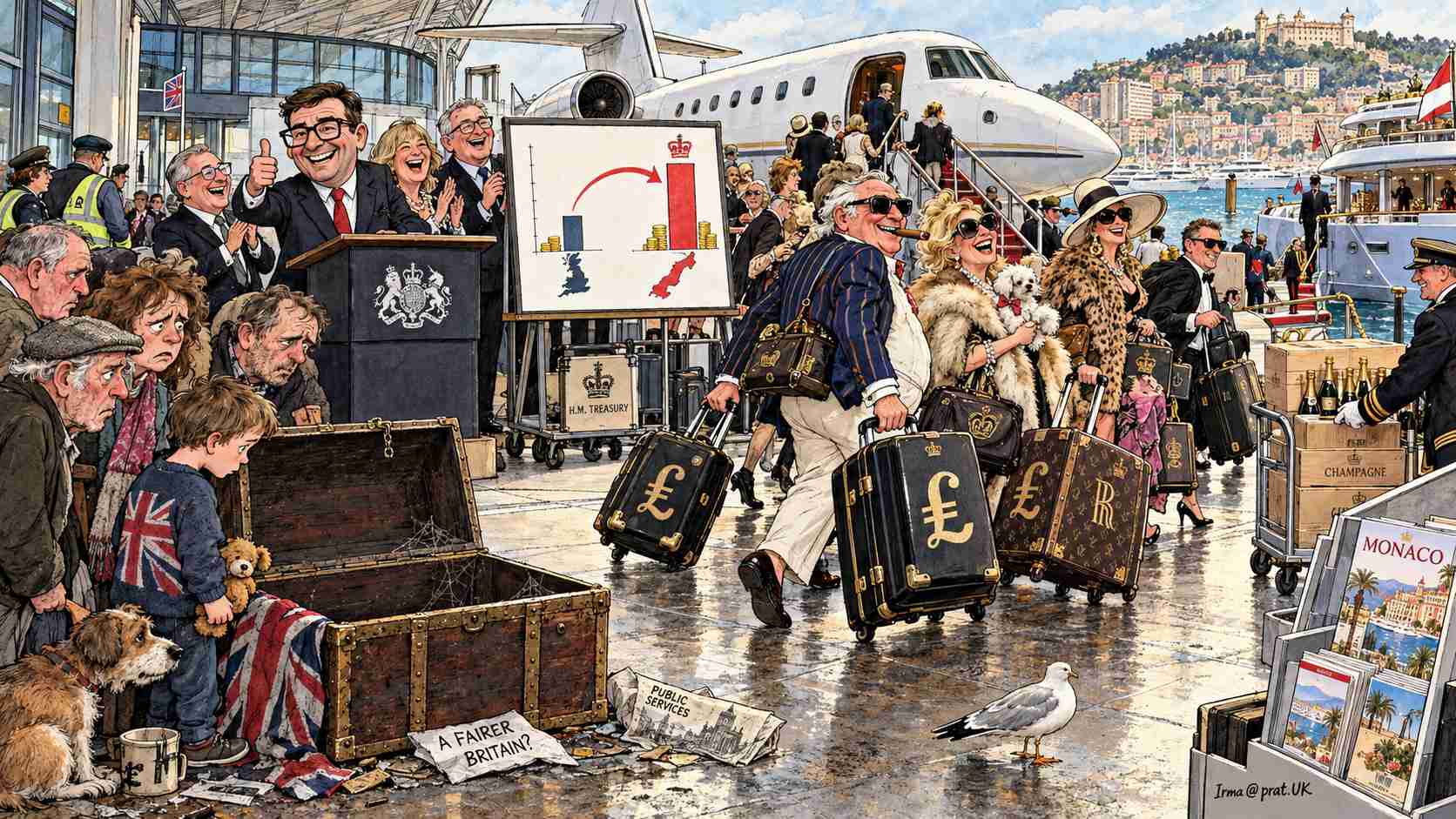
Government promises to make wealthy people pay more, discovers wealthy people can afford airline tickets and properties in countries where the Treasury has considerably less influence
LONDON - Britain's tax authorities have run into a serious problem with their ambitious plans to collect additional revenue from wealthy residents, after discovering that billionaires are not legally required to stay within convenient travelling distance of HM Revenue and Customs.
An analysis published by The Guardian found that people with a combined estimated wealth of £121 billion have either left Britain or loosened their residency connections since Labour came to power in 2024. Among the prominent departures is property billionaire David Reuben, who has moved to Monaco. Others have cited tax uncertainty, proposed inheritance changes and the removal of long-standing benefits for wealthy non-domiciled residents.
The Guardian investigation into Britain's super-rich leaving for Monaco and other countries also quotes economists and wealthy businesspeople who dispute the idea that Britain is experiencing an unprecedented billionaire exodus. The Treasury's immediate challenge is to work out how to tax people who have become wealthy enough to choose which country receives their tax returns.
Billionaires Leaving the UK: Government Discovers Rich People Have Access to Airports
For generations, British politicians have treated wealthy individuals as if they were large pieces of valuable furniture. The government could tax them, regulate them, lecture them and occasionally threaten to tax them again. The assumption was that the furniture would stay in the drawing room. Unfortunately, billionaires have developed an inconvenient habit of owning passports.
Unlike an ordinary worker with a mortgage in Birmingham and two children at local schools, a billionaire may own properties in London, Switzerland, Dubai and Monaco. When taxes become unattractive, the billionaire can relocate. The Birmingham worker can also relocate, provided he can find a job, afford the moving costs, transfer his mortgage and explain to the children why their new school is in the Mediterranean.
The government therefore faces a frustrating economic reality. Money is mobile. People with very large quantities of money are extraordinarily mobile, and nobody becomes a billionaire without eventually discovering the advantages of a good accountant.
Wealth Tax Debate: Treasury Announces Redistribution Has Reached the Mediterranean
The central argument for higher taxes on extreme wealth is straightforward. People with enormous financial resources can contribute substantially more to public services without suffering the hardship that ordinary taxpayers would. That principle has considerable public support, and campaigners such as Tax Justice UK make the case regularly. The difficulty is how governments collect those contributions without encouraging wealthy residents to move elsewhere.
Critics of Britain's tax changes argue that departures can reduce investment, employment and future tax receipts. Supporters reply that the wealthy often exaggerate their mobility and that a fair tax system should not offer permanent concessions merely because someone threatens to buy an apartment in Monaco. Both arguments deserve consideration. The Treasury, however, cannot collect British residential taxes from somebody by announcing that his departure is socially irresponsible. International taxation involves complicated rules, and the government has to balance fairness against economic incentives. The Institute for Fiscal Studies has written at length about where that balance lies.
The mathematics becomes particularly awkward when policymakers count wealthy residents' combined fortunes as though they were government revenue waiting to be collected. A billionaire with £10 billion in assets does not necessarily receive £10 billion in annual taxable income. Political speeches are, unfortunately, a good deal more exciting when somebody announces that there are billions available without explaining what portion is actually taxable. The Office for Budget Responsibility tends to ask.
Monaco Reports Unexpected Interest From People Concerned About Inequality
Monaco has long offered wealthy residents an attractive combination of favourable personal taxation, Mediterranean weather and the opportunity to buy a parking space worth more than an ordinary British home. The Monaco government describes the principality in rather warmer terms than the Treasury describes Britain. Britain offers extraordinary history, world-class culture, financial expertise and a familiar climate in which even July can become a medical argument about central heating.
A billionaire comparing the two countries may naturally weigh tax treatment alongside lifestyle, business interests and personal circumstances. Some wealthy people have chosen to stay in Britain, arguing that the country still offers exceptional opportunities and that affluent citizens should contribute fairly. Others have questioned whether higher taxes might eventually discourage enterprise.
The debate exposes a persistent weakness in British economic management, which is that policymakers sometimes behave as though collecting revenue and encouraging investment were unrelated activities. In reality government depends on a productive economy, and the economy depends on public infrastructure and predictable institutions. Neither can flourish indefinitely by treating the other as an enemy.
Government Considers Revolutionary Policy of Making Britain Attractive to Successful People
The practical challenge is to design taxes that are fair, enforceable and predictable enough that people can make long-term decisions without consulting relocation specialists every six months. Britain should not need to become a tax haven to attract investment. Nor should it assume that every wealthy individual leaving the country is a devastating economic catastrophe. The sensible objective is to encourage successful businesses, competitive investment and contributions to public services while preventing abuse of the tax system.
Balanced economic policy rarely produces exciting headlines, and declaring war on billionaires is much more satisfying. For the Treasury, however, there is one fundamental problem with declaring war on people who own private aircraft. The enemy has considerably better evacuation arrangements.
Britain may ultimately discover that successful wealth redistribution needs the continued presence of somebody with wealth. Otherwise the government risks an unprecedented economic achievement. It will have made the country more equal by ensuring everyone with substantial money has moved somewhere else.
Five Humorous Observations
- So we've discovered billionaires have passports. Who knew? They're not couches. You can't tax them and expect them to stay in the living room.
- A billionaire can move to Monaco. A guy in Birmingham with a mortgage and two kids can move to the other side of Birmingham.
- The government counts a billionaire's fortune as money it could be collecting. That's counting my Netflix list as money I've spent.
- A parking space in Monaco costs more than a house in Britain. And I still can't park at Tesco.
- Wealth redistribution: we did it. It's just been redistributed to Monaco. Which technically counts as more equal, because everyone with money is somewhere else.
Satire: this is parody based on the reporting linked above, written by people with no plans to move to Monaco and no means of getting there. The commentary and reactions are invented, and the Guardian's analysis includes economists and businesspeople who dispute the idea of an unprecedented exodus. Our UK satirical news and London satire remain resident in Britain for tax purposes. https://prat.uk/?p=51831


Comments
Post a Comment