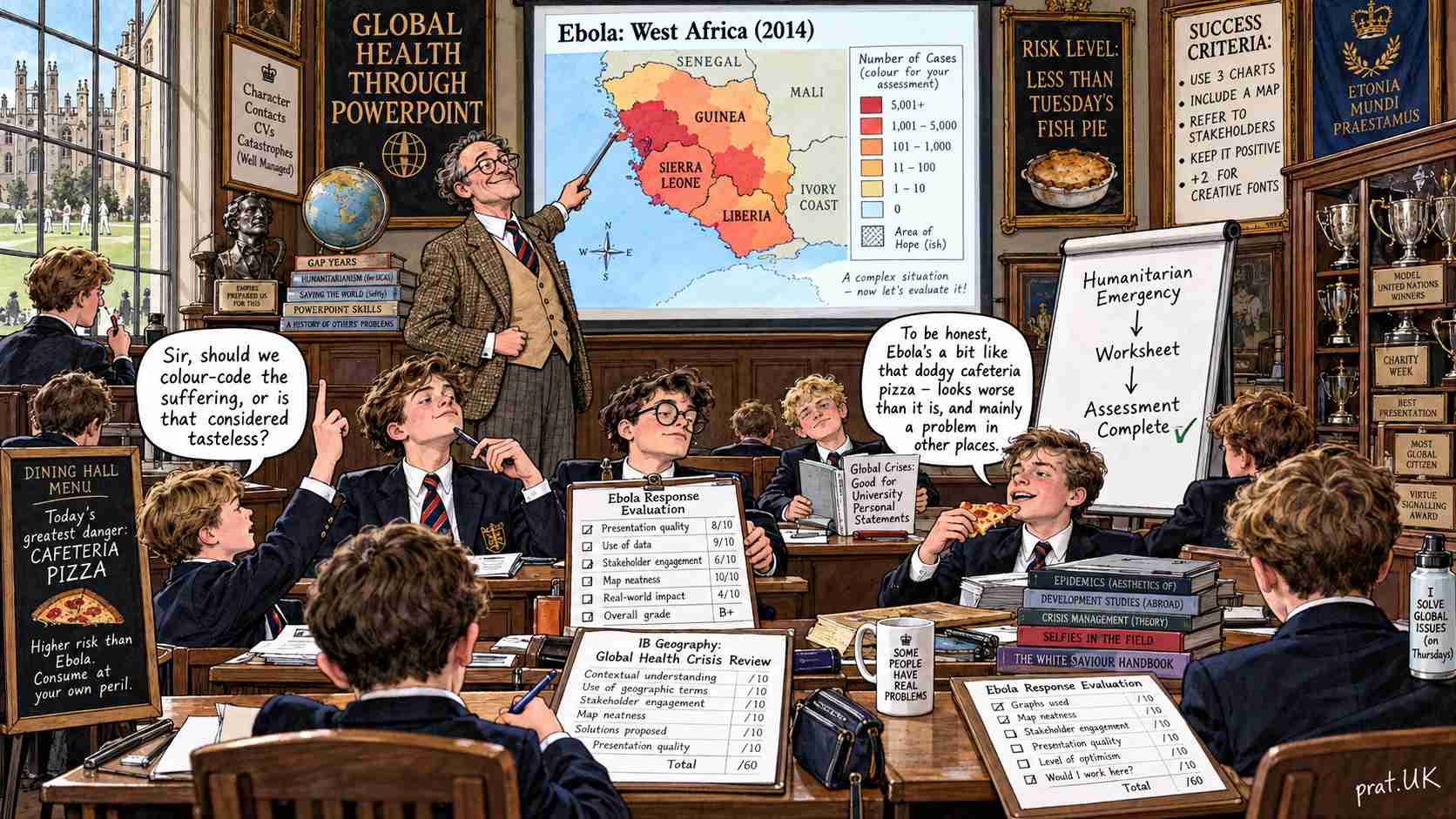
Eton Student Asked to Evaluate Ebola Response, Having Previously Evaluated Nothing More Dangerous Than Cafeteria Pizza
IB Geography converts a deadly epidemic into a worksheet, humanity celebrates another decisive administrative victory as global health emergency reaches its natural final stage: PowerPoint
ETON, BERKSHIRE — Britain’s educational establishment achieved a major breakthrough in infectious-disease control this week after the Ebola crisis was successfully reduced to several paragraphs, a map, three discussion questions and the terrifying instruction “Evaluate.”
The inspiration is a Financial Times classroom feature examining life on the frontline against Ebola, where the actual story is considerably less comfortable than the schoolroom version. Doctors and nurses in the Democratic Republic of the Congo have faced infection risks, inadequate resources, distrust, attacks and immense pressure while trying to control a dangerous outbreak.
Naturally, the next logical step was to ask teenagers what everybody could have done better.
At Eton College, which in the universe of this satire appears to have acquired an IB Geography department overnight through the same mysterious mechanism by which Britain acquires government departments, pupils were reportedly handed the Ebola case study shortly after breakfast.
This meant several boys went directly from evaluating whether the cafeteria scrambled eggs had the correct consistency to evaluating whether African health authorities had properly managed one of the most frightening infectious diseases on Earth.
“I thought the toast was slightly overdone,” said one pupil, Sebastian Fortescue-Wimbledon, examining a photograph of an Ebola treatment unit. “So I already had considerable experience with crisis management.”
He paused.
“My preliminary conclusion is that stakeholders should have implemented a more holistic strategy.”
There it was.
Civilisation had been saved.
Eton pupils being asked to evaluate an Ebola response...
- Eton pupils being asked to evaluate an Ebola response is educational outsourcing at its finest: doctors handle the epidemic, teenagers decide whether they did it properly.
- The frontline worker has PPE, disinfectant and contact tracing. The geography student has a highlighter and the phrase “on the other hand.”
- Humanity has finally developed a universal response to catastrophe: convert it into PowerPoint.
- A health worker can spend 18 hours containing Ebola and still receive fewer marks than a teenager who remembers to write “however.”
- The IB command word evaluate means “form a sophisticated opinion about something you would personally flee from at approximately 38 mph.”
Ebola Frontline Workers Battle the Virus While Eton Students Battle the Word ‘Evaluate’
On the frontline, healthcare workers must identify cases, isolate patients, protect themselves from exposure, trace contacts, work with frightened communities and arrange safe burials.
According to the World Health Organization, outbreak control can involve surveillance, contact tracing, laboratory services, infection prevention, clinical care, community engagement and, where appropriate, vaccination. The current Bundibugyo outbreak is especially difficult because there is no approved vaccine or specific treatment for that particular Ebola species.
At Eton, meanwhile, the principal danger was reportedly failure to include both sides of the argument.
“You cannot simply say Ebola is bad,” explained fictional geography instructor Mr Peregrine Thrustworthy, pacing before a projection screen.
“That is description.”
Several pupils gasped.
“You must evaluate Ebola.”
A boy dropped his fountain pen.
“Sir, surely Ebola has already received rather poor reviews.”
Thrustworthy shook his head sadly. This was exactly why Britain had lost an empire.
“You need balance. Advantages. Disadvantages. Stakeholders.”
The class therefore spent 20 minutes searching for advantages of an Ebola outbreak before eventually identifying “increased international awareness,” “employment opportunities in epidemiology” and “potentially excellent material for university personal statements.”
One pupil cautiously proposed that there might be situations in which no meaningful “advantages” existed.
He was immediately transferred to History.
IB Geography Reduces Human Suffering to Ten Marks
The genius of examination culture is its ability to convert events of almost unlimited human complexity into quantities ending in the word marks.
War?
Twelve marks.
Famine?
Eight marks.
Forced migration?
Ten marks plus a labelled diagram.
Ebola?
Apparently somewhere between coastal erosion and urban regeneration.
The process is remarkable.
A nurse watches a colleague become sick.
A village loses family members.
Health workers enter communities where fear and distrust can make disease control extraordinarily difficult.
Then, several thousand miles away, someone types:
“Using the case study and your own knowledge, evaluate the effectiveness of responses to the Ebola outbreak. ”
And suddenly suffering has boundaries.
Ten marks.
Not eleven.
Nobody wants Ebola getting ideas.
A poll conducted by the entirely prestigious Eton Institute for Asking Boys Near the Biscuits reportedly found that 73 per cent of pupils considered Ebola “challenging,” 19 per cent considered it “quite challenging,” and 8 per cent had accidentally been revising earthquakes.
The sample size was 26.
The margin of error was Sebastian.
Global Health Emergency Reaches Final Stage: PowerPoint Presentation
Human beings once believed the final stage of an epidemic was eradication.
We were naïve.
The final stage is PowerPoint.
Every modern disaster begins in reality and eventually migrates toward a conference room where somebody named Martin says, “If everyone could look at Slide 14.”
Floods become PowerPoint.
Wars become PowerPoint.
Inflation becomes PowerPoint.
Climate change has been living in PowerPoint since approximately 1997.
Ebola has now arrived.
This is how institutions demonstrate mastery over events that remain completely beyond their mastery.
The virus may be spreading, but the bullet points are aligned.
You cannot ask more from civilisation.
One fictional school administrator announced that Eton was taking the epidemic “extremely seriously,” as demonstrated by the use of a tasteful dark-blue template.
“We briefly considered red,” he said, “but felt it was unnecessarily emotive.”
Slide 3 contained a map.
Slide 4 contained learning objectives.
Slide 5 explained that by the end of the lesson pupils should be able to “identify the social, economic and environmental dimensions of Ebola.”
Slide 6 contained a stock photograph of somebody looking concerned.
Slide 7 was where humanity won.
There was a flowchart.
Ebola Frontline Doctor Receives B Minus for Insufficient Evaluation
The central comedy of teaching real-world crises through examinations is not that students study them. They absolutely should.
Understanding infectious disease, poverty, public trust, healthcare capacity, conflict and geography matters enormously.
The absurdity arrives when the bureaucratic machinery surrounding education pretends that the messiest problems on Earth can be neatly domesticated by academic command words.
Describe.
Explain.
Compare.
Evaluate.
A doctor in Congo may have to decide whether a fever represents Ebola, how to protect staff, how to communicate with frightened relatives and whether a patient can survive the night.
A geography student must decide whether the answer needs another paragraph.
Both face pressure.
Only one has an examiner writing “needs more development” in the margin.
A fictional Eton pupil named Hugo Cholmondeley-Smythe reportedly criticised frontline medical teams for failing to demonstrate “sufficient awareness of alternative viewpoints.”
Asked what he would personally have done differently during the outbreak, Hugo said he would first establish “a multi-agency framework.”
Asked what that meant, Hugo replied that he had no idea but it had earned him an A on migration.
Geography Discovers the Ultimate Ebola Containment Technology: Lamination
Schools have a remarkable ability to make dangerous phenomena harmless through office supplies.
Volcanoes become laminated diagrams.
Earthquakes become colour-coded revision cards.
Civil wars become timelines.
Pandemics become worksheets.
By the time geography finishes processing reality, the apocalypse has a glossary.
The Ebola virus itself reportedly attempted to enter an Eton classroom but was denied access because it had not completed the appropriate safeguarding paperwork.
Officials later trapped it inside a plastic wallet labelled:
FOOD & HEALTH: CASE STUDIES
This is known as containment.
WHO has repeatedly emphasized that controlling Ebola requires genuine public-health measures including surveillance, infection prevention, community involvement and contact tracing.
Eton’s experimental strategy instead relied on ring binders.
Results are pending.
Elite Education Turns Privilege Into Humanitarian Consultancy
There is also something magnificent about the confidence education gives teenagers.
A seventeen-year-old can barely determine whether one sock is inside another sock, yet give him a case study and suddenly he has opinions about national disease surveillance infrastructure.
This is not limited to Eton.
Every school does it.
Teenagers who cannot organise six people into a WhatsApp group are asked to design sustainable cities.
Students who leave yoghurt in backpacks for three weeks evaluate global food security.
Boys unable to locate their own PE kit develop recommendations for United Nations refugee policy.
A student who has forgotten his calculator proposes restructuring the Congolese healthcare system.
Education does not merely impart knowledge.
It gives you the confidence to say:
“The government should simply…”
Those four words have launched approximately 80 per cent of political careers.
Ebola Healthcare Workers in Congo Receive Helpful Advice From Berkshire
The class eventually developed several recommendations for frontline responders.
First, increase resources.
Excellent.
Nobody had considered resources.
Second, improve communication.
Groundbreaking.
Third, develop stronger international cooperation.
Doctors immediately slapped their foreheads.
Of course.
International cooperation!
Why had nobody mentioned that during the epidemic?
One imaginary healthcare worker in eastern Congo was shown the recommendations and reportedly replied:
“Thank God the boys have arrived.”
He then returned to the comparatively straightforward job of treating a deadly infectious disease in conditions involving insecurity, mistrust and enormous logistical difficulty.
The FT reported that frontline personnel have faced threats and attacks as well as shortages and delayed or unpaid wages, illustrating how epidemic response depends not merely on medical knowledge but on functioning institutions and community confidence. Organisations such as Médecins Sans Frontières have long documented exactly those pressures.
This presents a serious educational problem.
Reality refuses to fit on one side of A4.
IB Examiner Demands More Nuance From Catastrophe
At the conclusion of the exercise, students were required to write an essay.
The expected structure was familiar.
Introduction.
Argument.
Counterargument.
Conclusion.
This meant Ebola itself was required to display nuance.
One pupil wrote:
“Although Ebola has many disadvantages…”
The teacher stopped reading.
There are moments in education when a sentence becomes so perfect that improvement would constitute vandalism.
Another student concluded:
“Overall, the Ebola response has been successful to some extent.”
To some extent.
The most powerful phrase in British education.
The Roman Empire was successful to some extent.
The Titanic completed its journey to some extent.
Napoleon’s Russian campaign improved French familiarity with Eastern European geography to some extent.
And humanity has controlled infectious disease to some extent.
The phrase is indestructible because it means absolutely everything while committing its author to absolutely nothing.
Future cabinet minister located.
The Eton Cafeteria Remains the Greater Personal Emergency
After spending an hour evaluating the extraordinary risks faced by healthcare workers, the pupils returned to lunch.
A crisis immediately developed.
The chips were soft.
Sebastian stared at them.
“This,” he whispered, “is unacceptable.”
Minutes earlier he had written that limited medical supplies in an Ebola outbreak required “flexible adaptation to resource constraints.”
Now the ketchup dispenser was empty.
Theory had met reality.
He demanded accountability.
Another boy suggested stronger institutions.
A third proposed international intervention.
Eventually a cafeteria employee replaced the ketchup bottle, demonstrating the effectiveness of targeted humanitarian assistance.
The boys recorded this as primary research.
Humanity Celebrates Another Administrative Victory Over Epidemic Disease
And perhaps that is the peculiar lesson.
We should teach young people about Ebola. We should teach them about healthcare, public trust, conflict, poverty, epidemiology and the men and women doing dangerous work in places most students will only encounter through maps.
But there remains something deliciously absurd about civilisation’s determination to turn everything into assessment criteria.
Somewhere, healthcare workers are confronting a virus that WHO says can be severe and often fatal. The average case fatality rate across Ebola diseases has historically been around 50 per cent, although outcomes vary considerably and early supportive care can improve survival.
Somewhere else, a teenager is wondering whether that statistic belongs in Paragraph Two or Paragraph Three.
One fights Ebola.
The other fights the rubric.
And the rubric, unlike Ebola, has never been eradicated.
10 Humorous Observations Behind the Eton Ebola Satire
- Elite education prepares tomorrow’s leaders by teaching them to encounter terrible problems primarily through laminated worksheets.
- Ebola workers worry about infection, violence and medical supplies. Students worry whether the examiner accepts “economic factors” twice.
- Nothing shrinks an international emergency faster than the words Case Study: 10 Marks.
- The natural habitat of the modern humanitarian crisis is apparently Slide 7.
- Geography has achieved what medicine could not: Ebola can now be safely contained inside a revision folder.
- A frontline nurse may understand the outbreak through years of training. A 17-year-old understands it through a pie chart and therefore has several recommendations.
- The ultimate privilege is not avoiding danger. It is being invited to assess the performance of people confronting it.
- PowerPoint is the West’s ceremonial method for proving that something has been taken seriously.
- Teachers tell students there is no single correct answer, immediately before handing the paper to an examiner possessing a very specific correct answer.
- The great administrative dream has been achieved: somewhere between an epidemic and adolescence, human suffering has become coursework.
Disclaimer
This is satire. The Ebola outbreak and the risks faced by healthcare workers are real; the Eton classroom scenes, pupils, teachers, quotations, cafeteria survey and heroic deployment of laminated worksheets are comic constructions. The Financial Times classroom resource inspired the educational premise but does not establish that Eton College assigned this IB exercise. This story is entirely a human collaboration between two sentient beings: the world’s oldest tenured professor and a philosophy major turned dairy farmer.
SOURCE: Financial Times, Life on the frontline against Ebola.
For authoritative information on Ebola disease and outbreak control:
- World Health Organization: Ebola disease fact sheet
- U.S. Centers for Disease Control and Prevention: Ebola
- Médecins Sans Frontières: Ebola https://prat.uk/eton-student-asked-to-evaluate-ebola-response/


Comments
Post a Comment