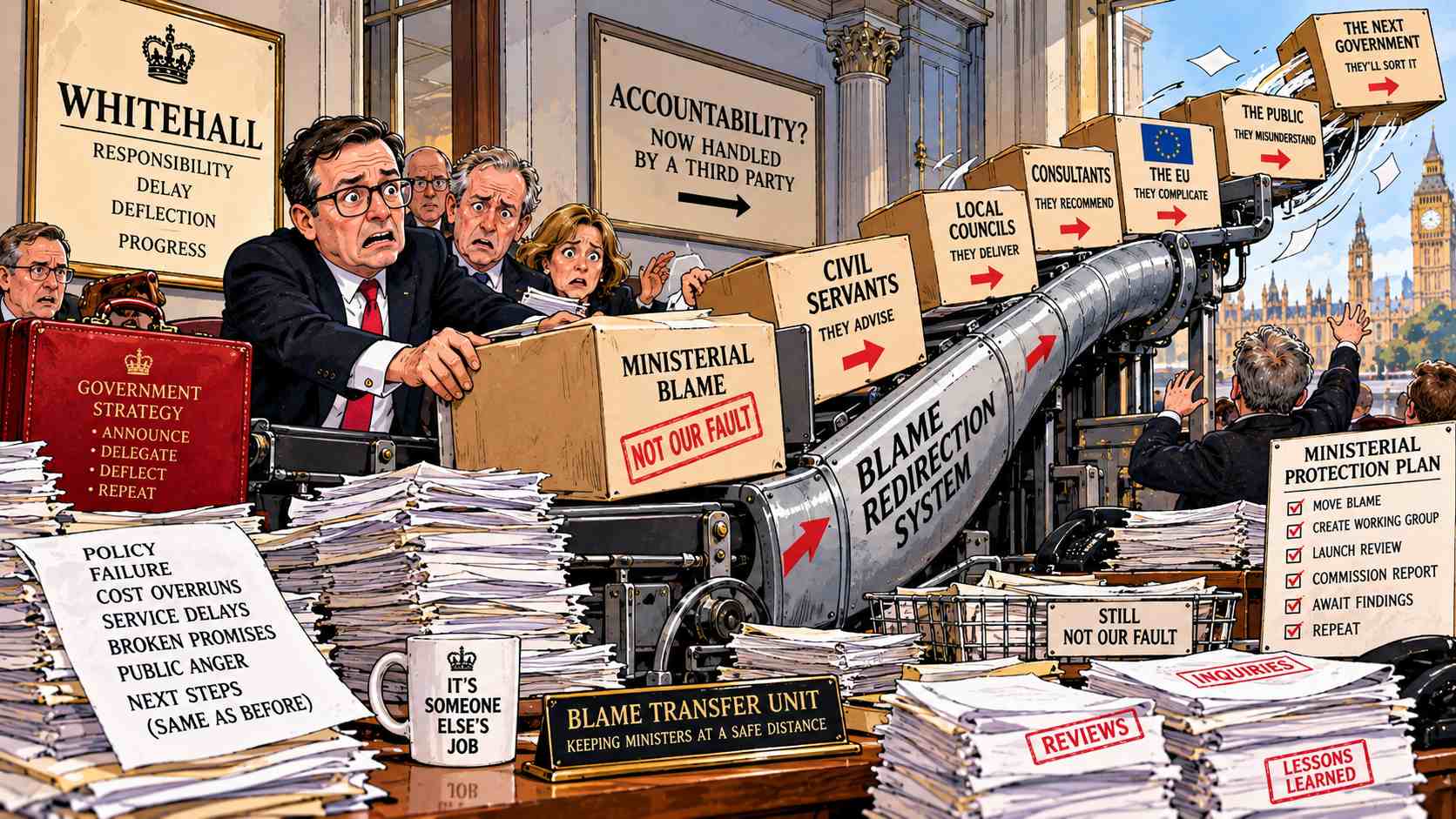
Devolution model offers local leaders greater freedom to explain the budget
WHITEHALL, LONDON - Officials responding to the childhood disparities examined by the Evening Standard have announced that decisions should be made closer to families, particularly decisions about which organisation will explain why the family is still waiting.
Putting Communities at the Heart of Policy
The new framework will place communities at the heart of policy by arranging a larger number of administrative boundaries around them. Residents will enjoy unprecedented proximity to the office referring them elsewhere.
"Local people know their areas best," a government spokesman said. "That is why we want them to understand every detail of the difficulties they will be responsible for managing."
Asked whether responsibilities would arrive with sufficient resources, he said funding was an important part of the conversation. The responsibilities, having completed their part of the conversation, were already on the van.
A Partnership Diagram With No Place for the Money
A council leader welcomed greater local discretion but requested a clear account of powers, money and obligations. Whitehall supplied a partnership diagram. It contained seventeen arrows, three concentric circles and no obvious place to enter an amount.
The leader said she was willing to be accountable for decisions she could make. A departmental official praised her commitment to accountability and suggested the discussion about decisions take place at a later meeting.
Parents struggled to follow the arrangements. Under the proposed model, one body would set priorities, another would commission, a third would coordinate and a fourth would assure. A mother asked which body would answer the telephone. The consultant indicated that operational questions belonged outside the diagram.
Local Decisions Without Local Powers
Devolution nevertheless has considerable appeal to residents who would like decisions made by people familiar with the place. The difficulties begin when familiarity is offered as a substitute for the practical ability to change anything.
"I know my kitchen very well," said father Gareth. "It does not follow that I can repair the boiler without tools, money or permission from the landlord."
The analogy was recorded as evidence of community insight. Officials declined to say which tier of government represented the landlord.
A second father asked who represented the plumber. An official replied that the plumber would be procured through a regional framework, subject to a business case, and was expected to arrive in the third year of the programme. Gareth said that was roughly what his landlord had told him too.
Questions about how funding is split between central and local government are examined by the Institute for Government and the Local Government Association, and the National Audit Office reports on whether devolved arrangements are working in practice. A parent suggested reading all three before the accountability map. She was told the map came with its own reading list.
The Accountability Map and How to Navigate It
A proposed accountability map will help residents identify the responsible institution. To use it, families must first identify the service, funding stream, geographic partnership and applicable transition arrangement. Parents lacking the necessary information may attend an introductory session on navigating the map.
Local philosopher Mavis Lane described the design as responsibility enjoying freedom of movement. "It travels downward very efficiently. Authority and resources appear to prefer a later train."
Families suggested a simpler public agreement: state what each organisation must provide, what resources it has and how residents can challenge failure. The proposal was welcomed in principle, the administrative location where promising ideas are stored without becoming obligations.
Ministers will launch the framework at a local venue to demonstrate their commitment to moving power out of Whitehall. After the photographs, they will return to London. Local leaders will remain to answer questions, thereby providing the first practical demonstration of the new settlement.
A spokesman for the department confirmed that no figure had been attached to the framework because the figure would depend on the outcome of local conversations. Local leaders confirmed that the conversations had not yet begun, because they were waiting for a figure.
Gareth said he would try to be patient. His boiler, he added, had a very strong view of its own about that. He has been given a leaflet on responsible energy use, a number for the landlord's agent and a diagram showing where the agent's agent works.
SOURCE: https://www.standard.co.uk/news/london/best-worst-places-london-children-grow-up-b1301437.html
Five Humorous Observations
- "Decisions closer to families." They mean the decision about who explains why you're still waiting. That decision's very close now. It lives next door. In a lovely office. With a very nice sign saying "Not Us."
- The responsibilities had finished their part of the conversation and were already on the van. That's what's great about responsibility, it travels light. The money's on a different van. Which broke down. In 2011.
- Seventeen arrows, three circles, nowhere to put a number. It's a diagram of a washing machine that doesn't have a hole for the clothes. But it spins beautifully.
- The dad knows his kitchen very well, but he can't fix the boiler without money and the landlord's permission. And the officials won't say which level of government is the landlord. Because it's always the landlord. It's always, always the landlord.
- Ministers launch it locally, take the photographs, and go back to London. Local leaders stay for the questions. That's devolution. They give you the power, take the picture, and leave you the stairs.
Responsibility for this disclaimer has been devolved to the reader, without the budget. Gareth, Mavis Lane and the accountability map are comic creations built on real reporting about childhood inequality in London. More political satire, plumber arriving in year three. https://prat.uk/?p=53874


Comments
Post a Comment