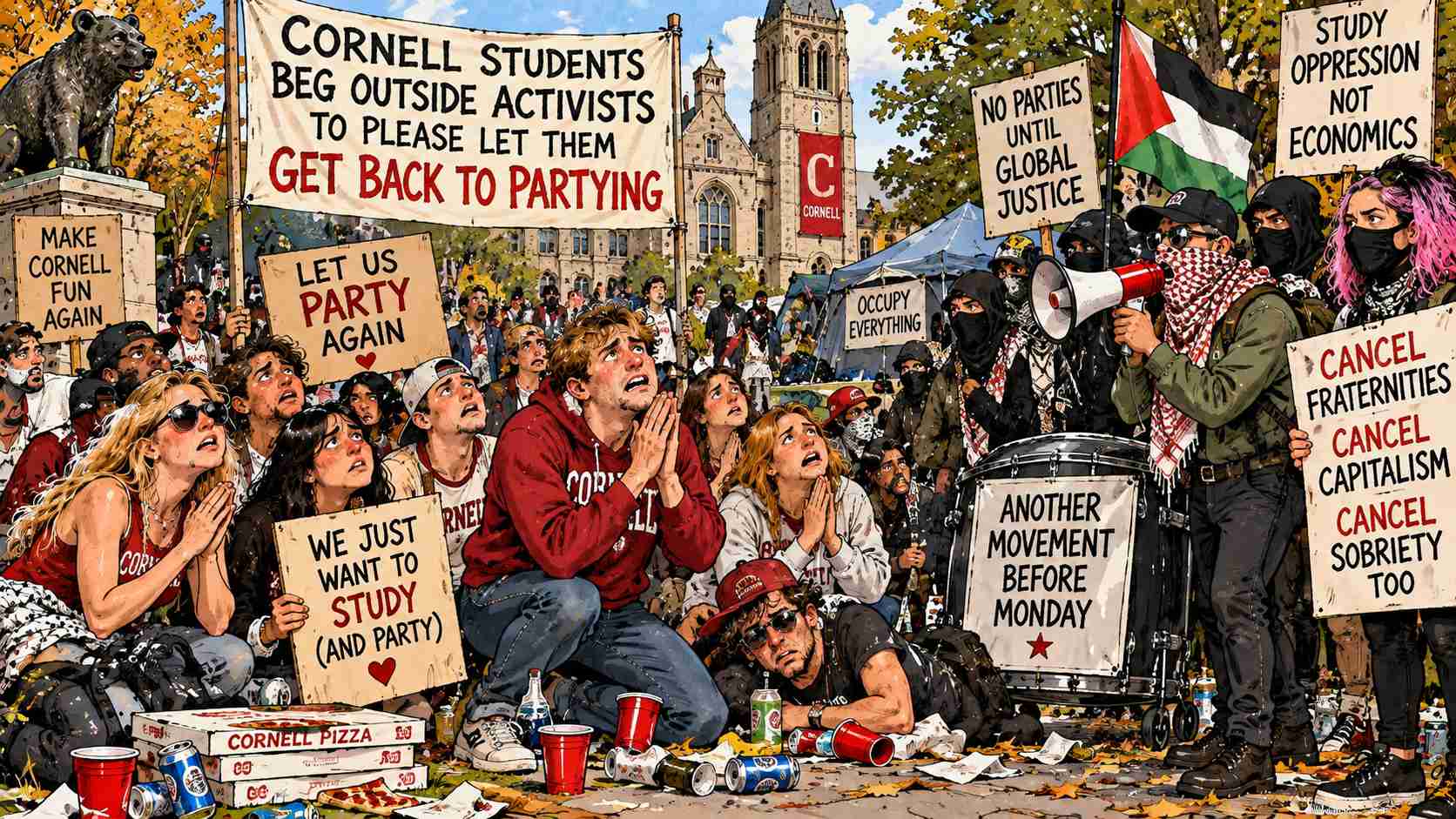
Cornell Students Beg Outside Activists to Please Let Them Get Back to Getting Hammered
Knackered undergraduates launch bold new movement demanding fewer movements, more revision and the restoration of the ancient right to waste a Saturday afternoon in bed
ITHACA, NEW YORK — Students at Cornell University have reportedly begun demanding something almost unheard of on the modern American campus: the chance to go back to being ordinary students.
That means a bit of revision, a lot more drinking, sleeping through alarms, moaning about the price of a sandwich and spending forty minutes choosing something on Netflix before nodding off nine minutes in. It's the great undergraduate tradition. We've all done it. Some of us went on to become Cabinet ministers.
Unfortunately, activists keep happening.
The latest Cornell demonstrations grew out of serious allegations about how the university handled a sexual-assault case, which is exactly the sort of thing that deserves proper scrutiny. But because this is America, and apparently no row is allowed to stay the size it was when it started, the whole business has now pulled in students, societies, local campaigners, social-media warriors and assorted people whose rucksacks hold more placards than textbooks.
The Guardian has tracked the escalating unrest in its report on the vandalism at a Cornell building and the student protests.
Meanwhile the independent Cornell Daily Sun reported that the October 5 demonstration was organised by 20 Cornell student organisations, which makes it a proper campus event. Twenty organisations. For comparison, that's about the number of societies at a British university that exist solely to hold a Wednesday-night quiz.
Then came the wonderfully modern twist.
The same paper reported that six social-media campaigners with no connection to Cornell were separately planning another rally for October 13. Cornell student organiser Spencer Krenk described it as organised by “outside influencers and not Cornell students.”
Somewhere in a hall of residence, a sophomore allegedly looked up from his calculus and asked the question that may define a generation:
“Hang on. We've got substitute protesters now?”
Thinking About Getting Hammered in the USA...
- Cornell students have finally found something harder to escape than a nine o'clock chemistry lecture: somebody else's protest timetable.
- The average undergraduate wants three things from university: a degree, a social life and plausible deniability about Saturday night.
- Staging a student uprising during fall break is wonderfully efficient, since nothing says mass movement like waiting until half the masses have gone home with their washing.
- Cornell students spent years dodging meetings, only to find that activists were booking extra ones on their behalf.
- The great campus divide may no longer be left versus right. It's people with megaphones versus people with midterms.
Cornell Students Ask for a Short Gap Between the Revolution and Beer Pong
Campus sources say most students hold the traditional undergraduate view that important issues deserve attention, provided the attention is finished by Friday teatime. Nobody wants to miss the weekend because they got stuck in a facilitated listening circle with a flip chart.
“It's been an emotionally draining few weeks,” said sophomore Nathan Brenner, an entirely representative imaginary undergraduate currently reading economics and leftover pizza.
“I support justice. I support accountability. I support peaceful protest. But I also bought twelve cans of hard seltzer on Thursday, and those have a shelf life somewhere between yoghurt and American democracy.”
Brenner said he first joined a march because a few mates were going. Standard procedure. It's how most of us ended up in the Young Conservatives.
Then someone handed him a placard.
Then somebody added him to a WhatsApp group.
Then that group became seven groups, one of which was named after a fruit for reasons nobody can remember.
“By Tuesday I was apparently on the Steering Committee for Transformative Institutional Structural Solidarity,” he said. “I've no idea what we steer. I haven't even got a car.”
That's the hidden cost of twenty-first-century activism. You start by pressing Like. Forty-eight hours later you're in charge of the folding chairs.
Outside Activists at Cornell: Scientists Discover a New Species, Activistus Externus
Political scientists have spent decades studying how networks, framing and outside organisations shape social movements. Normally this appears in books full of phrases like collective action and mobilisation structures, the sort of book you buy in September and sell back in December at a loss.
Cornell students have simplified the whole discipline. Their new taxonomy runs as follows:
Student: Has a lecture tomorrow.
Lecturer: Knows there's a lecture tomorrow and is somehow gloomier about it.
Community campaigner: Lives round the corner.
Outside activist: Discovered Ithaca had parking problems at lunchtime and had drafted demands by teatime.
The Cornell Daily Sun's reporting draws a vital distinction. The big October 5 rally was organised by actual Cornell student groups. The separate October 13 rally was first planned by unaffiliated social-media campaigners, and a student organiser publicly distanced Cornell groups from it.
That distinction matters.
It also makes for cracking comedy.
Because nothing says “Listen to student voices” quite like turning up from elsewhere with your own student voices in a carrier bag.
Cornell Fall Break Protest: A Rally for Students Who Aren't There
The best detail is the timing.
According to the Daily Sun, Krenk pointed out that the outside-organised October 13 protest fell when many Cornell students would be away on fall break.
You couldn't write that with a team of Oxford wits and a barrel of claret.
Imagine organising a rally on behalf of students during the one week designed to contain fewer students. It's like holding a dentists' conference at 3 a.m. in a tyre depot. The lack of dentists doesn't technically stop the conference. It just prompts follow-up questions, mostly about the tyres.
Cornell sociologists may eventually christen this Schrödinger's Student Movement: the students both represent themselves and aren't there until somebody opens the box. (Here's Britannica on Schrödinger's cat if you need a refresher. The cat, unlike the students, was at least in the building.)
Social Media Activism vs Old-School Agitprop: Uber for Outrage
Proper old-fashioned agitation took graft.
You needed printing presses.
Union halls.
Roneo duplicators.
Men in donkey jackets saying, “Comrade, the leaflets are coming Thursday.”
Today's organiser needs Instagram, Canva and the ability to say “We demand” without checking who “we” includes.
The internet has basically built Uber for political mobilisation. See controversy. Tap screen. Choose outrage level. Pick a font. Your activist arrives in twelve to eighteen minutes, and surge pricing applies during midterms.
None of this makes activism illegitimate. Outsiders have joined American causes for centuries, from abolition and the labour movement to civil rights and the environment. Even the Oxford Union, bless it, has spent two hundred years proving that plenty of people will turn up and shout about things that aren't their business. (Their website says it's about debate. Sure.)
But social media has stripped out the faff. Before, an outsider who wanted to reorganise Cornell had to travel to Ithaca, find out something about Cornell and talk to Cornell students.
Now step two is optional. Step three is a merch stall.
Cornell Students Discover Radical Concept Known as Homework
The emerging counter-revolution has reportedly adopted a dangerous slogan:
“Can everybody please shut up? I've got a test.”
Junior engineering student Lisa Park, another imaginary eyewitness speaking for millions of exhausted undergraduates, said she sympathised with calls for reform but feared activism was eating the semester whole.
“I've got thermodynamics at nine,” she said.
“Yesterday someone told me thermodynamics is actually bound up with institutional power structures.”
Park stared into the middle distance for several seconds.
“It's heat,” she eventually said. “It goes from the hot thing to the cold thing. That's it. I've been crying about it since August.”
University officials immediately set up a committee. Its report is expected shortly after Park graduates, possibly in a different decade, probably with a Latin title.
When Campus Protests Expand to Cover Everything, Including Bolivian Lithium
Here's another marvellous feature of modern political movements.
A row begins with one specific question. Then political gravity takes over.
Soon the protest covers sexual violence, university governance, policing, capitalism, foreign policy, historical injustice, climate change, labour relations, tuition fees, colonialism and whether the campus Starbucks properly acknowledges indigenous land.
Eventually every protest becomes a complete theory of civilisation.
You turn up protesting administrative misconduct. Three hours later somebody wants to know where you stand on Bolivian lithium extraction.
“I haven't done the reading,” said one terrified fresher.
That answer instantly qualified him for a senior role in university administration. Corner office. Reserved parking. Never has to finish anything.
Why Getting Hammered Is Now the Moderate Political Position on Campus
For decades, Telegraph columnists complained that students spent too much time drinking.
We owe them an apology.
Compared with political mobilisation, getting hammered is remarkably peaceful. Nobody at a fraternity party has ever cornered another guest by the keg and said, “Before you go, we'd like your signature on our twelve-point framework for institutional transformation.”
The keg doesn't demand structural change.
The keg has one policy.
Gravity.
Students increasingly appreciate the elegance of this philosophy. Campus moderates are said to be forming a new movement called Students for Returning to Normal Student Nonsense, which nobody can abbreviate and everybody agrees is perfect.
Their manifesto has five demands:
Do the homework.
Go to the hockey.
Eat something regrettable at half one in the morning.
Ring your mum on Sunday.
Pretend everything is under control.
Political consultants call it the most realistic five-point programme in American higher education since 1963. Two of the five were already happening before the movement was announced, and a third is mostly a lie told to Mum.
The Outsider Paradox: Who Actually Speaks for Cornell Students?
There's nothing sinister about outsiders joining a cause. Sometimes visiting campaigners bring attention, expertise and money. Sometimes students welcome them. Sometimes movements grow stronger for the solidarity.
But outsiders hit an awkward philosophical snag when they start claiming to represent the people who actually live at the institution.
Say students tell an outside organiser, “Thanks for the support, but that's not our rally.”
The organiser has two options.
Listen to student voices.
Or explain to the students why listening to student voices requires the students to listen to the organiser.
At that point activism enters its Möbius strip phase. One side, one edge, no way out. Everybody empowers everybody against everybody else's wishes, and somewhere a postgraduate gets the bill for the poster board.
Cornell's Quiet Hour Compromise: A Proposed Protest Timetable
Satirical sources inside the administration say Cornell is weighing a compromise.
From 2 p.m. until 4 p.m. every day, students may protest.
From 4 p.m. until 6 p.m., administrators may apologise.
From 6 p.m. until 8 p.m., outsiders may demand systemic transformation.
At 8.01 p.m., everyone goes home because somebody has organic chemistry.
Emergency megaphone exemptions will be available from the dean's office, subject to seven forms, three references and one diversity impact statement explaining why the shouting has to happen tonight rather than Thursday. Approval takes six to eight weeks, by which time the protest will be over and the megaphone will have graduated.
Students overwhelmingly like the idea.
In a thoroughly fabricated Bohiney Institute survey of 1,204 Cornell undergraduates plus one barman who seemed oddly well informed, 84% said they backed the right to peaceful protest, 79% supported serious institutional accountability and 93% wanted somebody else to organise it because they had plans on Friday.
The remaining 7% were already making placards. Two had misspelt “accountability.”
America's Universities Rediscover Their Original Product: Education
Cornell was founded as a university.
This obscure historical fact deserves renewed attention.
Universities used to sell education. Lately they've diversified. They now offer education, politics, social-media content, ideological theatre, internal investigations, emergency statements and enough committees to run a small Scandinavian country.
Students, meanwhile, stubbornly keep turning up expecting lectures.
Some even study.
Researchers have confirmed isolated sightings. One sophomore was reportedly seen reading an entire chapter without simultaneously drafting a statement condemning anybody. Experts at first thought the photograph had been doctored. A second team suspected a very good fancy-dress costume.
Cornell Students Finally Occupy the Library
By Thursday evening, hundreds of Cornell students had reportedly launched their boldest protest action yet.
They occupied the library.
Then they sat down.
Then they opened books.
Administrators panicked. Security staff approached cautiously, the way you'd approach a fox holding a sausage roll.
“What are your demands?” an official whispered.
“Quiet,” replied 300 students in unison.
Outside activists immediately announced a solidarity rally.
Students locked the doors.
10 Humorous Observations About Cornell's Campus Protest Circus
- Every protest eventually reaches the stage where the original grievance has picked up six extra causes, four acronyms and somebody demanding the nationalisation of the vending machines.
- You can spot an outsider at once, because outsiders still have the energy to stand around for four hours.
- A genuine student protester carries a rucksack, a phone charger and a creeping dread about an unfinished essay. The professional arrives with laminated signs.
- Cornell students protesting Cornell is campus politics. Somebody finding Cornell on Instagram on Tuesday and issuing demands on Wednesday is Deliveroo activism.
- Nothing kills a spontaneous grassroots movement faster than discovering the grass has a head of communications.
- Students came to Ithaca for intellectual stimulation. Nobody told them they'd spend sophomore year finding out who authorised the megaphone.
- The outside activist's natural predator is the student who says, “Actually, we didn't ask you to speak for us.”
- College administrators spent decades encouraging civic engagement and are now discovering it has no closing time.
- Organisers assume every student wants social transformation. Some would settle for the dining hall keeping the mozzarella sticks out after ten.
- Cornell's most radical emerging faction may be students demanding the revolutionary right to go to class, get plastered on Friday and moan about tuition fees in private.
Satire Disclaimer
This is satire. The underlying Cornell controversy, the allegations of sexual assault and the questions around university procedures are serious matters. Anyone affected can find support through RAINN in the United States or Rape Crisis England & Wales in the UK. The exaggerated characters, dialogue, polls, committees and revolutionary mozzarella-stick movement above exist for comic purposes only. The distinction between genuine Cornell student organising and separately organised outside advocacy rests on published reporting, including the Cornell Daily Sun's report that 20 student organisations planned the October 5 rally while six social-media campaigners unaffiliated with Cornell separately organised another event.
SOURCE: The Guardian https://prat.uk/cornell-students-say-to-outside-activists/


Comments
Post a Comment