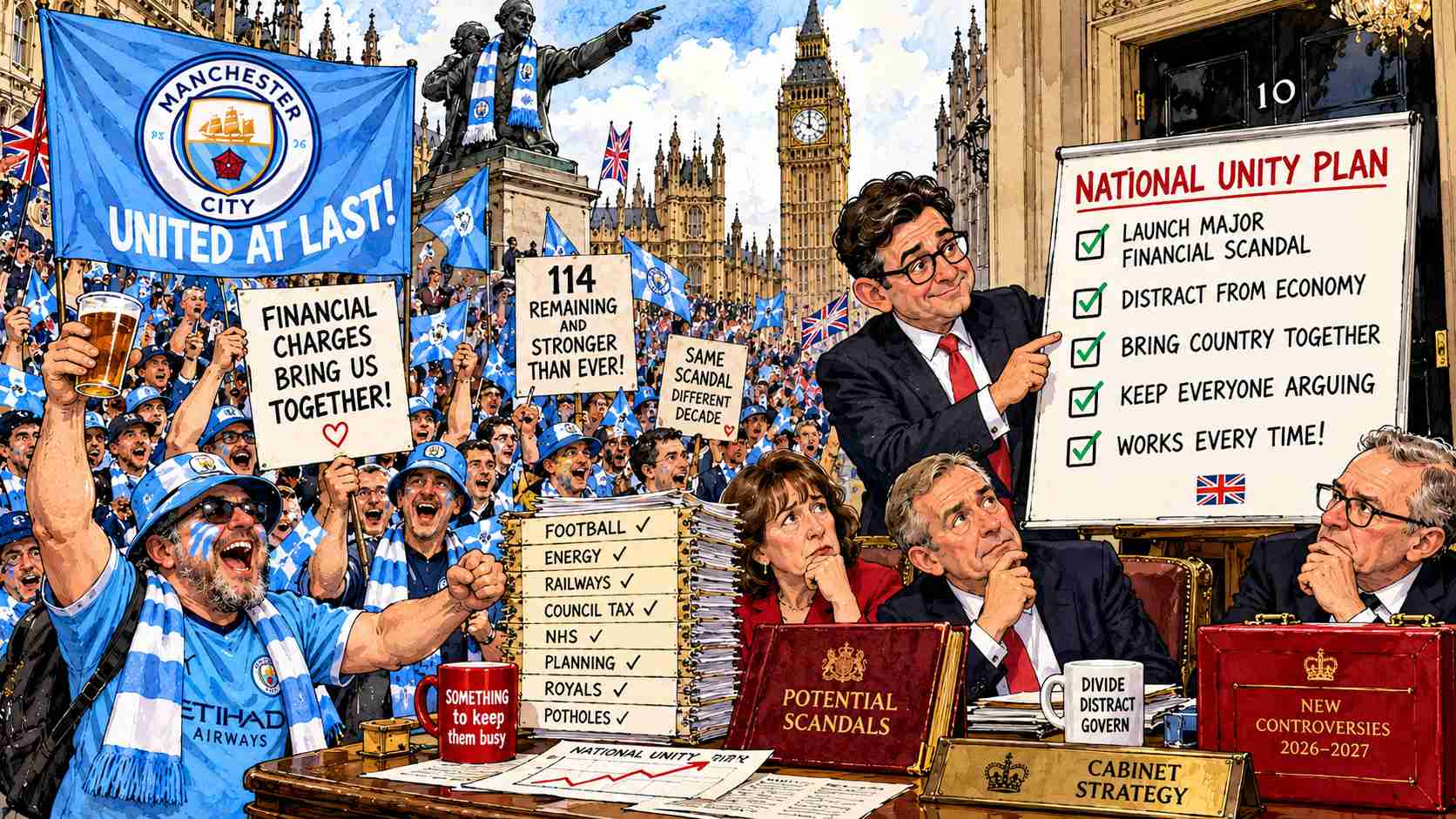
Britain's wealthy football clubs celebrate the principle that everybody is equal before the law, although some organisations can afford to employ an entire legal department to establish what the word "everybody" means.
MANCHESTER, ENGLAND, October 17, 2026. Manchester City have presented British political scientists with a fascinating question about the meaning of equality after appealing an independent commission's findings that the club seriously breached financial regulations over nine seasons.
According to the Premier League's official September 29 decision, the commission concluded that commercial arrangements artificially increased reported revenues and reduced costs by more than £900 million. The club maintains that the findings contain material errors and has appealed.
The case has prompted renewed debate over whether financial rules apply equally to every football club or whether equality should be interpreted according to the size of the organisation's legal department.
Legal philosophers have long argued that justice must be blind.
Modern football has introduced an important refinement: justice may be blind, but she can still recognise the sound of a very expensive solicitor entering the room.
Premier League Financial Rules: The Magnificent Equality of Rich and Poor Football Clubs
The Premier League requires clubs to comply with financial regulations designed to maintain the integrity and sustainability of the competition.
In principle, these requirements apply to everybody.
In practice, the process of determining whether they have been followed can involve thousands of pages of legal submissions, expert testimony, disputed commercial valuations and enough accounting terminology to render an ordinary taxpayer unconscious.
A small football club struggling to pay its electricity bill may regard financial compliance as a relatively straightforward exercise.
Money arrives. Money leaves. If more money leaves than arrives, the chairman develops a nervous condition.
A wealthy football club has additional options.
Its representatives can explain the philosophical complexity of commercial sponsorship, the economic implications of international branding, the historical development of football ownership and why the absence of a suitable definition of income makes the entire concept of accounting unnecessarily restrictive.
By the time the explanation is complete, everyone involved has forgotten what the original question was.
A small businessman in Manchester expressed admiration for the system.
"When HMRC asks me why my accounts don't balance, they send a letter. Apparently I should have appointed forty lawyers and argued that the definition of balance is open to interpretation."
The businessman is now considering rebranding his plumbing company as an international sporting institution.
His first sponsorship arrangement will involve a wealthy uncle paying £50,000 for the privilege of having his name printed on a spanner.
Manchester City's £900 Million Finding Becomes a Question of Perspective
The commission's findings concerning more than £900 million have created an exciting opportunity for economists to reconsider the relationship between money and reality.
Traditionally, income is money received in exchange for goods, services or other legitimate transactions.
Expenses are money spent.
Profit is what remains after subtracting expenses from income.
This simple arrangement has caused considerable inconvenience to governments, football clubs and anyone hoping to appear wealthier than the contents of his bank account would suggest.
A new school of financial thought proposes eliminating the inconvenience by allowing organisations to determine their income according to how rich they feel.
A man earning £30,000 annually could report an income of £300,000 if he believed his personal brand possessed significant international marketing potential.
A struggling restaurant could declare itself worth £40 million because the owner's cousin had once mentioned that the chips were excellent.
A government could announce that the national debt was actually a national asset because future generations would inherit the valuable experience of paying it off.
The upside would be huge.
Britain would become the richest nation on Earth by Wednesday, provided nobody attempted a withdrawal.
The Lawyer-to-Justice Ratio
Researchers examining modern legal systems have proposed a new statistic called the Lawyer-to-Justice Ratio.
The formula measures the number of legal representatives employed by an organisation divided by the probability that anyone involved will understand the final decision.
For a small business appearing before a local tribunal, the ratio might be one lawyer to three comprehensible sentences.
For a billion-pound football institution, the ratio can expand until the written judgment weighs more than the stadium roof.
The Manchester City commission held a 42-day hearing that concluded in December 2024. The Premier League says the evidence transcripts extended to approximately 7,000 pages.
Seven thousand pages.
That is considerably more reading than most British politicians undertake between general elections.
A university professor calculated that an ordinary football supporter attempting to read the entire record would have to give up watching football, going to work and occasionally speaking to his family.
Even then, he might struggle to explain the difference between beneficial ownership and a questionable sponsorship agreement.
Fortunately, supporters have developed a more efficient legal process.
If the findings concern Manchester United, read every page.
If they concern Manchester City, read the league table.
Manchester City's Appeal Becomes Britain's Most Popular Sporting Competition
Manchester City's official appeal statement says the commission's decision contains serious errors and maintains the club's innocence. The appeal process is ongoing, with a hearing expected by mid or late January.
Football supporters have responded by treating legal proceedings as another European competition.
The independent commission has completed the first leg.
Manchester City are contesting the result in the second leg.
The lawyers have requested additional time, the accountants are examining goal difference, and the supporters want to know whether away findings count double.
There is even discussion of appointing a referee to decide whether the appeal board has remained sufficiently neutral.
Any decision against City would be reviewed by VAR, followed by a demand that the VAR officials themselves undergo an independent investigation.
Should the club succeed in its appeal, rival supporters would immediately question the competence of the appeals process.
Every possible outcome therefore guarantees another competition, another argument and more legal expenses.
Football has finally discovered a tournament in which the lawyers always qualify for the next round.
Westminster Recognises a Familiar System of Rules, Exceptions and Appeals
British politicians have long admired the benefits of complicated regulations.
Rules demonstrate that the government is taking a problem seriously.
Exceptions demonstrate that the government understands commercial realities.
Appeals demonstrate that the government respects procedural fairness.
And prolonged uncertainty demonstrates that everyone involved can continue receiving a salary while nothing is resolved.
A Treasury adviser has suggested that all future financial regulations should contain a special provision allowing sufficiently wealthy organisations to challenge the definition of each individual word.
The phrase "pay your taxes" could occupy an entire parliamentary session.
The word "your" alone might require three constitutional lawyers, two economists and a consultation lasting until Christmas.
Smaller taxpayers would retain the existing procedure of paying immediately.
This would preserve equality before the law while reducing the administrative burden on people wealthy enough to challenge it.
Manchester City's eventual legal outcome remains undecided. Football's governing authorities must still determine sanctions, subject to the continuing process.
One principle, however, appears secure.
In Britain, everybody gets their day in court.
Some people simply have enough money to turn it into an entire season.
Five Humorous Observations
- Seven thousand pages. I've never finished a book with a hundred and fifty pages and a dragon on the cover. And these people want me to read seven thousand about sponsorship.
- Justice is blind but she can hear a very expensive solicitor coming. It's the one bit of the process everybody believes. A solicitor walks into a room like a cheque.
- My plumber asks for fifty quid and a cup of tea. These lads say income is how rich you feel. Well, I feel loaded. Hello, bank, I feel loaded, I'd like to make a withdrawal.
- The appeal's a second leg. Then VAR. Then an investigation into VAR. It never ends. Somewhere there's a bloke whose whole job is checking the people checking the people checking the lines.
- "Pay your taxes." Three constitutional lawyers on the word "your." I'd pay to see that. Honestly, "your" is the most dangerous word in the language. Ask anyone who's shared a fridge.
This article is a work of satire. Government programmes, parliamentary proposals, pub conversations, characters and humorous quotations are satirical constructions, not actual announcements or recorded testimony. Manchester City denies wrongdoing and has appealed the commission's findings. Our legal department, which consists of one intern and a library card, has approved this disclaimer; readers with larger legal departments may lodge an appeal via our guide to news satire sites. https://prat.uk/?p=52812


Comments
Post a Comment