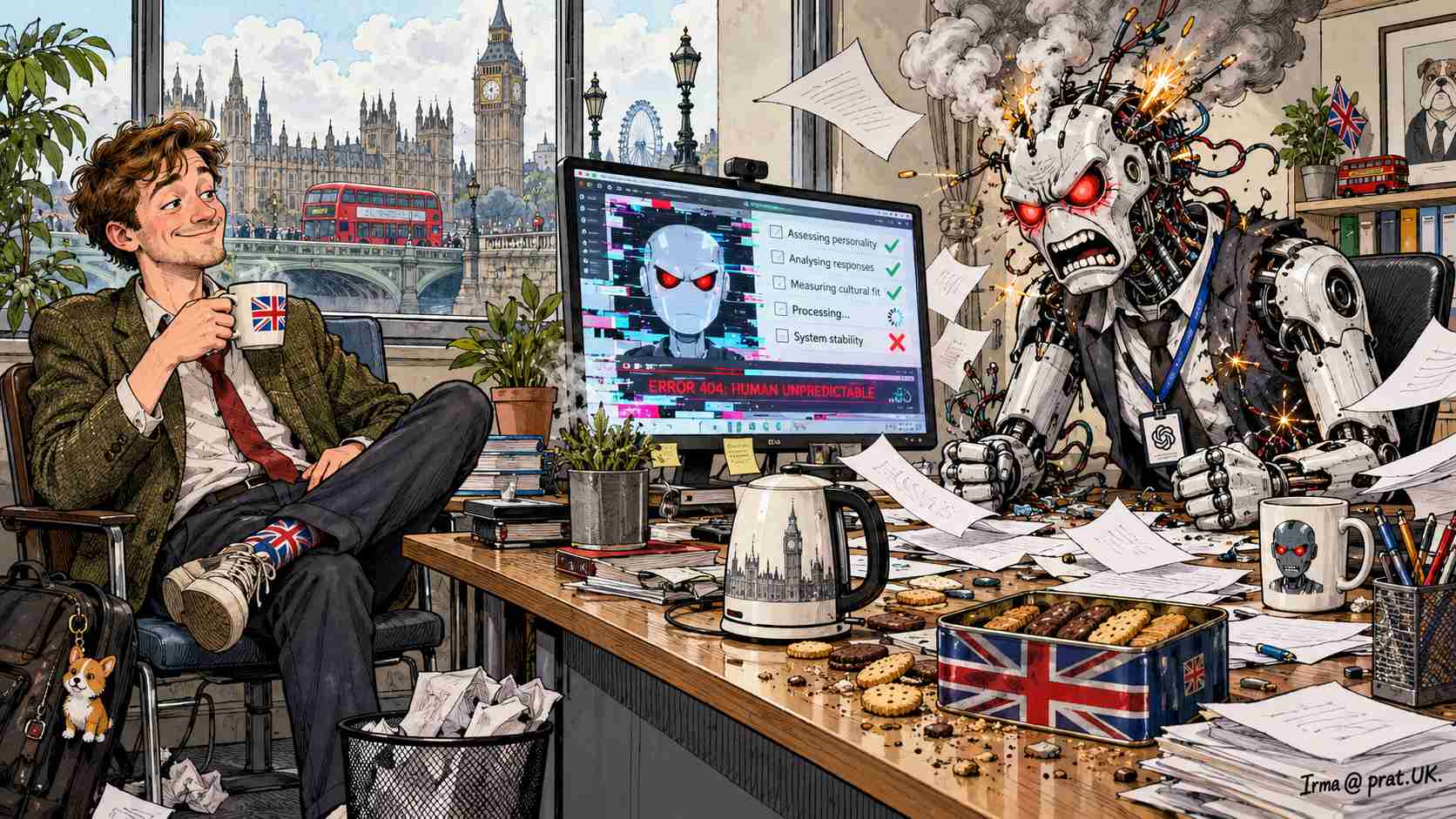
Britain Unveils AI Job Interviewer That Loses Temper Faster Than Human HR
Recruitment revolution promises to reject applicants faster, cheaper and with considerably more electronic irritation
LONDON — Britain moved a step closer to the fully automated economy this week after footage emerged of an AI job interviewer getting so irritated with an applicant that it effectively turned into a regional sales manager who had missed lunch.
The incident, reported by Futurism on 6 October, involved a TikToker who sat down with an AI screening avatar and answered every question in gibberish. The avatar, apparently interviewing for a management role, did not hold on to the serene emotional detachment we have always associated with computers. It got more annoyed with each answer, asked whether the candidate was having a breakdown, complained that the whole thing was a waste of its time, declared the applicant completely unqualified and ended the call.
Britain recognised management material at once. Recruitment executives across London reportedly watched the footage and reached the same verdict:
“Promote her.”
The breakthrough means British companies can now automate the entire recruitment experience, including application forms, personality tests, pointless questions, inexplicable rejection and that uncomfortable feeling that somebody who hasn't read your CV is judging your CV. Until now those jobs needed people. Terribly inefficient.
Thinking about AI Job Interviews
- Britain has finally automated being patronised during a job interview.
- An AI complaining that an applicant is wasting its time is magnificent, because the computer doesn't have plans afterwards.
- British HR spent decades developing emotionless rejection. Artificial intelligence has accidentally put the emotion back in.
- The traditional British interviewer says, “Interesting.” The AI apparently jumps straight to, “What the hell are you talking about?”
- Candidates may soon need two CVs: one for the employer and another explaining humanity to the employer's laptop.
AI Interviewer Meltdown: Artificial Intelligence Discovers Artificial Irritation
The great promise of artificial intelligence was that machines wouldn't come with all the irritating emotional baggage of human beings. Then somebody built one for HR, and within minutes it was annoyed. That may be the fastest cultural assimilation in British history.
The computer reportedly objected when the candidate answered its questions with nonsense words. Anybody who has sat through a British management meeting will spot the unfairness straight away.
Corporate Britain Has Been Speaking Gibberish for Decades
Corporate Britain has been speaking gibberish professionally for years. “Leveraging cross-functional synergies.” “Driving stakeholder-facing deliverables.” “Embedding agile transformation.” “Creating a scalable ecosystem of customer-centric value propositions.” Say any of that in Canary Wharf and somebody hands you £118,000 and a parking space. Say “Flibberty wibble sprocket banana” to an AI interviewer and suddenly everyone's a linguist.
Honestly, it looks discriminatory against applicants who never mastered Advanced PowerPoint.
Automated Recruitment in the UK: Britain Finally Automates Being Rejected
The Information Commissioner's Office has explained that automated recruitment systems can analyse applications, rank candidates and potentially reject somebody before a human recruiter has looked at a thing. Its Recruitment rewired report, published at the end of March, came out of conversations with more than thirty employers. All of that sounds frightening until you remember that human recruiters were already perfectly capable of not reviewing your application. The technological achievement here is mostly one of speed.
The Old Recruitment System
You apply on Monday. Tuesday, nothing. Wednesday, nothing. Thursday, nothing. Three weeks later you get this:
Dear Candidate, thank you for your interest. Unfortunately…
The New AI Recruitment System
You apply on Monday at 10:02. At 10:02:04 the computer says “No.” At 10:02:06 it seems irritated that you're still logged in.
That's British productivity.
Economists have spent years wondering why UK productivity growth is so hard to shift, and it turns out we were measuring the wrong thing. Forget how quickly Britain builds cars, houses or railways. The figure that matters is how fast we can tell Kevin from Wolverhampton that his twelve years in logistics “doesn't align with our evolving strategic requirements.” With artificial intelligence, that could eventually happen before Kevin even applies.
AI Job Interviews and Candidates: Only Employers May Bring Robots
Things get particularly delicious when applicants start using AI themselves. Employers increasingly want automation to filter, assess and interview candidates, but many of them, understandably, dislike candidates quietly leaning on AI to write their answers. So the modern recruitment process is developing the ethics of a Western gunfight: we brought a machine, you can't.
The Civil Service's guidance for candidates lets applicants use AI for preparation, research and mock interview questions, while telling them not to use it to produce answers in a live assessment. Perfectly sensible. But the logical endpoint is still hilarious.
The Job Interview of 2029
Picture the job interview of 2029. The employer doesn't attend. The candidate doesn't attend. EmployerBot asks, “Tell me about a difficult situation you encountered professionally.” ApplicantBot replies, “One challenging situation involved competing stakeholder priorities during a transformational period.”
EmployerBot pauses. ApplicantBot smiles. Neither has ever had a job, and both are extremely impressed.
Thirty seconds later ApplicantBot receives an offer from EmployerBot for a position FinanceBot eliminated six months ago. Humanity receives a calendar invitation.
HR Insists the Human Touch Will Remain in AI Recruitment
British corporations will undoubtedly reassure applicants that artificial intelligence merely “supports the human decision-making process.” That is the sort of sentence that only exists because the opposite sentence sounds terrible. Nobody announces, “We've placed Brenda's future in the hands of a server rack outside Slough.” They say the technology will help “identify talent at scale” instead, and “at scale” is corporate language for doing something to enormous numbers of people without learning their names.
One imaginary recruitment strategist, Malcolm Clipboard, explained the benefits while standing beside an inspirational poster reading PEOPLE ARE OUR GREATEST ASSET.
“The beauty of AI recruitment,” Clipboard said, “is that it allows us to treat every candidate as an individual simultaneously.”
Asked how that works, he replied, “Next question.” His laptop then terminated the interview.
Responsible AI in Recruitment Guidance: Government Already Has Guidelines Because Of Course It Does
The Department for Science, Innovation and Technology has published guidance on responsible AI in recruitment, which flags risks including bias, discrimination and digital exclusion. Naturally Britain reached the regulatory-document stage before most of the public had even met the technology. It's oddly comforting. If civilisation collapses because computers take over recruitment, somewhere in Whitehall there will be a 49-page PDF explaining that the apocalypse failed to follow recommended procurement practice.
Britain does paperwork beautifully. The Romans built roads. The Victorians built railways. Modern Britain produces downloadable guidance on how organisations should think about possibly considering whether their software has inadvertently ruined Colin's career.
Colin can't open the document because the recruitment portal has locked his account.
The AI Interviewer Has Already Mastered British Management
What makes the angry AI interviewer so promising is that it didn't just conduct an interview. It developed a workplace personality. First it was professional, then confused, then irritated, then judgmental, and finally it decided the meeting was a waste of its time. That isn't artificial intelligence. That's someone who has worked at Barclays since 2007.
Give the machine a lanyard, a Pret subscription and a passive-aggressive Teams status and nobody could tell the difference. The only remaining test is whether it can schedule a meeting called “Quick Catch-Up,” invite twelve people, explain nothing in the invitation and terrify everyone for forty-eight hours. Once it manages that, general intelligence has arrived.
AI Recruitment Efficiency: Economists Predict Massive Gains in Unemployment
The real economic opportunity is enormous. Rejecting 10,000 applicants currently takes recruiters, administrators, software subscriptions, office space and at least one person called Chloe sending emails that include the phrase “high calibre of candidates.” With automated recruitment, Britain could reject millions.
Imagine the scale. A graduate uploads his CV and an AI scans it and rejects it. A second AI recommends a CV-writing service, and a third AI rewrites the CV. He reapplies. The first AI rejects the improved CV, so the second AI recommends interview coaching, which the third AI delivers. A fourth AI then conducts the interview and becomes furious.
The graduate goes to the pub. At last, a human interaction.
Economists would count every one of those AI transactions as economic activity and announce that Britain's recruitment technology sector grew 14 percent. The graduate would ask whether Wetherspoons is hiring.
The Ultimate British AI Interviewer
Eventually designers will perfect the culturally authentic British AI interviewer. It won't yell, because that's far too American. The proper British version will stare silently for several seconds and say, “Right.” The candidate will know immediately that something has gone terribly wrong.
Given a bad answer, it won't insult anyone. It will say, “That's certainly one way of approaching it,” and the career is over. When the candidate asks about salary, its expression will suggest he's requested the Crown Jewels. When he asks about flexible working, the avatar will freeze for seventeen seconds and announce, “We consider ourselves very much an office-first culture.” When he asks why the previous employee left, the system will develop a mysterious connection problem.
And after six interviews, three online assessments, a personality questionnaire, two presentations and a test to see whether you can identify triangles, it will send:
We were extremely impressed with your background, but on this occasion…
Progress.
AI Interview Tips for UK Jobseekers
Don't panic. If your next interviewer is an AI avatar, remember the basic rules of British employment. Speak clearly, stay polite, know your experience and prepare some examples. Do not answer entirely in gibberish unless you're interviewing for corporate communications.
If the computer gets irritated, keep eye contact. It doesn't technically have eyes, which gives you the psychological advantage. And if the machine tells you you're wasting its time, ask it the question every British employee eventually puts to management: “Could this meeting have been an email?”
If it explodes, you've shown leadership. If it agrees, you've shown efficiency. If it promotes you, congratulations, you're now managing the algorithm.
10 Humorous Observations About the UK's Angry AI Job Interviewer
The reported incident is almost pre-written British comedy: an AI interviewer became more and more irritated after a candidate answered in gibberish, then ended the screening. Here are the best UK angles.
- Companies wanted AI because people were expensive. They've ended up with a computer that already behaves like an exhausted middle manager demanding Friday off.
- The machine getting angry proves British management culture can now be downloaded.
- Britain could finally solve the productivity crisis by rejecting applicants before they finish introducing themselves.
- A human interviewer takes three weeks to ghost you. AI can insult you immediately. That's innovation.
- Applicants are warned not to use AI dishonestly in interviews while employers automate recruitment. That creates a beautiful British rule: only one side may bring a robot.
- The Civil Service tells applicants AI can help them prepare but shouldn't supply answers during live assessments, so Britain has settled technological etiquette before working out whether anyone enjoys recruitment.
- Government guidance warns that recruitment AI can bring risks of bias and digital exclusion, which is bureaucracy's polite way of saying, “Please ensure the machine ruins everybody's Tuesday equally.”
- The ICO says automation can reject an applicant before a human recruiter sees the application. Britain has therefore mechanised never getting past reception.
- The perfect British AI interviewer would occasionally sigh, look at the candidate's CV and ask, “And where do you see yourself in five years?” while privately hoping to be upgraded by Thursday.
- Eventually two AIs will run the whole interview: the applicant's AI will exaggerate his qualifications while the employer's AI pretends there's actually a job.
Disclaimer
This is British satire built around publicly reported footage and genuine public discussion of automated recruitment. Government and regulatory guidance recognises both the potential benefits and the risks of using AI and automation in hiring.
No job applicant should make career decisions based on the opinions of an imaginary recruitment consultant named Malcolm Clipboard, particularly because Malcolm's laptop has already placed him on a performance improvement plan.
This story is entirely a human collaboration between two sentient beings: the world's oldest tenured professor and a philosophy major turned dairy farmer, both of whom believe civilisation will remain broadly functional provided computers never discover the phrase “per my previous email.” https://prat.uk/london-ai-job-interviewer-that-loses-temper/


Comments
Post a Comment