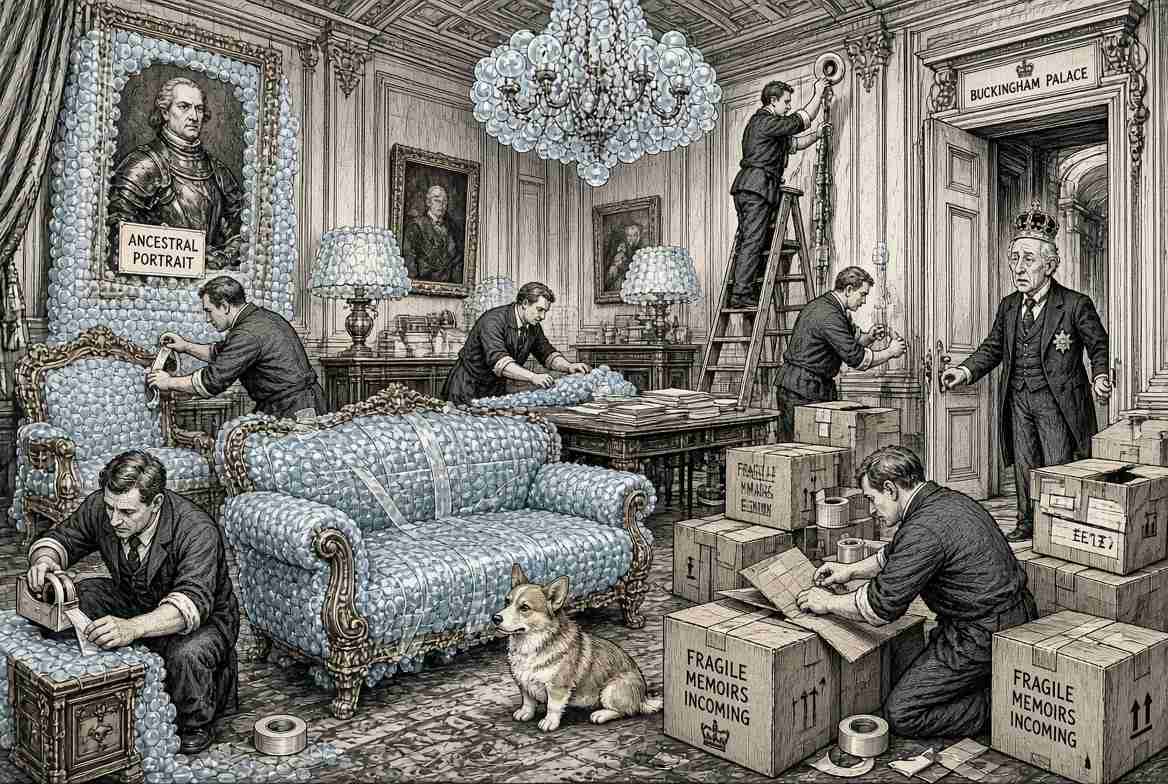
King Charles ‘Bracing for Worst’ Over Diana Memoir Swan Song as Palace Staff Begin Bracing the Furniture
Monarch Discovers Britain’s Most Dangerous Weapon Is Apparently a Relative With a Publishing Contract
LONDON — King Charles III is reportedly confronting one of the gravest threats to the British monarchy since somebody first realized castles have doors: a member of the extended family has written things down.
Charles Spencer’s new memoir, Swan Song: Diana, My Sister, was published September 22 and recounts his relationship with Princess Diana, her marriage, her death, and the extraordinary week surrounding her funeral. The publisher describes the 384-page book as Spencer’s account of Diana’s life from the perspective of her brother.
Which explains why Buckingham Palace has reportedly entered DEFCON TEAPOT.
Diana Memoir Swan Song
- Buckingham Palace apparently treats a memoir the way ordinary people treat a hurricane warning: secure the windows, charge the phones, and move the good china upstairs.
- The terrifying weapon threatening the monarchy is not a revolution. It is a relative who remembers things.
- Royal families spend centuries preserving history, then become alarmed whenever somebody reads it aloud.
- Britain does not need reminding about Diana. Britain remembers Diana more reliably than it remembers where it put Northern Ireland policy.
- King Charles allegedly needs to “brace himself,” suggesting somebody at the Palace has finally discovered the emotional purpose of upholstery.
Buckingham Palace Activates DEFCON Teapot: Staff Ordered to Brace Everything
Palace staff have allegedly been instructed to brace everything.
Chairs.
Tables.
Sideboards.
Ottomans.
The little footstool nobody knows whether Camilla actually uses.
One aide was reportedly discovered hugging a Georgian writing desk while whispering, “Steady, old boy. Chapter Nine is coming.”
This is Britain, after all. National emergencies are handled according to severity.
Level One: Make tea.
Level Two: Close the curtains.
Level Three: Make stronger tea.
Level Four: Tell everyone that His Majesty is “mindful.”
Level Five: Somebody publish a photograph of a corgi.
The terrifying thing about Charles Spencer is that he possesses the one weapon Buckingham Palace has never successfully neutralized:
Memory.
Not missiles.
Not tanks.
Not republicanism.
Memory.
Worse, he has apparently combined memory with paragraphs.
Royal Family Discovers History Gets Dangerous When Bound in Hardcover
For centuries the British monarchy has carefully preserved history.
It maintains archives.
Ceremonies.
Portraits.
Documents.
Castles.
Regiments.
Genealogies reaching back approximately to the afternoon God finished creating Kent.
Then somebody writes a memoir and suddenly the Palace reaction becomes:
“Good heavens. Who authorized history?”
Spencer’s book revisits Diana’s childhood, marriage, global celebrity, death and funeral.
The monarchy therefore faces the horrifying possibility that British citizens might remember Princess Diana.
Researchers at the entirely unofficial Royal Institute of Things Everybody Already Knows conducted an emergency survey of 1,000 Britons and reportedly asked:
“Do you remember Princess Diana?”
Ninety-eight percent answered yes.
One percent answered, “Of course.”
The remaining one percent was Prince Andrew’s communications department, which declined to comment.
The findings devastated Palace strategists who had apparently been relying on Britain eventually confusing Diana with a motorway service station.
Did King Charles Say Britain Would Forget Princess Diana “Soon Enough”?
Among the most reported passages in Spencer’s book is his allegation that, during an argument following Diana’s death, the then Prince Charles said words to the effect that people would eventually forget her.
Buckingham Palace has challenged Spencer’s account, saying grief can affect memory and judgment.
This leaves Britain facing one of history’s great unresolved questions:
Would Britain forget Princess Diana?
We now have nearly three decades of observational data.
There have been books.
Documentaries.
Television dramas.
Magazine covers.
Anniversary specials.
Podcasts.
Biographies.
Exhibitions.
Auctions.
Photographs.
Commemorations.
And enough royal analysis to power the BBC until approximately 2147.
Britain has forgotten plenty of things since 1997.
Britain has forgotten governments.
Britain has forgotten cabinet ministers.
Britain has forgotten where several billion pounds went.
Britain has occasionally forgotten how trains work.
But Diana?
Apparently not.
If forgetting Diana was the strategy, somebody should probably cancel it.
It has not met its performance targets.
What Does “Soon Enough” Mean? Britain Quietly Checks the Royal Definition
The phrase “soon enough,” if Spencer’s recollection is accurate, deserves examination.
Oxford scholars define “soon” loosely as “within a short period.”
Palace time apparently operates differently.
Three decades may qualify as “before lunch.”
A century is “shortly.”
The Norman Conquest happened “recently.”
Henry VIII is apparently still awaiting final paperwork.
Using the royal definition, Britain may forget Diana sometime between the completion of HS2 and the first functioning government website.
Economists call this “long-term forecasting.”
Ordinary people call it “not happening.”
Charles Spencer’s Swan Song and the Relative Who Kept Receipts
Every family has one dangerous person.
Not the drunk uncle.
Not the cousin selling vitamins online.
Not the aunt who brings up inheritance at Christmas dinner.
The dangerous relative is the one who remembers exact conversations.
“You said this in 1997.”
Nobody wants that relative.
Especially if the relative has an agent.
Charles Spencer is not merely remembering family disputes over Sunday roast.
He has Penguin.
That changes everything.
Once Penguin enters the disagreement, Christmas dinner has become international publishing.
There is no coming back.
Ordinary families settle disputes by shouting in kitchens.
Aristocrats settle them with 384 pages, serialization rights and an audiobook.
That is civilization.
Buckingham Palace Crisis Plan: Tea, Curtains and a Cheese Factory
Sources deeply familiar with absolutely nothing say Buckingham Palace’s traditional emergency protocol has now been activated.
First, close the curtains.
This prevents history from seeing inside.
Second, make tea.
Tea remains Britain’s principal defense against emotional complexity.
Third, walk slowly through a corridor.
Nothing communicates institutional stability more effectively than a 77-year-old man walking past an oil painting.
Fourth, announce that the King has a busy schedule.
Monarchs are never escaping controversy.
They are “undertaking engagements.”
If the memoir becomes particularly uncomfortable, His Majesty can inspect a cheese factory.
The British constitutional system has survived wars, rebellions and abdications largely because somewhere there is always a ribbon that desperately needs cutting.
Palace Staff Begin Physically Bracing Royal Furniture Ahead of Memoir Season
The phrase “bracing for the worst” has caused confusion among household staff.
One footman reportedly interpreted it literally.
By lunchtime, three Chippendale chairs had been secured with rope.
A Regency sofa was moved away from the windows.
Two priceless cabinets were issued helmets.
The throne was told to crouch beneath a sturdy table.
“Better safe than sorry,” explained one imaginary Palace upholstery consultant.
“You never know when another chapter might drop.”
Royal furniture has survived German bombing, generations of corgis, visiting American presidents and Prince Philip sitting down enthusiastically.
But nobody knows whether it can survive memoir season.
Why Britain Still Remembers Princess Diana Nearly Thirty Years Later
The fundamental comic problem for the monarchy is simple.
Institutions love history when history looks good in oil paint.
History becomes less attractive when it talks.
Diana remains unusually powerful in public memory because she occupied two worlds simultaneously.
She belonged to the monarchy while also appearing emotionally separate from it.
She possessed titles but sometimes seemed uncomfortable with the institution behind them.
She lived inside palaces while somehow communicating that palaces could be lonely places.
That tension made her endlessly compelling.
It also means that every new recollection about her does something extraordinary:
It makes Britain discuss the monarchy again.
Which, for Buckingham Palace, is roughly equivalent to a restaurant discovering customers have begun discussing the kitchen.
The Royal Memoir Industrial Complex: Every Royal Book Spawns Another
The monarchy now faces another problem.
Everyone writes books.
Harry wrote one.
Royal correspondents write them.
Former aides write them.
Biographers write them.
Historians write them.
Now Diana’s brother has written one.
At current rates, Britain will soon produce more royal memoirs than actual royals.
Economists estimate that by 2035 the entire British publishing industry could consist of people explaining what happened inside Buckingham Palace while Buckingham Palace explains why it did not happen that way.
GDP will be measured in revelations per capita.
The Bank of England may eventually introduce a new inflation measure:
RPI.
Royal Publishing Index.
“Never Complain, Never Explain” Meets Publishing at £24.99
For generations the monarchy operated according to a wonderfully effective formula:
Never complain.
Never explain.
Unfortunately, publishing invented a competing formula:
Complain.
Explain.
£24.99.
The royal family may remain silent.
Books do not.
Books sit there.
Books wait.
Books get translated.
Books become audiobooks.
Books appear beside airport gates where people have six hours to kill.
A monarchy can ignore an allegation.
It is harder to ignore it when someone beside you on a flight to Málaga is listening to Chapter Twelve through noise-canceling headphones.
Experts Confirm Palace Decree Cannot Erase Public Memory of Diana
Professor Nigel Wainscot, chairman of the completely unaccredited Centre for Applied Royal Forgetfulness, said Britain suffers from what specialists call “remembering.”
“Once the public remembers something,” Wainscot explained, “there is currently no constitutional mechanism allowing the monarch to order everyone to forget it.”
This is considered a major weakness in Britain’s unwritten constitution.
Parliament could theoretically legislate.
But enforcement would be difficult.
“You would need approximately 68 million small memory erasers,” Wainscot said.
“And Scotland would refuse on principle.”
Palace Furniture Remains Calm as Britain Keeps Remembering Diana
By late afternoon, Buckingham Palace had restored a measure of calm.
The curtains remained closed.
The kettle remained operational.
The furniture had been informed there was no immediate danger.
One Victorian chaise longue reportedly asked to be transferred to Balmoral anyway.
Meanwhile, Britain continued doing what Britain has done for nearly thirty years.
Remembering Diana.
Discussing Diana.
Arguing about Diana.
Watching another Diana documentary.
Reading another Diana article.
And wondering how anyone could ever have imagined that one of the most famous women on Earth would simply fade quietly from public consciousness.
The ultimate irony may be that every attempt to manage Diana’s memory seems to guarantee another round of Diana headlines.
Cause.
Effect.
Book.
Headline.
Documentary.
Anniversary.
Repeat.
If Buckingham Palace truly wanted Britain to forget Diana, it picked a curious strategy:
Become involved in the most endlessly discussed family drama in modern British history.
And now the King is reportedly “bracing for the worst.”
Perhaps he needn’t worry.
Britain has already heard almost everything.
The problem is not revelation.
The problem is recollection.
Somewhere inside Buckingham Palace tonight, a staff member is probably straightening a cushion, checking the curtains and whispering the most terrifying sentence anyone can utter inside a royal residence:
“Apparently there’s another chapter.”
10 Humorous Observations on the King Charles Diana Memoir Palace Panic
- Charles Spencer’s Swan Song runs 384 pages, meaning Buckingham Palace faces approximately one constitutional embarrassment every twelve pages.
- The Palace response to unpleasant history remains beautifully British: curtains closed, kettle boiling, nobody available for comment.
- The monarchy’s greatest vulnerability may be that nearly everyone involved eventually writes a book.
- According to Spencer, Charles allegedly said after Diana’s death that people would “forget her soon enough.” Almost thirty years later, Britain appears to have misplaced the forgetting instructions. Buckingham Palace has disputed Spencer’s account.
- You know a family argument has escalated when Penguin Random House becomes an interested party.
- Royal public relations consists largely of explaining why the thing everybody remembers happened differently.
- The House of Windsor possesses castles, jewels, guards, estates and centuries of institutional power, yet remains defenseless against Chapter Seven.
- Every royal memoir creates another royal memoir, making the British monarchy the world’s most elaborate book club.
- Palace aides reportedly fear “new revelations,” while the British public responds, “New? We bought the commemorative plates.”
- The safest person at Buckingham Palace may now be the furniture, because at least nobody expects the sofa to release a memoir.
Further Reading on Charles Spencer’s Swan Song and the Palace Response
The factual scaffolding for this satire is real: Swan Song was published September 22, 2026, and Spencer says it presents Diana’s story from his perspective as her brother. It includes disputed claims about exchanges with the then Prince Charles after Diana’s death, and Buckingham Palace has challenged aspects of Spencer’s account. For the straight reporting, see the publisher’s page for Swan Song, ABC News on Spencer’s eulogy and the Palace rebuke, TODAY’s summary of the book’s biggest takeaways, and The Conversation’s review.
Disclaimer
This satire takes real public reporting and sends it galloping through the ornamental hedges of exaggeration, absurdity and comic deduction. The mock surveys, upholstery experts, furniture emergencies and constitutional memory-erasing programs are jokes. This story is entirely a human collaboration between two sentient beings: the world’s oldest tenured professor and a philosophy major turned dairy farmer. No sofas were destabilized during publication. https://prat.uk/king-charles-bracing-for-worst-over-diana-memoir/


Comments
Post a Comment