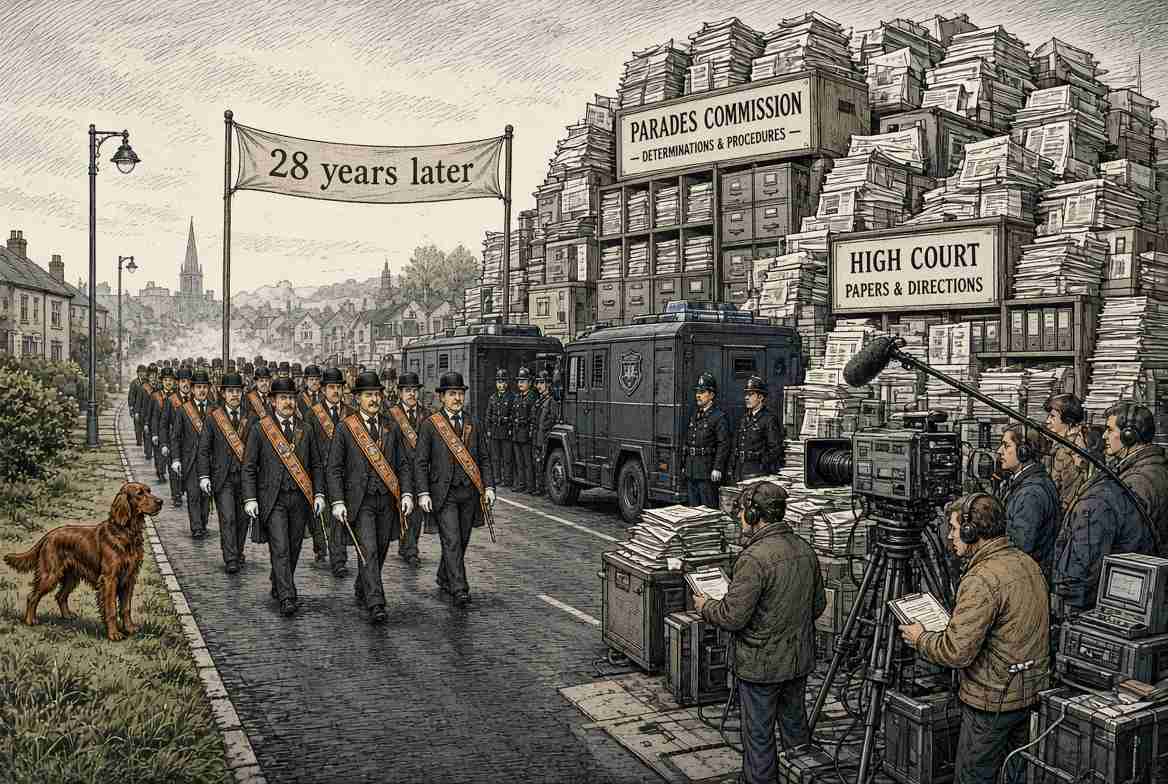
Drumcree Standoff Returns After 28 Years, Northern Ireland Furious to Discover Someone Rebooted the 1990s
Orange Order Parade on Garvaghy Road Reopens a 1998 Peace Process Argument, and It Only Needs 35 Marchers
PORTADOWN, NORTHERN IRELAND — Residents of Northern Ireland awoke this weekend to discover somebody had apparently restored the country from a backup file dated 1998, complete with Drumcree, disputed marching routes, emergency court hearings, politicians appealing for calm and enough historical baggage to exceed Ryanair's allowance by several centuries.
The Drumcree dispute suddenly returned to prominence after the Parades Commission permitted an Orange Order parade along Garvaghy Road in Portadown, the predominantly nationalist area at the centre of one of Northern Ireland's most bitter recurring disputes during the 1990s.
The commission imposed considerable restrictions. The parade would begin at 8 a.m., consist of only 35 participants and proceed silently.
In other words, after nearly three decades of political evolution, constitutional negotiation, demographic change, peace-building and several generations of mobile phones, Northern Ireland once again found itself debating whether 35 men could walk down a road without talking.
Historians immediately checked their calendars.
“Good Lord,” said one imaginary professor at the Institute for Preventing History From Climbing Out of the Basement. “We distinctly remember putting this argument away.”
Thinking About the Drumcree Parade...
- Northern Ireland successfully went 28 years without this particular Drumcree confrontation, demonstrating that history can remain dormant for almost three decades before someone accidentally clicks “Restore Previous Session.”
- The proposed parade involved just 35 people, which means Northern Ireland has achieved perhaps the highest geopolitical tension-per-pedestrian ratio ever recorded.
- Thirty-five men walking down a road sounds less like an international political crisis and more like a badly organized golf outing.
- The parade was supposed to take place in silence, creating the unusual possibility of an argument in which the participants were legally required not to contribute.
- Courts spent hours deciding whether 35 men could walk somewhere for approximately 15 minutes. At that rate, approving a trip to Tesco could require judicial review.
Drumcree Parade 2026: The Facts Behind the Farce
The factual scaffolding is almost satirical before we touch it: the permitted parade was limited to 35 participants, scheduled for 8 a.m., required to proceed in silence, and concerned a route the Orange Order had been barred from using since 1998. Thousands gathered to oppose it, while courts spent the weekend revisiting the decision.
Drumcree Dispute: Northern Ireland Opens Museum of Historical Arguments, Discovers Exhibit Is Still Alive
The Drumcree dispute is remarkable because almost everything else from 1998 has aged normally.
Dial-up internet disappeared.
The Spice Girls changed.
Televisions became flat.
Phones became computers.
Bill Clinton stopped being president.
Yet Drumcree has apparently been sitting beneath a dust sheet waiting for somebody to say, “Whatever happened to that incredibly sensitive argument about marching down Garvaghy Road?”
And suddenly the sheet flew off.
The dispute dates back decades, but the modern standoff became particularly explosive during the peace process of the 1990s. The Parades Commission, established in 1998 under the Public Processions (Northern Ireland) Act 1998, subsequently barred the Orange Order from completing the disputed route year after year. In 2026, litigation over the commission's procedures reopened the possibility of the march.
This is what makes Northern Irish history so efficient.
Other countries waste valuable money erecting historical reenactment villages.
Northern Ireland occasionally achieves the same effect simply by filing paperwork.
Orange Order Parade of 35 Men Becomes National Crisis
The number 35 deserves special attention.
Thirty-five.
Not 35,000.
Not 3,500.
Thirty-five.
There are larger queues waiting for coffee at airports.
There are wedding photographs containing more people.
A particularly ambitious WhatsApp family group can exceed 35 members before somebody's aunt begins sending inspirational pictures of waterfalls.
Yet according to the approved arrangements, these 35 participants could have become the central moving objects in a political confrontation involving courts, police, residents, political leaders, two governments and thousands of protesters.
Reuters reported that around 2,000 protesters blocked access to the predominantly Catholic area while the police remained between the opposing groups.
That produces an extraordinary statistic.
For every Orangeman authorized to participate, approximately 57 protesters could potentially oppose the parade.
Economists call this the Political Consequences Per Pedestrian Index, or PCPPI, a measurement invented several seconds ago but already considered more comprehensible than most Treasury forecasts.
At 57-to-one, Drumcree comfortably beats the international average, where one person walking down a street generally produces approximately zero constitutional emergencies.
Walking Becomes Advanced Political Science
The deeper philosophical problem involves the meaning of walking.
Most societies consider walking a transportation method.
You put one foot in front of another.
Then, and this is where the technical complexity increases, you repeat the procedure.
Northern Ireland has demonstrated that under certain circumstances walking can simultaneously become an assertion of tradition, territorial symbolism, community identity, legal precedent, public-order question and television event.
This represents an astonishing administrative achievement.
A normal pedestrian sees a road and thinks:
“Can I walk there?”
At Drumcree the question becomes:
“Can I walk there, under which determination, pursuant to what commission ruling, following which judicial review, subject to which restrictions, in light of what historical precedent and accompanied by how many accordion bands?”
By the time you get the answer, you could have walked around the entire town.
Twice.
Parades Commission and High Court Introduce Competitive Drumcree
The legal proceedings added another layer of glorious confusion.
A High Court ruling in August overturned an earlier Parades Commission determination because of procedural issues. The Orange Order reapplied. The commission eventually permitted the parade with restrictions. Another High Court intervention temporarily stopped it. That ruling was appealed, and another hearing in the early hours of Sunday restored the commission's decision.
At some point the legal system stopped resembling jurisprudence and began resembling Wimbledon.
“Parade permitted.”
“Advantage residents.”
“Injunction.”
“Deuce.”
“Appeal.”
“Advantage Orange Order.”
“Court adjourned because everybody needs coffee.”
The final hearing reportedly began shortly after midnight, only hours before the scheduled parade.
Nothing calms an extraordinarily sensitive community dispute quite like discovering the legal answer at approximately the same hour nightclub patrons discover kebabs.
Politicians Deploy Britain's Traditional Emergency Weapon: Asking Everyone to Calm Down
Political leaders responded with the classic phrase reserved for situations where calm has become noticeably unavailable.
They appealed for calm.
Prime Minister Andy Burnham urged calm on all sides, while Irish Taoiseach Micheál Martin called for sensible mediation and criticized the commission's decision. Northern Ireland Secretary Chris Bryant also urged compromise as the standoff continued.
“Calm” occupies a fascinating position in British political vocabulary.
Nobody asks people to remain calm at a garden centre.
Nobody enters Greggs and announces, “I urge everyone here to exercise restraint regarding the sausage rolls.”
An official appeal for calm therefore functions almost exactly like a hotel fire alarm.
It tells you the situation has progressed beyond the point where anyone needed reminding.
Northern Ireland Demonstrates Superior Grievance Preservation Technology
Museums preserve artefacts.
Libraries preserve books.
Archives preserve documents.
Northern Ireland occasionally preserves arguments.
The Drumcree dispute has been maintained with astonishing historical fidelity, right down to the 1998 Northern Ireland Assembly debates in which everyone already sounded exhausted.
Every component remains recognizable: route, identity, tradition, objections, law, public order, political symbolism.
If the British Museum preserved antiquities this effectively, the Rosetta Stone would occasionally demand a press conference.
Future historians may therefore stop referring to Drumcree as merely a dispute and begin classifying it as a form of cultural storage.
The Smithsonian has airplanes.
The Louvre has the Mona Lisa.
Northern Ireland has disagreements kept at perfect emotional humidity.
The Fifteen-Minute Orange Order Parade Requiring Three Decades of Preparation
The Orange Order's original September application said the contested portion of the parade would take approximately 15 minutes.
Fifteen minutes.
Northern Ireland has therefore potentially achieved a preparation-to-event ratio approaching one million minutes of controversy for every minute of marching.
You could cook pasta longer.
You could spend more time looking for parking.
Some people take 15 minutes deciding what to watch on Netflix.
Yet this particular quarter-hour required police planning, judicial consideration, political intervention, public protest and an international news audience.
NASA has launched objects into space using less emotionally complicated countdown procedures.
“T-minus ten minutes.”
“Parade authorization confirmed.”
“Negative. Judicial review.”
“Stand by.”
“Commission ruling restored.”
“Residents assembling.”
“Abort walking.”
Garvaghy Road: A Road Carrying More History Than Traffic
The fundamental absurdity, of course, is that Garvaghy Road is still physically a road.
Cars travel on it.
People live beside it.
Delivery vans arrive.
Children presumably ask whether they're there yet.
And yet history has loaded this ordinary stretch of pavement with so much symbolic freight that Google Maps should probably display:
GARVAGHY ROAD
Traffic: Moderate
Political significance: Severe
Estimated travel time: 7 minutes
Estimated historical explanation: 340 years
This is what happens when geography acquires memory.
A mile of road can become longer than an empire.
Northern Ireland Peace Process Discovers Peace Is Not the Same as Amnesia
Behind the comedy lies the reason Drumcree retains its power.
The old confrontations were associated with serious sectarian violence during a fragile period in Northern Ireland's peace process. The circumstances today are profoundly different, but the memories are not ancient history to many people involved.
That is precisely why the spectacle feels simultaneously ridiculous and serious.
Thirty-five people walking along a road should be boring.
Thousands of people standing on a road should be ordinary.
A judge discussing a road should be municipal government.
But history changes the arithmetic.
Thirty-five pedestrians plus one contested road plus generations of memory can equal a national political crisis.
Only Northern Ireland could transform elementary mathematics into postgraduate constitutional studies.
Drumcree 2026: Please Do Not Restart Your Country While Updates Are Installing
Perhaps the best way to understand the entire episode is through modern technology.
Northern Ireland spent nearly three decades installing updates.
Peace agreements.
New institutions.
Changing politics.
New generations.
Economic development.
Cross-border cooperation.
Different political majorities.
Then somebody apparently clicked an old desktop icon marked:
DRUMCREE.EXE
The screen froze.
Police appeared.
Lawyers materialized.
Politicians rushed toward microphones.
Thousands gathered.
And somewhere in Portadown, history displayed the most terrifying computer message imaginable:
“Would you like to restore settings from 1998?”
Northern Ireland appears to have clicked:
“Remind me later.”
Which, given the alternatives, may be the most historically authentic compromise imaginable.
Drumcree Latest: Standoff Unresolved as Bryant Urges Compromise
The real episode continued into September 28, with Northern Ireland Secretary Chris Bryant meeting representatives and calling for compromise while the standoff remained unresolved.
10 Humorous Observations Before Anyone Starts Marching
- Britain spent decades worrying about the return of the Troubles, apparently overlooking the more immediate danger: the return of the route-planning dispute.
- Drumcree has become less a political dispute than a museum exhibit where the exhibits occasionally leave the glass case and demand directions.
- Northern Ireland has preserved this argument so carefully that UNESCO may eventually designate it a World Heritage Grievance.
- The controversy proves that a road can be made of asphalt, gravel and approximately 400 years of unresolved footnotes.
- Most nations use streets to get from one location to another. Northern Ireland occasionally uses them to debate constitutional history.
- The legal position changed so many times over the weekend that lawyers probably began issuing decisions using football substitution boards.
- Thousands gathered because 35 people wanted to walk along a street, proving once again that crowd size is inversely proportional to the simplicity of the original proposal.
- The instructions reportedly included an early start, limited numbers and silence. It was less a parade than a monastery being transferred between postcodes.
- Politicians appealed for calm, the traditional governmental announcement meaning everybody has already stopped being calm.
- The great achievement of Drumcree is reminding the world that in Northern Ireland even walking can develop a constitutional dimension.
Disclaimer
This story is satire built around a real and sensitive political dispute whose consequences have historically been anything but humorous. The jokes target bureaucracy, historical repetition, political theatre, legal complexity and humanity's astonishing capacity to preserve an argument long after everyone has purchased new furniture.
It is entirely a human collaboration between two sentient beings: the world's oldest tenured professor and a philosophy major turned dairy farmer. Neither was permitted to march anywhere while preparing it, although both reserve the right to walk quietly to the refrigerator. https://prat.uk/drumcree-garvaghy-road-standoff/


Comments
Post a Comment