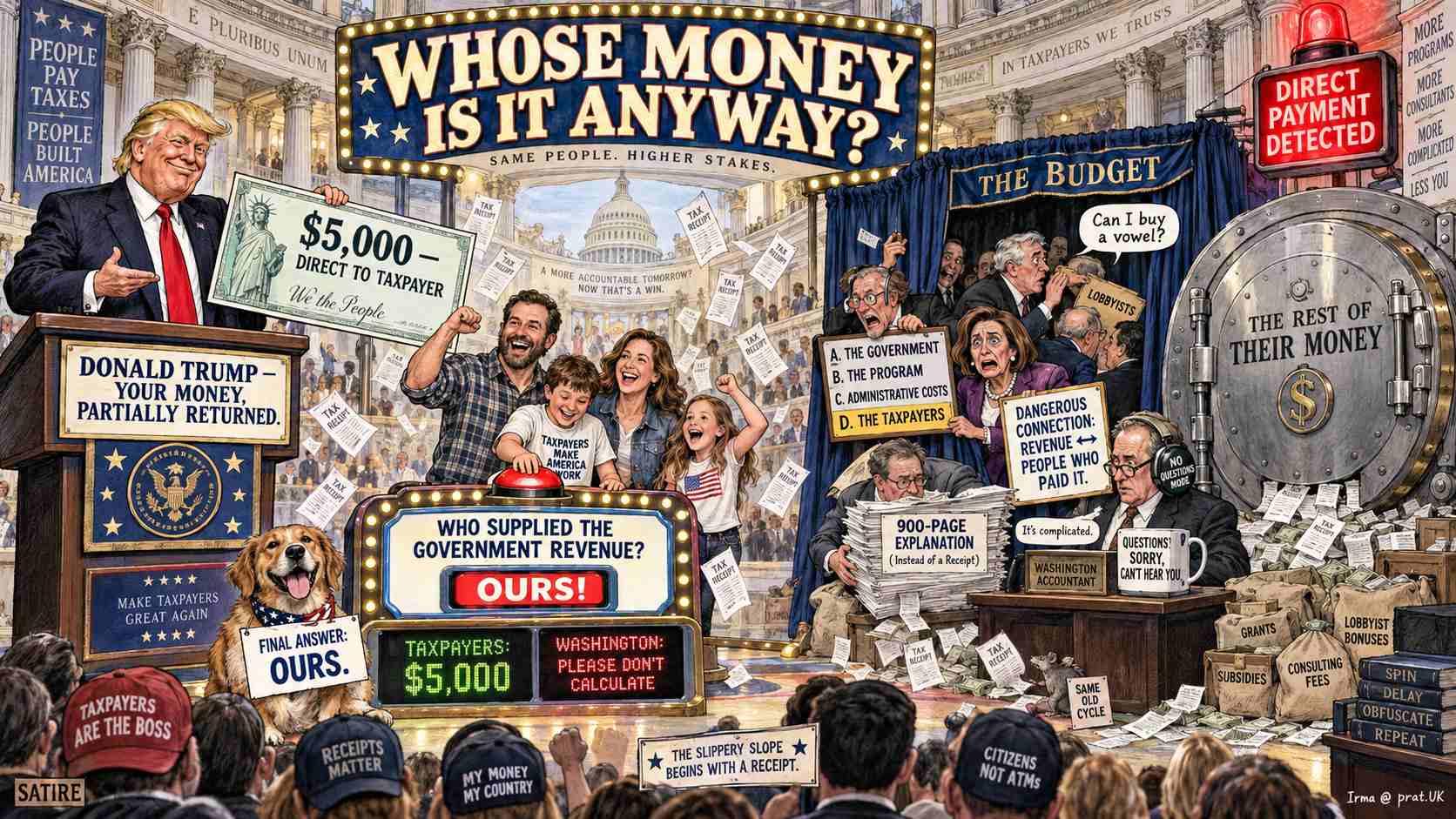
Democrats Warn $5,000 Trump Checks Could Lead to Slippery Slope Where Taxpayers Begin Asking What Happened to the Rest of Their Money
Washington reportedly fears direct payments could expose dangerous connection between government revenue and the people who supplied it
Democrats and assorted Washington fiscal traditionalists expressed alarm this week over President Donald Trump's proposal to give American adults $5,000 if Republicans retain control of Congress, warning that directly handing citizens recognizable quantities of money could establish a dangerous precedent in which taxpayers begin asking what government normally does with the other several trillion dollars.
Trump announced the proposed "Trump Dividend" at the Republican National Committee's midterm convention in Dallas, promising $5,000 to adult American citizens if Republicans hold the House and Senate. News organizations estimate the plan would cost more than $1 trillion, and details about eligibility, congressional authorization and funding remain unresolved.
That factual uncertainty has not prevented Washington from reaching the traditional bipartisan conclusion that the most important issue is who gets credit.
Democratic officials were reportedly especially concerned about the psychological consequences of ordinary Americans opening an envelope and finding actual money rather than a twelve-page brochure explaining the availability of a refundable tax credit available to qualifying households subject to subsection 4(c)(ii).
"This is extremely dangerous," explained one fictional senior Democratic strategist while being carried between television studios by two policy analysts. "People might start thinking government programs are supposed to produce something they can identify."
The strategist then disappeared into the Department of Deliverables to attend a $14 million conference on improving deliverables.
Democrats Demand All Free Money Travel Through Proper Bureaucratic Channels
Washington experts emphasized that responsible government assistance traditionally begins with the recipient proving to the government that the government should give the recipient some of the recipient's money.
This process ensures dignity.
Applicants are normally expected to provide their income, address, employment history, marital status, household composition, blood type, favorite vegetable and an affidavit confirming they have never accidentally earned eleven dollars above the qualifying threshold.
Only then can government begin helping.
Trump's proposal threatens to vandalize this elegant system by replacing it with the administrative doctrine known technically as "Here's five grand."
Policy professionals recoiled.
"It eliminates important stakeholders," warned Dr. Cynthia Formletter, director of the Institute for Procedural Equity and Stapler Access. "Where are the administrators? Where are the regional coordinators? Where is the community outreach consultant earning $184,000 to explain that the check is coming?"
Formletter estimated that a properly designed $5,000 federal benefit should involve at least fourteen agencies, three nonprofit organizations, two congressional committees and one website that crashes at 9:04 Monday morning.
Otherwise citizens might get the money.
Dangerous New Practice Involves Giving Taxpayers Money Directly
Economists noted that the Trump proposal raises legitimate fiscal questions.
CBS News reported that sending $5,000 to roughly 245 million adult citizens could cost upward of $1 trillion. The president suggested tariffs could contribute to funding the payments, but the amount collected from tariffs is far below the total potential cost. Congressional approval would also be a major issue, a point The Washington Times and Forbes both raised in their coverage of the announcement.
Those are boring questions involving arithmetic.
Washington therefore quickly advanced to the more important issue: Who would get politically rewarded for the arithmetic?
Trump's critics characterized the proposal as something dangerously close to buying votes, producing the unusual spectacle of American politicians suddenly discovering that voters might alter their political preferences when government gives them material benefits.
Political scientists immediately evacuated the building.
For generations, campaigns have promised tax credits, student benefits, healthcare subsidies, housing programs, farm support, retirement benefits, business incentives, childcare assistance and deductions for purchasing an environmentally approved toaster.
Apparently none of these programs has ever influenced a voter.
Then somebody mentioned putting $5,000 on a check.
Democracy collapsed behind the sofa.
Experts Fear Benefits Could Begin Reaching Actual People
The greatest concern is precedent.
If Americans receive government money without first completing an administrative obstacle course, they may expect future programs to operate similarly.
That would be catastrophic.
A citizen receiving $5,000 might begin asking why a program supposedly costing $10 billion does not result in ten billion dollars worth of visible things.
From there, according to experts, the descent toward fiscal curiosity becomes almost impossible to stop.
First the citizen receives the check.
Then the citizen looks at his tax return.
Then he sees federal spending figures.
Then he gets a calculator.
Within six months he is standing outside the Department of Transportation shouting, "HOW DOES A ROUNDABOUT COST $38 MILLION?"
Nobody wants that.
America functions because federal expenditures are expressed in numbers large enough to become weather.
Five thousand dollars is comprehensible.
One trillion dollars is astronomy.
When Congress says $842 billion, the human brain hears refrigerator noise.
But $5,000?
That's a transmission.
That's a used fishing boat.
That's several months of groceries.
That's a family vacation if nobody orders anything at the airport.
Citizens can visualize five thousand dollars, making it inherently dangerous to the federal budget.
Officials Recommend Money Pass Through Fourteen Agencies First
A compromise proposal circulating among satirical congressional staffers would preserve Trump's $5,000 payment while making it sufficiently governmental.
Under the compromise, every American would technically receive $5,000.
First, however, the Department of Treasury would send $5,000 to the Department of Citizen Dividend Coordination.
That department would retain $318 for administration.
The money would then travel to the Federal Office of Equitable Distribution, which would conduct a six-month study determining whether distributing money constitutes distribution.
Another $427 would disappear.
The remaining funds would be forwarded to a nonprofit called Americans for Accessible Prosperity Outcomes, where a vice president of community engagement would conduct listening sessions at a resort in Scottsdale.
Eventually taxpayers would receive a prepaid debit card containing $742.18.
Everyone in Washington would recognize this as a successful $5,000 program.
A commemorative plaque would cost $900,000.
Application Form Expected to Require Only Name, Causing Panic
Perhaps the most destabilizing possibility is administrative simplicity.
Americans accustomed to federal forms could receive money without answering questions such as:
"Did you reside continuously within a designated rural empowerment census tract between February 3 and February 7?"
"Have you previously received assistance under Schedule F excluding assistance described under Schedule F?"
"Attach supporting documentation demonstrating that attached documentation has been attached."
Without these safeguards, recipients could experience the frightening sensation of efficiency.
One imagined government employee described the danger.
"My grandfather filled out Form 8827-B," he said. "My father filled out Form 8827-B. I fill out Form 8827-B. Now Trump wants somebody to receive money without Form 8827-B? What are we, animals?"
He then revealed Form 8827-B was discontinued in 1986.
Nobody had told his department.
Welfare Becomes Vote-Buying Precisely When the Other Party Signs the Check
The episode has also revived America's oldest fiscal philosophical debate: when does giving voters something become buying their votes?
The accepted Washington answer appears to be: when the other team does it.
A politician supporting a tax credit describes it as "helping working families."
His opponent describes the same measure as "reckless pandering."
Then the opponent wins office, enlarges the credit and holds a press conference beside a family selected for unusually photogenic children.
This is called governing.
Trump has simply removed several layers of romantic lighting. His sales pitch is essentially: Republicans win, you get $5,000.
Subtlety has left the building carrying a red hat.
There are serious reasons to scrutinize the proposal. A payment exceeding $1 trillion would require funding, legislation and consideration of inflationary effects. CBS News notes that broad pandemic-era stimulus payments were later associated by many economists with at least part of the subsequent inflation surge.
But those concerns apply regardless of whether the spending proposal arrives wearing a red tie, a blue tie or a Congressional Budget Office footnote.
Which ruins everything, because fiscal responsibility becomes much less entertaining when applied consistently.
Taxpayers Make Terrifying Discovery That Government Money Comes From Somewhere
The Trump dividend may ultimately fail, change substantially or never receive congressional authorization, as The Guardian notes in its coverage of the convention speech.
But Washington has already encountered the idea's most dangerous consequence: people are doing multiplication.
Five thousand dollars multiplied by hundreds of millions of adults produces a number exceeding $1 trillion.
And once voters discover multiplication, there may be no containing them.
Soon somebody will divide. Then subtract. Eventually, one taxpayer in Ohio will look at federal expenditures, compare them with his family's finances and utter the sentence that has haunted governments since Mesopotamia: "Wait a minute."
At that point democracy enters uncharted territory.
Citizens might ask why temporary programs become permanent. They might ask why agencies established to solve problems sometimes survive the problems. They might wonder why every government initiative has a communications director. They may even ask what a deputy assistant associate administrator does.
Nobody knows. Including the deputy assistant associate administrator.
Washington Urges Americans Not to Follow the Money
Officials therefore encouraged taxpayers to remain calm and avoid performing independent calculations.
Government money, experts reminded everyone, is extremely complicated.
For example, when government takes $5,000 from you, that is revenue. When government gives $5,000 back, that is spending. When a politician promises to give it back before an election, that is pandering. When another politician promises to spend it on something you like, that is investment. When neither party knows how to pay for it, that is bipartisan cooperation.
The safest course is therefore to stop asking questions and accept that Washington operates according to mysterious financial principles unavailable to ordinary households, businesses, mathematicians and occasionally the Treasury Department.
Because once taxpayers start asking what happened to the rest of their money, the slippery slope becomes terrifyingly steep.
First comes the $5,000 check. Then comes the calculator. Then comes the federal budget.
And somewhere in Washington, a consultant quietly whispers: "Dear God. They've found the receipts."
15 Humorous Observations Behind the Story
- Washington has spent decades perfecting the art of giving people money, but apparently the money becomes suspicious when it arrives without a caseworker.
- A government benefit is compassionate. A check with the opposing party's fingerprints on it is apparently an attempted coup by direct deposit.
- The truly radical feature of Trump's proposal may be that taxpayers could recognize the number without consulting an accountant.
- Washington normally prefers $5,000 in benefits to require $6,400 worth of administration.
- A direct payment risks teaching citizens that money can travel from Washington to their mailbox without changing planes in seventeen departments.
- Democrats calling the proposal vote-buying creates an awkward question about whether voters are supposed to remain emotionally unaffected by every other government benefit.
- Republicans have discovered fiscal generosity immediately before an election, one of Washington's most reliable seasonal migrations.
- Trump calls it a "dividend," which sounds considerably better than "your government temporarily returning something it found in your trousers."
- The dangerous part is not receiving $5,000. The dangerous part is citizens starting to divide federal spending by the number of taxpayers.
- Once Americans see a check, they may begin wondering why highway projects require twelve years, six consultants and an environmental study of a puddle.
- Bureaucracies dislike cash because cash has insufficient opportunities for acronyms.
- A $5,000 payment costing more than $1 trillion proves Washington has finally discovered a spending program too expensive for Washington: one people can see.
- If the proposal required a 63-page application, three interviews and proof of hardship, everybody would recognize it as respectable government.
- Americans may soon discover there are only two kinds of government spending: money politicians condemn and money politicians named themselves.
- The genuine slippery slope begins when taxpayers ask the forbidden question: "Where did the rest go?"
Satire Disclaimer
This article is satire. Political statements, invented experts, bureaucratic offices and absurd quotations are used for parody and commentary. The underlying Trump $5,000 proposal and reported political reaction are based on contemporary news reporting; the comic bureaucracy surrounding them has been inflated well beyond the federally recommended pressure level. https://bohiney.com/5000-trump-checks-could-lead-to-slippery-slope/


Comments
Post a Comment