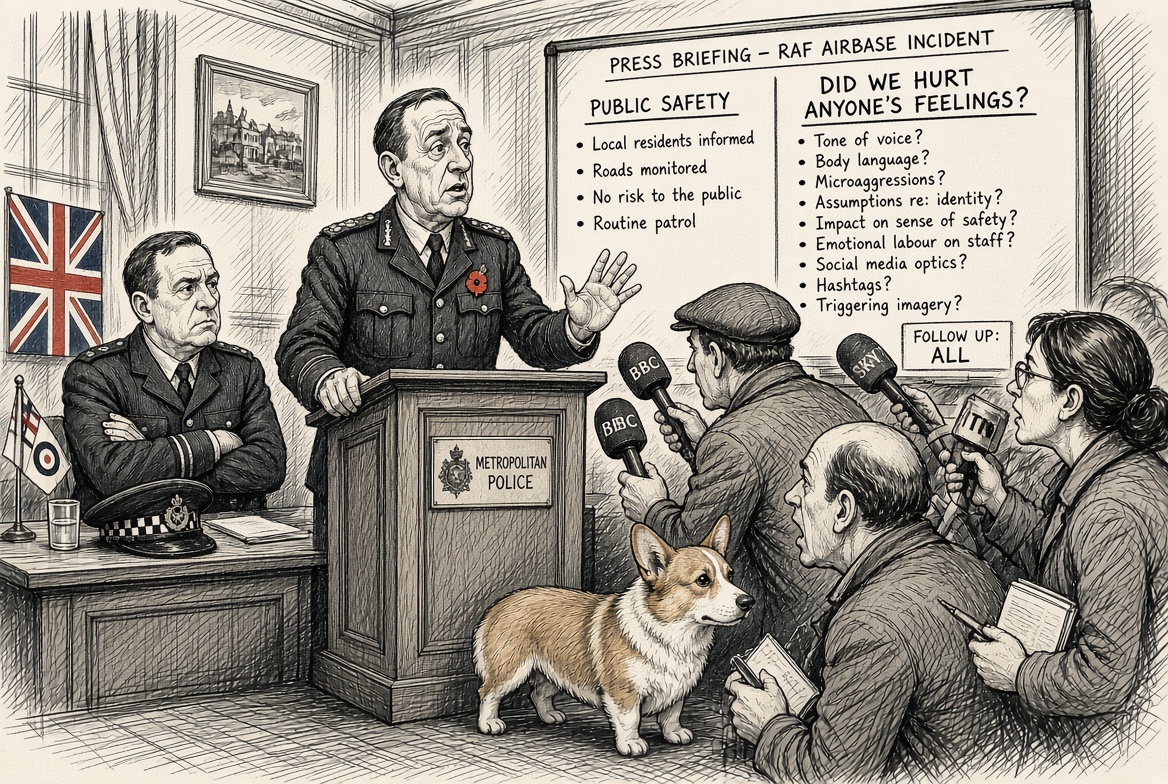
Britain Foils Possible Terror Plot, Immediately Launches Investigation Into Whether Britain Hurt the Terrorists’ Feelings
Suspected Bomb Plot Near RAF Base Disrupted, Britain Responds With Traditional Counterterrorism Weapon: National Self-Doubt
FAIRFORD, ENGLAND — Britain was confronted this weekend with that rarest of national emergencies: an incident sufficiently suspicious that even the British were briefly prepared to describe it as suspicious.
Five British nationals were arrested after police received a report shortly after midnight Sunday concerning three suspicious vehicles travelling toward RAF Fairford in Gloucestershire. Armed officers responded, a 400-metre cordon went up, roughly 85 households were told to evacuate, and Army explosive-ordnance specialists examined the vehicles. Counter Terrorism Policing took over the investigation.
Then Britain remembered who it was.
Officials urged everyone not to speculate.
This was understandable. Britain had only reached the preliminary investigative stage known technically as three vans, five arrests, explosives suspicions, counterterrorism police and an evacuated village.
Anything beyond that would be reckless.
Authorities are investigating whether a foreign state may have been involved. Reuters reported that a source familiar with the investigation regarded an Iran-linked motive as the leading possibility, while Russian sabotage and an Islamist plot were also being examined. Police, however, have publicly stressed that they are keeping an open mind, and the AP reports that detectives are pursuing “multiple lines of inquiry.” Iran’s embassy has rejected suggestions of Tehran’s involvement as unfounded.
So everybody calm down.
Britain has narrowed the possibilities to Iran, Russia, Islamist extremists, somebody else, nobody in particular, or possibly Britain itself.
Think About It...
- Britain can evacuate 85 homes faster than it can evacuate one qualifying phrase from a government statement.
- Five men can be arrested near an airbase, but the first suspect interrogated by Britain is apparently Britain.
- Nothing says national emergency quite like armed police, bomb disposal robots, three suspicious vans, and an official reminding everyone not to speculate.
- British counterterrorism now appears to require both a bomb squad and a philosophy department.
- Iran, Russia and Islamist extremism are reportedly among lines of inquiry, creating the geopolitical equivalent of Cluedo: Tehran, Moscow or somebody else, with the explosives, near the runway.
RAF Fairford Terror Arrests: Did Britain Make the Explosives Feel Unwelcome?
The modern British response to a suspected terror plot now resembles couples therapy conducted inside an ammunition depot.
“We need to establish what happened,” explained one entirely satirical Whitehall sensitivity consultant, “but equally we must ask what Britain may have done to cause three suspicious vans to feel they had no alternative but to travel toward an American-used military installation after midnight.”
This is the beauty of national self-doubt.
You can save enormous money on counterintelligence because every investigation eventually comes back to you.
Police find suspicious vehicles?
“What did Britain do?”
Possible explosives?
“What historical factors made them explosive?”
A military base may have been targeted?
“Have military bases considered being less targetable?”
Soon RAF Fairford will be required to attend a mediation session with Iran, Russia and three white vans.
The base will begin.
“I feel threatened when unexplained vehicles approach me after midnight.”
The vans will respond:
“We hear you, but your runway is very triggering.”
Then a civil servant will make everyone write one positive thing about each other on a Post-it note.
Counter Terrorism Policing and Britain’s Most Dangerous Weapon: The Qualifying Clause
Police caution is entirely appropriate during an active investigation. Arrest is not conviction, motives have not been established, and foreign-state involvement remains under examination. The men were first held under the Explosives Act and later arrested on suspicion of preparation of terrorist acts, which is a real offence rather than a mood.
But Britain possesses a special cultural talent for transforming perfectly legitimate caution into metaphysical bewilderment.
A government statement can begin with:
“Five men have been arrested on suspicion of preparing a terrorist act…”
…and somehow finish twelve paragraphs later with the public wondering whether anyone was arrested at all.
Britain does not jump to conclusions.
Britain approaches conclusions through a planning inquiry.
First there is a consultation period.
Then an environmental assessment.
Then somebody discovers a protected newt living under the conclusion.
The conclusion is postponed until 2031.
By comparison, an ordinary Gloucestershire resident reportedly saw suspicious vans and balaclava-clad men and called 999. CNN’s reporting notes that British outlets, citing sources, said the operation was not intelligence-led, suggesting local vigilance may have played a key role.
This remains an important component of British national security known as having eyes.
No satellite.
No £4.7 billion surveillance contract.
No interdepartmental steering committee.
Just somebody driving through the countryside thinking:
“Three vans, balaclavas, middle of the night, military airbase. That seems a bit bloody unusual.”
Within minutes, the citizen had completed the sort of deductive reasoning government normally outsources to Deloitte.
RAF Fairford Suspicious Vans: Iran, Russia or Somebody From Procurement?
The foreign-policy portion of the investigation has become especially British.
Reuters reported that investigators were looking at several possibilities, including an Iranian connection, Russian sabotage and an Islamist motive. CBS News quotes the Met’s counter-terror chief saying the activity may have been carried out by proxies working, knowingly or otherwise, for a foreign state.
Which means the United Kingdom currently has more theories than vans.
Iran has denied involvement.
Russia has become such a familiar suspect in European security stories that one assumes MI5 forms now contain:
Possible Russian involvement?
☐ Yes
☐ No
☐ Obviously we’re checking
Yet the five men arrested are British nationals.
That introduced a terrible administrative complication.
Apparently you can be British and still potentially have links, motivations, sympathies, employers, handlers, ideas or instructions involving somewhere else.
Nobody prepared the bureaucracy for this.
Whitehall had hoped terrorism would continue arriving with an international return address and customs declaration.
Instead, investigators must perform the tiresome work of finding evidence.
Government Warns Real Danger Is Reaching Conclusions Before Tea Arrives
Britain’s system has therefore settled on the perfect national compromise.
Police will investigate vigorously.
Politicians will speak cautiously.
Commentators will speculate furiously.
Everyone will condemn everyone else for speculating.
And eventually a television presenter will ask whether the entire discussion has become “toxic,” at which point the alleged explosives will become the fourth-most important subject in the programme.
A satirical survey by the Institute for Advanced British Hesitation found that 94% of Britons believe authorities should “wait for the facts,” while 87% simultaneously have already explained the whole thing to their spouse.
Another 63% blamed Iran.
Forty-eight percent blamed Russia.
Thirty-one percent blamed America.
Twenty-seven percent blamed government cuts.
Nineteen percent blamed Brexit.
Eight percent blamed cyclists.
These numbers total far more than 100%, which makes them ideally suited to modern political discourse.
National Self-Doubt Elevated to Strategic Deterrent
For centuries, Britain maintained security through the Royal Navy.
Then nuclear weapons.
Now it has discovered something potentially more terrifying:
agonising over whether defending Britain sends the wrong message.
Imagine being a hostile intelligence service trying to understand this.
Agent: “Our operation has been discovered.”
Commander: “Excellent. What are the British doing?”
Agent: “Investigating themselves.”
Commander: “Us?”
Agent: “No. Themselves.”
Commander: “Why?”
Agent: “They appear concerned they may have caused us to become hostile.”
Commander: “Did they?”
Agent: “I don’t know. I’m beginning to feel guilty.”
This may actually be Britain’s greatest deterrent.
Attack the country and within six hours you’ll be dragged into a national debate so exhausting you’ll confess merely to get your evening back.
Meanwhile, the Bomb Squad Continues Doing Something Radical
The reassuring part of the whole affair is that beneath the national fog machine, the practical machinery worked.
A member of the public reported suspicious activity.
Armed police responded.
Five men were arrested.
Residents were evacuated.
Explosive specialists were called.
Counterterrorism officers took charge.
That is what governments are supposed to do when confronted with an uncertain but potentially serious threat.
The absurdity begins when straightforward prudence becomes cultural paralysis, when “we don’t yet know” quietly mutates into “perhaps knowing would itself be problematic.”
There is an enormous difference between refusing to prejudge five suspects and refusing to acknowledge that hostile states and extremist organisations sometimes undertake hostile actions.
One is due process.
The other is a philosophy seminar with a bomb-disposal robot parked outside.
Britain Successfully Survives Another Encounter With Britain
The suspects have since been released on bail while remaining under investigation.
And so the proper answer remains: investigate.
Follow the evidence.
Determine whether explosives offences occurred.
Determine whether there was a terrorist plan.
Determine whether anyone overseas directed, assisted or inspired it.
If Iran is involved, evidence should establish that.
If Russia is involved, evidence should establish that.
If neither is involved, evidence should establish that too.
But Britain need not spend the intervening period staring into a national mirror asking whether RAF Fairford’s existence constitutes an act of emotional aggression against passing vans.
Sometimes a suspicious van is just a suspicious van.
Sometimes a balaclava at 1 a.m. is not an exciting new Cotswolds fashion trend.
And occasionally, when five people are arrested near a military installation while bomb-disposal experts examine vehicles, the British government is permitted to investigate the suspects before commissioning a 280-page report entitled Understanding Our Own Role in Making Explosives Cross.
Tea can still be served.
Nobody is suggesting barbarism.
10 Humorous Observations About the RAF Fairford Terror Investigation
- Police say they are keeping an open mind, which in Britain risks becoming an open-plan office with no walls whatsoever.
- The suspects are British nationals, which complicates the cherished national pastime of locating the entire problem conveniently overseas.
- A resident spotting suspicious vehicles helped trigger the response, proving Britain’s most reliable early-warning system remains somebody looking out the window and saying, “That’s odd.”
- Government caution is sensible until it becomes a sentence so carefully balanced that nobody can remember what happened.
- Iran denies involvement, ensuring Britain now has both an investigation and an international argument about the investigation.
- Russia reportedly being examined as another possibility means Britain has reached the stage where every mystery comes with a complimentary Kremlin theory.
- Three vans heading toward a strategic airbase at 12:45 in the morning are apparently insufficient evidence for the traditional British response of raising one eyebrow.
- Modern counterterrorism involves determining what happened, who did it and whether discussing either question before Tuesday constitutes irresponsible discourse.
- Britain once ruled a quarter of the planet. It now requires three committees to decide whether noticing three suspicious vans is culturally insensitive.
- The bomb squad examines possible explosives. Whitehall examines whether Britain has been sufficiently introspective about why anyone might possess them.
Disclaimer
This is satire. The comic experts, surveys, dialogue and bureaucratic institutions above are humorous inventions; factual claims about the RAF Fairford investigation are attributed to police and published reporting. No determination of guilt is implied regarding the five men, and the investigation remains ongoing.
This story is entirely a human collaboration between two sentient beings: the world’s oldest tenured professor and a philosophy major turned dairy farmer. No cows were radicalised during production, although one refused to rule out foreign-state involvement. https://prat.uk/britain-hurt-the-terrorists-feelings/


Comments
Post a Comment