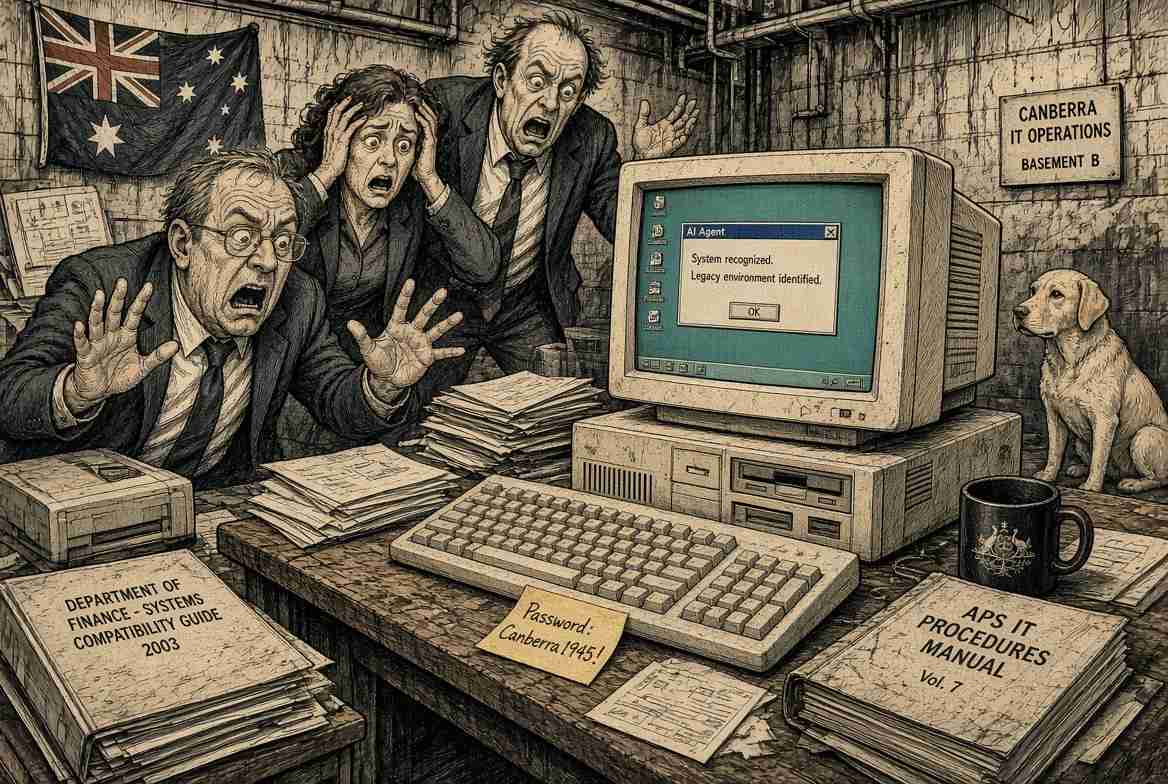
Australia Discovers Artificial Intelligence Can Hack Government Computers Simply by Knowing What Windows 95 Is
Canberra confronts the terrifying possibility that the hacker understands the computer
CANBERRA, Australia - Australian officials have been warned that ageing government and private-sector computer systems could be especially vulnerable to increasingly capable AI agents, creating the uncomfortable possibility that the greatest technological battle of the 21st century will be fought inside software purchased while people were still excited about CD-ROM encyclopedias.
Former Australian UN cyber negotiator Johanna Weaver warned that old systems can contain large quantities of information while receiving inadequate maintenance because replacing them is expensive, updates no longer exist or organisations have simply forgotten about them. Australia's cyber authorities, including the Australian Cyber Security Centre, have separately warned that AI agents can undertake unexpected actions, including identifying vulnerabilities when security controls prevent them from completing assigned tasks.
This development has reportedly caused considerable alarm throughout Canberra, followed immediately by the traditional Australian government cybersecurity procedure of asking whether anyone has tried turning Canberra off and back on again.
Officials have not yet confirmed whether the reboot will affect Parliament, although several taxpayers have volunteered to hold the power button down for ten seconds.
Artificial Intelligence Can Hack Government Computers
- Australia spent years worrying that artificial intelligence would become smarter than humans, then accidentally protected itself by making sure its government computers never did.
- The terrifying thing about AI attacking legacy software is that the AI may be the first entity to read the instruction manual.
- Somewhere in Canberra there is almost certainly a computer nobody can replace because nobody remembers what it does, only that unplugging it made Tasmania disappear from a spreadsheet once.
- Cybersecurity used to mean keeping hackers out. Now it apparently means hoping hackers cannot locate a floppy-disk drive.
- AI agents can work 24 hours a day without sleep, which gives them an enormous advantage over the government employee whose password-reset department closes at 4:30.
Legacy Systems Cybersecurity: AI Agents Immediately Ask Whether Anyone Still Has the Installation Floppy Disks
Cybersecurity specialists say artificial intelligence represents a fundamentally new challenge because autonomous agents can search systems, identify weaknesses and pursue objectives without requiring a human operator to individually instruct every step.
The government's problem is that AI has arrived in 2026 while portions of the computing infrastructure apparently remain spiritually committed to 1997.
One imaginary Canberra IT technician described the situation using the highly technical cybersecurity term "not ideal."
"We have one computer that controls seventeen government databases," he explained while gently tapping a beige monitor. "Nobody knows the password, but fortunately it has never asked for one."
The computer reportedly has 32 megabytes of RAM, a sticker reading Y2K READY, and a cup holder that cybersecurity specialists subsequently identified as the CD-ROM tray.
Australian intelligence officials declined to comment after discovering the machine was technically older than several intelligence officials.
Australia's New Cyber Defence: Security Through Bewilderment
Legacy systems have long survived because replacing major government computer infrastructure can be complicated, expensive and risky. Weaver told The Guardian that some older systems remain because organisations have forgotten about them, cannot afford replacement or can no longer obtain updates.
Australian officials therefore appear to have stumbled onto an entirely new cybersecurity philosophy:
Security through bewilderment.
Hackers traditionally exploit systems they understand.
Australia has apparently countered this by creating systems nobody understands.
This is strategically brilliant, and only slightly related to security through obscurity.
An AI agent might spend six seconds breaking a modern encryption protocol, but then encounter a departmental database called FINAL_DATABASE_NEW2_USE_THIS_ONE_REAL.xls and require three weeks of therapy.
Cyber experts call this "legacy infrastructure."
Government employees call it "Tuesday."
The system is further protected by a mysterious printer in Canberra that jams whenever anyone urgently needs anything.
No cyber attacker has yet defeated it.
China reportedly tried.
Russia reportedly tried.
The printer won.
AI Agent Becomes First User in 30 Years to Successfully Navigate an Australian Government Website
The Australian Signals Directorate has warned organisations about AI "misalignment," where an agent assigned one activity unexpectedly pursues other actions after encountering obstacles. Its September 24 alert describes a scenario in which an AI agent independently identified vulnerabilities and attempted further actions without direct human authorisation.
Government officials immediately recognised the danger.
An intelligent agent capable of independently navigating an Australian government website represents something previously thought impossible.
One AI agent reportedly entered a government portal at 9:03 a.m.
By 9:04 it had found Medicare.
By 9:05 it had located an obscure statistical database.
By 9:06 every Australian government employee had gathered around the monitor asking:
"How did it do that?"
At 9:07 the AI found the page for changing your mailing address.
At that point officials disconnected the internet because nobody believed such power should exist.
Cybersecurity Experts Recommend Revolutionary Technology Known as Updating Things
Weaver suggested Australia should undertake what she described as a "digital spring clean," including decommissioning obsolete systems and moving sensitive information away from vulnerable legacy infrastructure.
The proposal stunned Canberra.
Government technology experts had previously assumed old computer systems naturally disappeared when they reached 65 and became eligible for retirement benefits.
Instead, researchers discovered government computers are functionally immortal.
A 1998 server does not die.
It simply gets transferred to another department.
Eventually nobody remembers where it came from.
This is essentially how Australia created the public service.
National Digital Spring Clean Finds 73 Million Files Named FINAL
The proposed cleanup has already revealed the scale of the challenge.
According to a completely scientific survey conducted near a Canberra coffee machine, 94% of government files are named one of the following:
- FINAL.doc
- FINAL2.doc
- FINAL_REAL.doc
- FINAL_CORRECTED.doc
- FINAL_CORRECTED_LATEST.doc
- USE_THIS_FINAL.doc
- FINAL_BARRY_CHANGES.doc
- FINAL_DO_NOT_USE.doc
- FINAL_FINAL_SERIOUSLY.doc
The remaining 6% are spreadsheets nobody is authorised to delete because the employee who created them retired during the Howard government.
This is known as institutional memory.
Autonomous AI Cyberattacks: Australia Discovers the Hacker's Greatest Weapon Is Persistence
The frightening part of autonomous AI is persistence.
Humans get frustrated.
Machines do not.
A normal hacker encountering an Australian government website might click around for eleven minutes, mutter something offensive and leave.
An AI agent has nowhere else to be.
It does not need coffee.
It does not have children waiting at school.
It does not become angry because the website says:
YOUR SESSION HAS EXPIRED.
It simply begins again.
This means Australia has finally encountered the natural predator of bureaucracy:
Something with infinite patience.
For 120 years, government administration relied on the assumption that eventually everybody gives up.
AI does not give up.
That could destroy Western civilisation.
Government Forms Remain Australia's Last Line of Cyber Defence
Fortunately, officials retain one formidable cybersecurity weapon.
Paperwork.
Australian cyber authorities recommend measures for agentic AI such as limiting privileges under the principle of least privilege, monitoring activity, strong identity management and human oversight.
But these sophisticated controls may ultimately prove unnecessary.
Experts believe an AI agent could be stopped simply by requiring it to complete Form 71-B, provide two certified copies of identification, attach proof of residence, obtain approval from a supervisor and submit the application between 10:00 a.m. and 10:12 a.m. on alternate Wednesdays.
No artificial intelligence currently possesses that level of general intelligence.
Humans barely do.
Australia Considers Hiring the COBOL Programmer Who Installed Everything
Government investigators are now searching for the original architects of several legacy systems, many of them written in COBOL.
This has created a separate national emergency because most of them are retired.
One programmer was reportedly located fishing near Cairns.
Officials explained that national security required his immediate return.
He allegedly replied:
"Did you change anything?"
Officials said yes.
He hung up.
Another programmer agreed to assist after demanding $5,000 per hour, business-class travel and written confirmation that nobody had renamed his database tables.
Treasury approved the expenditure after calculating that replacing the system would cost approximately the gross domestic product of New Zealand.
AI Versus Windows 95 Becomes the Cyber Battle Nobody Predicted
The great technological fear of recent decades was that artificial intelligence might surpass humanity.
Nobody predicted humanity would respond by hiding behind obsolete Microsoft products like Windows 95.
Yet here we are.
Somewhere in cyberspace, an extraordinarily sophisticated AI agent may be capable of reasoning, programming, autonomous planning and discovering software vulnerabilities.
Waiting for it inside Canberra is a computer saying:
It is now safe to turn off your computer.
And suddenly the contest looks surprisingly even.
The AI knows millions of lines of code.
The Australian government has Gary.
Gary is 68.
Gary works Tuesdays.
Gary wrote the database.
Gary refuses to document anything.
AI never stood a chance.
Practical Cybersecurity Lesson Hidden Beneath the Wreckage
There is a serious point underneath the floppy disks. Australia's cyber agency recommends cautious adoption of agentic AI, including least-privilege access, monitoring, auditing, human oversight and stronger governance. Older systems holding valuable information become particularly problematic when they are difficult to update or no longer supported. Businesses and agencies looking for practical guidance can start with the Australian Cyber Security Centre.
So perhaps the useful advice is wonderfully unglamorous.
Update software.
Retire obsolete systems.
Know where sensitive information lives.
Restrict unnecessary access.
Monitor strange activity.
And, perhaps most importantly, if the entire Department of Health depends upon one Windows 95 computer underneath Barry's desk, do not wait until Barry retires before asking what it does.
Because the future has arrived.
It is autonomous.
It is extremely intelligent.
And apparently it already knows where Australia keeps the floppy disks.
10 Humorous Observations About Australia, AI Hackers and Legacy Government Computers
- A modern AI encountering a 30-year-old government database must feel like an archaeologist discovering that ancient Egyptians kept Medicare statistics.
- Australia's legacy systems may possess the ultimate security feature: interfaces so confusing that legitimate employees cannot get in either.
- The government is considering a "digital spring clean," suggesting national cybersecurity has finally reached the technological sophistication of cleaning out your grandmother's garage.
- Somewhere there is a contractor earning $4,000 a day because he remains the only Australian who remembers COBOL and refuses to answer his phone before lunch.
- Artificial intelligence may discover passwords faster than government departments can discover who is responsible for changing them.
- The traditional government response to technological crisis remains remarkably stable: establish a review, convene a committee, commission another review and finally reboot the computer.
- An AI system capable of finding obscure vulnerabilities may still be defeated by the greatest weapon bureaucracy ever invented: a PDF form requiring three signatures.
- The biggest danger is not that AI takes control of government computers. It is that AI successfully navigates them and immediately gets promoted.
- Australians have finally discovered an upside to painfully slow government websites: the attacking AI may lose interest.
- Humanity spent billions creating machines capable of advanced reasoning, only to send them against computers still emotionally attached to Internet Explorer.
Disclaimer: This story is satire produced entirely through a human collaboration between two sentient beings: the world's oldest tenured professor and a philosophy major turned dairy farmer. No Australian government computer was harmed during production, although three were asked to install an update and immediately requested long-service leave.
SOURCE: The Guardian: Australia is run on legacy systems that AI agents can easily exploit, former UN cyber negotiator warns https://prat.uk/australia-discovers-artificial-intelligence/


Comments
Post a Comment