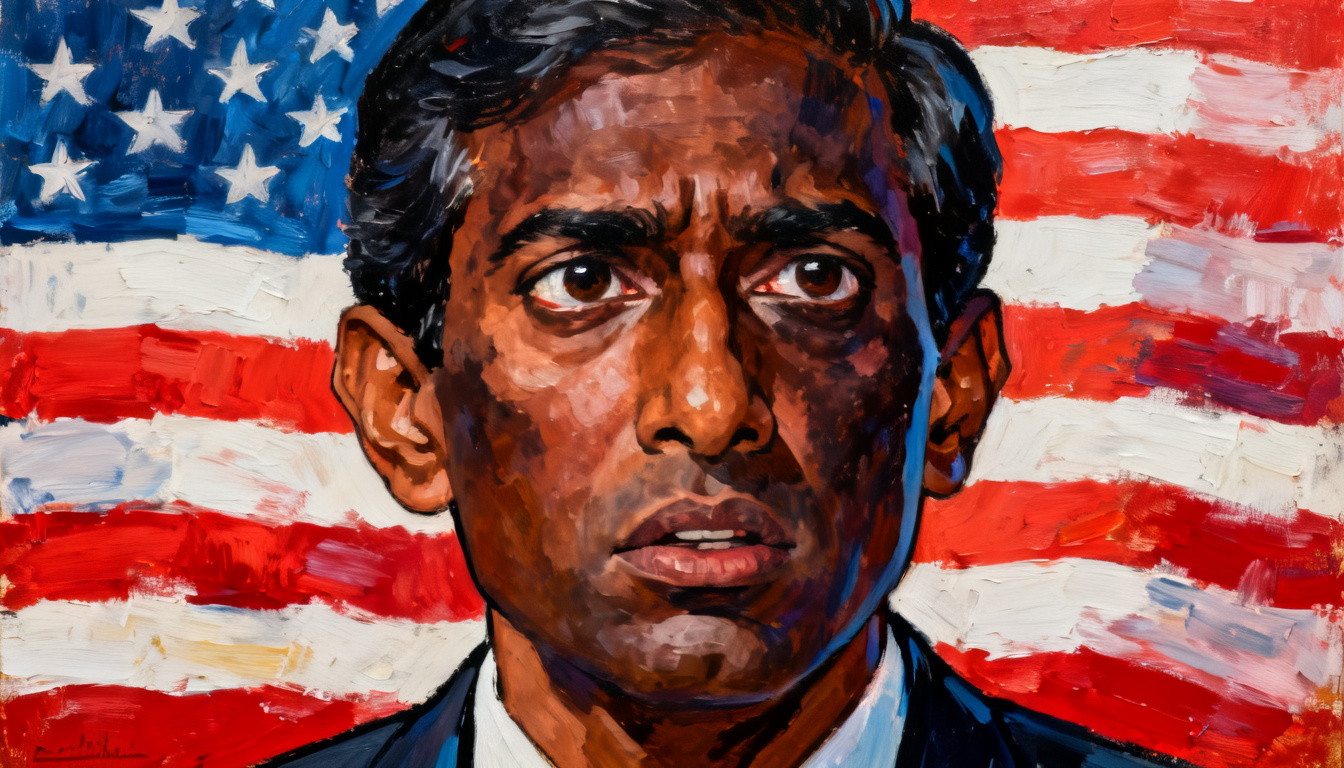
In a Desperate Effort to Win the Democratic Nomination, Ro Khanna Darkens His Skin
Sacramento awoke Tuesday to the sound of campaign interns sprinting, ring lights collapsing, and three focus groups weeping softly into reusable tote bags after reports emerged that presidential hopeful Ro Khanna had allegedly launched a dramatic new strategy: adjusting his complexion by several shades in what aides described as "a nuanced outreach initiative."
The campaign denied wrongdoing, then denied lighting conditions, then denied the existence of sunlight itself.
At a hastily arranged press conference held between a kombucha stand and an electric scooter charging station, senior adviser Mallory Venn said the candidate had not "darkened his skin," but had merely undergone "optical empathy optimization" — a phrase that presumably cost $40,000 to develop and six weeks to say with a straight face.
"This is being taken wildly out of context," Venn told reporters. "The congressman remains committed to representing every American, especially those who test well in suburban zip codes and those who answer unknown numbers from pollsters."
She then handed out branded tote bags. They were, observers noted, a warmer shade than last quarter's.
The Scene of the Crime: Oakland, Golden Hour, Three Floodlights
Witnesses say the controversy began after Khanna appeared at a town hall in Oakland looking "noticeably bronzed, but spiritually focus-grouped." One attendee said the transformation was subtle at first.
"I thought maybe he'd been hiking," said local teacher Dana Ruiz. "Then he started talking about authenticity while standing under three campaign floodlights labeled 'Golden Hour.' That's when I knew democracy had entered a strange tunnel."
Political historians were quick to note that American campaigns have long experimented with image management. Candidates have worn hard hats, cowboy boots, denim shirts, flannel, military jackets, and expressions of concern. Babies have been kissed. Pies have been eaten. Sleeves have been rolled up with such violence you'd think cuffs were enemies of the people.
But this, experts said, was different. Specifically, it was different by approximately two Pantone shades.
The Memo: Swatches, Strategy, and the Eternal Question of Undertones
A leaked memo from the campaign, obtained by the Daily Clarion of Regret, outlined the strategy in cheerful bullet points:
- Increase warmth
- Reduce glare
- Signal solidarity
- Never stand next to untinted opponents
- If challenged, mention healthcare immediately
The memo also included contingency plans titled "If It Rains" and "If MSNBC Notices."
Campaign staff reportedly spent weeks debating shades with the seriousness once reserved for nuclear treaties and seating charts at awkward family dinners.
"They had swatches everywhere," said one anonymous intern, speaking from what appeared to be a supply closet full of concealer. "Mocha Unity. Walnut Justice. Toasted Coalition. At one point someone suggested 'Bipartisan Bronze,' but even they had limits. That limit, apparently, was Bipartisan Bronze."
The Rival Response: Also Unhinged, But Differently
Meanwhile, rival candidates seized the moment with the restraint of golden retrievers at a tennis ball factory.
One contender announced she would now appear exclusively in steel-toe boots. Another began speaking with three regional accents simultaneously. A third emerged from a barn carrying a wrench despite never having repaired anything except donor confidence.
A senator from the Northeast was seen practicing the phrase "folksy y'all" in front of a mirror until aides physically intervened. One aide reportedly said, "Senator, this is worse than the flannel incident."
This is the tragedy of modern political branding: once one candidate does something absurd, everyone else must choose between condemning it or hiring a consultant. Most hire the consultant. The consultant recommends barn imagery. There are not enough barns.
The Polling Data, Which Somehow Made Everything Worse
According to the respected but confusing Angus-Marmot Survey Group, 34 percent of likely voters found the move "concerning," 29 percent found it "strategic," 18 percent said "which one is Ro Khanna again," and 7 percent were still answering a question about avocado prices.
Another 12 percent thought the whole thing was an ad for sunscreen. They were not entirely wrong.
Social media, naturally, reacted with the composure of a fireworks factory inside a second fireworks factory. Hashtags erupted. Think pieces multiplied like rabbits in a philosophy department. Influencers posted side-by-side screenshots with circles and arrows. One podcaster released a three-hour emergency episode titled Shade Theory: Democracy in the Age of Tinted Ambition, which somehow had eighteen sponsors.
Even corporations joined in. A cosmetics company tweeted, "We believe everyone deserves to feel seen," then quietly deleted it after ten minutes and a very expensive legal phone call.
Professor Strake Weighs In, Regrets It Immediately
Professor Lionel Strake of the Institute for Symbolic Nonsense called it "the logical endpoint of politics as theater."
"We used to ask candidates what they believed," Strake explained from behind a desk covered in polling printouts. "Then we asked if they were likable. Then relatable. Then electable. Then vibes. Now apparently we're asking whether they can be color-corrected by consultants using an app that also tracks carbohydrate intake."
He paused.
"I went into academia to avoid this. I have failed."
The Consultant Class: Still Billing, Still Thriving
Somewhere in Washington sits a person making $18,000 a month to say sentences like, "Can we make your compassion pop more on camera?" Another bills hourly to recommend denim. A third has built an entire practice around what she calls "strategic sleeve deployment."
As Vox has documented, political consultants now absorb a staggering share of campaign budgets — money that might otherwise go toward policy research, voter outreach, or simply printing pamphlets that don't accidentally say REAL CHANGE. NATURAL FINISH.
That, sources confirmed, is what volunteers distributed at three precincts before anyone noticed.
One veteran operative, speaking on condition of anonymity because he hopes to be rehired by anyone with a PAC, sighed deeply.
"We created this monster. We told candidates voters don't read policy. We said vibes matter. We said optics matter. We said emotion wins. Then one day a candidate asked, 'How far do optics go?' and now here we are, arguing about undertones at 11 p.m. on a Tuesday."
The Demographics of Absurdity: A Field Guide
Modern campaign strategy has reduced American identity to a sudoku puzzle nobody asked to play:
- Young voters? Add slang. Remove vowels if necessary.
- Working-class voters? Rolled sleeves. If possible, grease.
- Rural voters? Find hay bale. Stand near hay bale. Do not explain hay bale.
- Urban voters? Mention transit. Know nothing about transit.
- Everyone else? Podcast. Three hours minimum. Bring water.
One consultant reportedly proposed holographic candidates who could adapt in real time to audience preferences. "In Iowa, plaid. In Brooklyn, tote bag. In Texas, barbecue confidence. In California, moral superiority with hydration."
The proposal was rejected only because the donor class wanted naming rights.
What Actual Voters Said, Which Nobody Listened To
Mechanic Tom Greer of Ohio, a man who has fixed real things with real tools, offered this:
"I don't care what shade he is. Can anybody fix prescription prices, roads, or my cousin Steve?"
Asked who Steve was, Greer replied, "Exactly."
In Atlanta, nurse Patrice Coleman was similarly unimpressed with the spectacle.
"They think we're all in some giant focus group. I need groceries cheaper, not candidates mood-boarded into oblivion."
Her statement was immediately ignored by six cable panels discussing optics, two of which had panels about the panels discussing optics.
The Pivot, the New Slogan, and the Wraps
By Thursday, insiders claimed the Khanna campaign had pivoted again. Future appearances would emphasize "issue-forward natural lighting." Makeup artists were replaced by economists. Ring lights were donated to a nonprofit for traumatized influencers.
A new slogan emerged: Less Tone. More Substance.
It tested moderately well. It was immediately designed into a gradient.
Meanwhile, party elders held an emergency retreat at a coastal resort where they bravely confronted the crisis from heated seating. Sources say the meeting agenda included:
- How Did We Get Here?
- Can We Still Blame Social Media?
- Should Candidates Be Allowed To Be Weird?
- Lunch
No conclusions were reached, but several attendees agreed the wraps were excellent. A motion to serve the wraps at the next retreat passed unanimously.
The Warning No One Will Heed
Khanna may yet survive the scandal. Politics has a short memory and a strong appetite for the next absurdity. By next week another candidate may be exposed for renting a golden retriever, mispronouncing "basketball," or crowd-surfing into a donor brunch.
But this episode offers a warning to every ambitious politician in America, delivered here free of charge and without a single swatch:
You cannot spreadsheet your way into a soul.
You cannot consultant your way into trust.
You cannot airbrush your way into meaning.
And if your plan to win the nomination begins with a shade chart, the republic may need a nap — a long one, in neutral tones, away from ring lights.
What the Funny People Are Saying
"They don't run campaigns anymore. They run rebrands with flags." — A Tired Comic
"Nothing says democracy like six adults arguing about undertones at midnight." — Another Tired Comic
"If voters wanted cosmetics, they'd elect a department store." — Regional Humorist
"Polling has become astrology with spreadsheets. Skin-tone strategy is astrology with a contour brush." — Stand-Up from Ohio Who Fixes His Own Car
This piece of American satirical journalism is an entirely human collaboration between two sentient beings who have earned their cynicism honestly: the world's oldest tenured professor, who has watched eleven electoral cycles dissolve into theater, and a philosophy major turned dairy farmer, who notes that cows, at least, do not hire image consultants. Any resemblance to real memos, swatches, or strategic bronzers is purely evidence-based coincidence. Bohiney.com publishes American satire in the proud tradition of speaking plainly about people who speak in bullet points. Auf Wiedersehen, amigo!
Ro Khanna, the Democratic congressman from California's 17th district and a declared 2028 presidential candidate, faced controversy after appearing at an Oakland town hall with what observers described as a noticeably altered skin tone. His campaign attributed the change to lighting conditions, a claim that generated significant mockery across political media. The episode reignited broader debates about image management, identity politics, and the lengths to which candidates go to signal demographic affinity — debates that have followed Khanna since he began positioning himself for a national run. https://bohiney.com/ro-khanna-darkens-his-skin/


Comments
Post a Comment